

Most CMS scalability advice starts with traffic, servers, and load tests. That's necessary, but it's not sufficient for an enterprise DXP. A platform can absorb demand and still fail the business because editors can't publish efficiently, brands can't share governed components, localization creates bottlenecks, or every release introduces regression risk.
The harder question is whether your operating model can grow without multiplying manual work. CMS scalability includes infrastructure elasticity, delivery performance, content governance, workflow capacity, and the ability to coordinate many sites and teams. Sitecore XM Cloud and SharePoint Online make that distinction visible, especially when organizations add AI, personalization, search, digital asset management, and regional publishing requirements.
Table of Contents
Rethinking What CMS Scalability Really Means
Traffic handling is only one layer of scalability. A traditional platform may survive a campaign spike while the editorial organization collapses under the effort required to create, translate, approve, test, and publish the campaign across multiple brands. The HTTP Archive Web Almanac CMS chapter reports that most CMS platforms improved Core Web Vitals from 2024 to 2025. That suggests raw page speed is increasingly a baseline expectation, not the complete definition of scale.
A scalable DXP must therefore address two different systems:
- Infrastructure scalability: The ability to add capacity, distribute requests, cache content, and maintain responsive delivery as demand changes.
- Operational scalability: The ability to support more editors, markets, content types, approvals, integrations, and sites without creating proportional administrative effort.
Operational limits often appear first in the content model. A page assembled from copied blocks becomes difficult to update consistently. A localization process that relies on manual handoffs creates delays. A shared component library without ownership rules lets each brand request exceptions until reuse becomes meaningless. Personalization can produce a similar result when every audience variation bypasses caching and requires bespoke testing.
The limits that matter in practice
Enterprise teams should audit editorial throughput, time-to-publish, approval queues, translation coordination, content reuse, and release failure patterns alongside server metrics. A platform that handles requests efficiently but forces authors to duplicate content across sites isn't scaling well. It's transferring the constraint from infrastructure to people.
The headless CMS market illustrates the architectural response. One estimate values the global headless CMS software market at USD 1.75 billion in 2025 and projects USD 6.23 billion by 2033, with a 17.5% CAGR from 2026 to 2033, while another forecast estimates USD 84.00 billion in 2025 rising to USD 155.20 billion by 2032, implying 9.16% annual growth. The estimates differ substantially, but Grand View Research's headless CMS market analysis captures the shared structural direction, enterprises are separating content creation from delivery to support more channels, brands, and release cycles.
The architecture helps, but it doesn't solve governance automatically. Headless shifts more responsibility to APIs, frontend applications, orchestration, observability, and engineering teams. The right measure of scale is not how many requests the CMS can serve. It's how much complexity the organization can control.
Core Dimensions of Scalable Content Platforms
Enterprise CMS scalability rests on several connected dimensions. Infrastructure elasticity keeps capacity aligned with demand. Content delivery performance protects the customer experience. Editorial workflow capacity determines whether teams can produce and govern content fast enough. Multi-site governance keeps reuse, permissions, localization, and brand standards manageable as the estate expands.

Infrastructure elasticity
Cloud deployment changes the scaling model from buying larger servers to adjusting managed capacity and standardizing releases. One market report estimates that cloud-based headless CMS deployment accounted for 76.9% of the market in 2025 and projects it to reach 81.2% by 2034, with the market forecast to grow from USD 2.1 billion in 2025 to USD 12.8 billion by 2034 at a 22.6% CAGR. Those figures come from MarketIntelo's headless CMS market report.
For architects, the important question is whether the platform can scale application nodes, delivery services, search, integrations, and authoring independently. Autoscaling is useful only when the application is stateless enough to add capacity safely and when databases, queues, storage, and third-party services can keep up.
Content delivery performance
Caching remains one of the most effective controls. Google's content-driven performance guidance distinguishes object, page, database, query, full-page, and client-side caching. Each layer addresses a different bottleneck, so enterprise platforms typically need a cache strategy rather than one generic cache setting.
Useful operational indicators include cache hit ratio, origin response time, API latency budgets, error rates, and the share of requests requiring personalization. A cache hit ratio that looks strong in anonymous traffic can deteriorate quickly when audience rules, session state, or rapidly changing content bypass the edge.
Editorial workflow and governance
Editorial throughput, approval wait time, translation backlog, component adoption, and publishing error rates reveal whether the organization can scale. The cloud-native architecture perspective is useful here because deployment architecture and operating architecture must evolve together. Teams need structured models, clear ownership, role-based permissions, reusable components, versioning, and predictable release controls.
A scalable platform makes the safe path the easy path. If editors must copy content, developers must approve every routine change, or brands can bypass shared patterns without review, the organization will accumulate operational debt even while infrastructure remains healthy.
Comparing Architecture Patterns for Scale
Architecture determines where scaling effort lives. A monolith keeps more capabilities together, which can simplify early delivery but makes independent scaling and release coordination harder. Headless separates authoring from presentation. Composable extends that separation across specialized services. Cloud-native platforms push more infrastructure management into managed services, while hybrid designs preserve selected legacy capabilities where replacement would introduce unnecessary risk.

| Dimension | Monolithic | Headless/Composable |
|---|---|---|
| Delivery model | Tightly coupled authoring and rendering | API-driven content delivery with separated presentation |
| Scaling mechanism | Often vertical or platform-wide scaling | Independent scaling of delivery, frontend, and supporting services |
| Personalization | Frequently embedded in platform execution | Distributed across APIs, edge services, frontend logic, and decisioning tools |
| Maintenance | Centralized but potentially heavy and release-bound | Modular, but integration and observability responsibilities increase |
| Cost profile | More predictable at first, with growing maintenance exposure | Variable, based on services, environments, engineering, and operations |
| Primary risk | Shared bottlenecks and tightly coupled releases | Orchestration complexity, API governance, and latency management |
A monolithic Sitecore XP estate can remain appropriate when its integrations, personalization rules, and authoring model are stable. It becomes harder to evolve when teams need independent release cadences across many sites or when delivery workloads compete with authoring and processing workloads. Scaling the whole platform may solve a symptom while increasing infrastructure and maintenance demands.
Headless and composable patterns improve separation, but they don't make complexity disappear. API contracts require ownership. Frontends need shared component standards. Search, DAM, analytics, identity, and experimentation must work within defined latency budgets. The API-first approach helps teams reason about those contracts before implementation expands.
Choosing based on organizational maturity
Cloud-native managed platforms reduce routine infrastructure work and support elastic delivery, but they also require disciplined release management and vendor governance. Hybrid architecture is often the practical transition path for organizations modernizing incrementally, particularly when regulated integrations or legacy authoring features can't move immediately.
The most scalable pattern is the one your team can operate consistently. A theoretically flexible architecture that lacks API governance, testing automation, or experienced ownership can create a larger bottleneck than a simpler platform with strong standards.
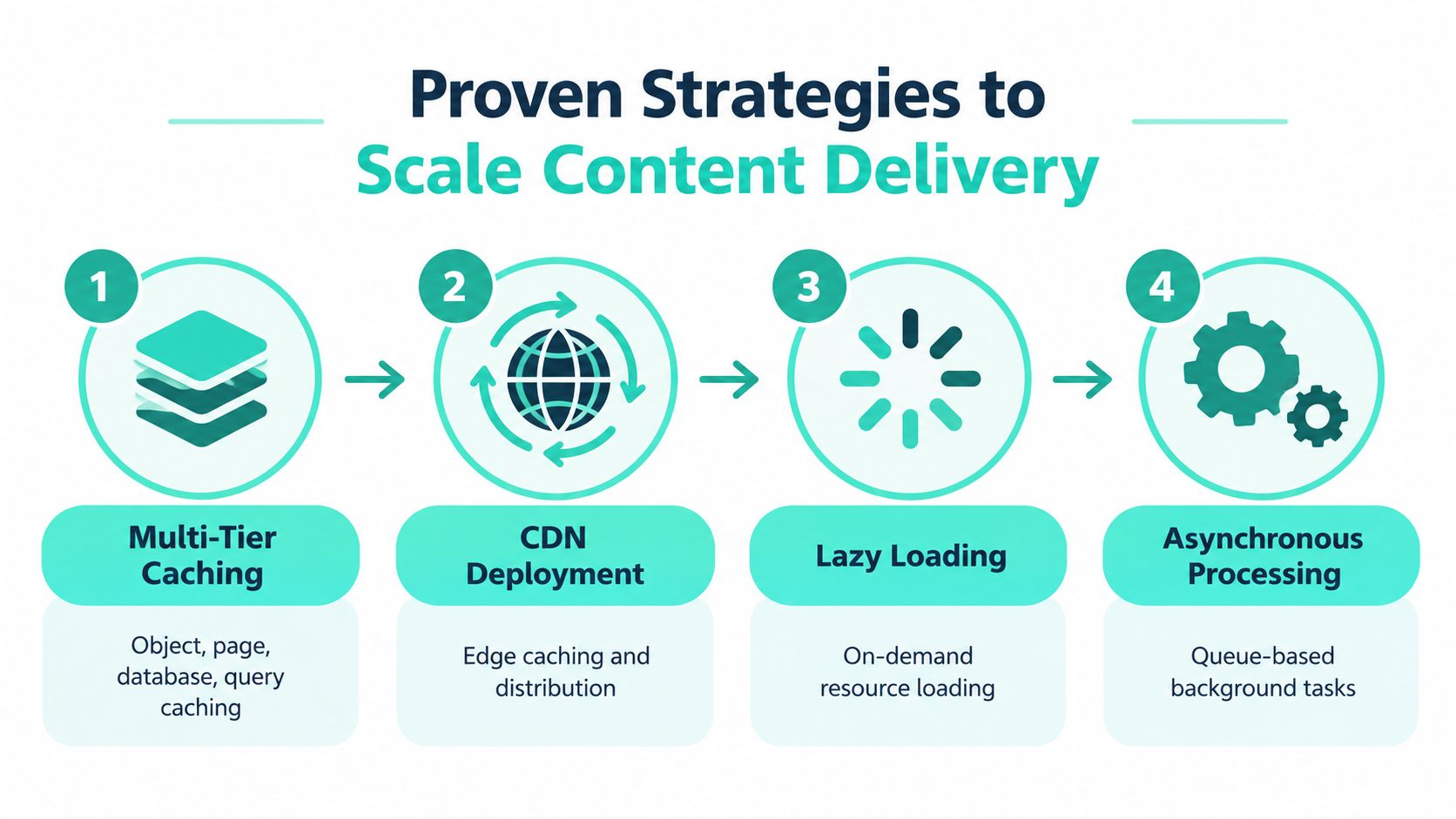
Proven Strategies to Scale Content Delivery
Start with the request path, not the infrastructure diagram. Identify which requests are anonymous and repeatable, which require origin computation, which call external services, and which contain personalized data. Then assign each class an appropriate delivery and caching strategy.
Build cache layers deliberately
Google's performance guidance identifies several caching layers, including object, page, database, query, full-page, and client-side caching. Use them according to the bottleneck:
- Full-page and edge caching: Serve anonymous, semi-static pages without repeatedly invoking the origin.
- Object and query caching: Reduce repeated lookups for navigation, taxonomy, configuration, and common content relationships.
- Database caching: Protect the database from recurring reads, while monitoring invalidation and freshness.
- Client-side caching: Prevent browsers from downloading unchanged assets and responses repeatedly.
The content delivery network guidance provides useful context for placing content closer to users. A CDN won't fix slow origin logic, poor cache invalidation, or oversized responses, so teams should measure origin behavior separately from edge performance.
Protect the origin from avoidable work
Lazy-load below-the-fold media and defer nonessential integrations. Move search indexing, asset transformations, personalization preparation, notifications, and other heavy tasks into asynchronous queues where the business process allows it. Synchronous publishing workflows are particularly dangerous when an editor action triggers multiple external calls before the interface responds.
The Carnegie Mellon web-scaling lecture provides a practical benchmark anchor. Its examples cite roughly 12 requests per second per core for WordPress and about 8 requests per second per core for MediaWiki, while identifying caching commonly accessed objects as a way to reduce database and web-server load. The Carnegie Mellon web-scaling material is useful for understanding why cache misses and origin work matter, though enterprise platforms need their own baselines.
Teams evaluating static publishing can also browse static site generation topics when deciding which content can be prebuilt and served without runtime rendering. Static generation is powerful for stable content, but personalization, frequent updates, and authenticated experiences still require carefully designed dynamic paths.
Platform-Specific Scaling with Sitecore and SharePoint
Sitecore XM Cloud addresses infrastructure scaling through a cloud-native delivery model, while its broader value appears in how it combines authoring, experimentation, AI assistance, and reusable experience patterns. The implementation target shouldn't be “move Sitecore to the cloud.” It should be a governed operating model where teams can launch and improve experiences without rebuilding the same capability for every brand.
Sitecore XM Cloud and Stream
Sitecore Stream's Content Copilot generates and optimizes on-brand text-based components. Stream Premium adds brand intelligence so AI outputs can align with an assigned brand kit for a specific site. Sitecore's XM Cloud documentation also explains that brand-aware AI can retrieve relevant brand insights after a brand kit is assigned in XM Cloud.
That mechanism matters because AI content generation without brand governance can increase review work rather than reduce it. Sitecore's approach connects generation to reusable brand controls, which gives enterprise teams a way to standardize content creation across sites while keeping human approval in the workflow.
XM Cloud also supports A/B/n testing, allowing marketers to optimize components, control traffic, and automatically serve the strongest variant. Sitecore's February 2025 product announcement confirms the capability, while Stream documentation connects AI-generated content testing with the original version. That creates a practical feedback loop between production and experimentation.
SharePoint Online for intranet scale
SharePoint Online has explicit governance boundaries that must shape information architecture. A tenant can have up to 2,000 site collections, and a single site collection can contain up to 2,000,000 items, as documented in Microsoft's SharePoint Online limits. Those aren't targets to approach casually. They're planning constraints for site provisioning, ownership, lifecycle management, and content placement.
Hub sites organize related sites under shared branding. Microsoft's hub site documentation describes the model, which suits global intranets with departmental, regional, and functional sites. SPFx components, Power Platform workflows, Microsoft 365 identity, and search should follow the same governance model. Otherwise, the intranet may scale in site count while becoming harder for employees to use and administrators to control.
Migration and Testing Checklist for Scale
A migration creates a rare opportunity to remove structural debt. It also exposes every weak assumption about content quality, cacheability, integrations, and release safety. Treat scalability as a set of acceptance criteria, not as a promise attached to the target platform.

Before migration
- Audit the estate: Inventory templates, content types, integrations, workflows, permissions, redirects, media, localization dependencies, and abandoned content.
- Validate the model: Separate reusable structured content from page-specific presentation. Define ownership, lifecycle, taxonomy, versioning, and publishing rules before transformation begins.
- Baseline performance: Record response times, cache behavior, origin load, API latency, search performance, publishing duration, and key user journeys under representative conditions.
- Map personalization: Identify which experiences are cacheable and which require runtime decisions. Don't assume an anonymous page remains cacheable after audience logic is introduced.
- Define rollback: Preserve migration checkpoints and establish a tested route back to the previous platform or release.
During testing
Load tests should represent more than a public homepage. Include search, navigation, content APIs, authenticated journeys, media delivery, publishing, indexing, and third-party calls. Test cache-warm and cache-cold conditions, because the origin experiences the latter when content is invalidated or a new route launches.
Failover testing should cover dependencies, not just application instances. Confirm how the platform behaves when search, identity, DAM, analytics, or an external API becomes slow or unavailable. After cutover, monitor publishing queues, broken links, cache invalidation, rendering differences, and editor feedback. A migration is complete only when the operating model performs reliably, not when content imports finish.
Monitoring, Observability, and Cost Management
Scalability requires continuous evidence. Track technical signals alongside operational ones so teams can distinguish a delivery problem from a content-process problem. A slow page may reflect an origin query, a cache miss, a personalization call, a third-party dependency, or an overloaded authoring workflow.
Metrics that support decisions
A useful dashboard should connect:
- Delivery: Cache hit ratio, origin response time, API latency, error rates, and backend saturation.
- Content operations: Time-to-publish, approval queue age, failed publishing jobs, translation backlog, and editorial throughput.
- Experience quality: Search success, key journey completion, accessibility defects, and regression findings.
- Financial control: Compute consumption, storage growth, external API usage, environment count, and cost by brand or business unit.
Observability also requires correlation. If a release increases API latency, identify the content type, component, integration, and audience rule involved. If authoring slows, inspect indexing, media processing, workflow dependencies, and database activity rather than scaling frontend servers reflexively.
Teams building a broader data-quality practice can consult this guide to the 5 pillars of data for context on observability principles beyond CMS telemetry.
Cost follows architecture and behavior
Cloud-native systems reward right-sizing, cacheable delivery, asynchronous processing, and environment discipline. They can also create sprawl when every team provisions its own preview environment, retains unused assets, or adds a specialized service without ownership. The cloud cost optimization guidance is relevant when reviewing infrastructure consumption alongside business demand.
Set service-level objectives around user experience, publishing reliability, recovery, and support responsiveness. Don't pay for an abstract availability target that exceeds the business requirement, and don't underfund monitoring for a platform that supports revenue, customer service, or critical employee operations.
Next Steps for Implementing Scalable DXPs
Start with an audit, not a replatforming decision. Map the current content estate, delivery paths, authoring workflows, integrations, ownership model, and cost profile. The result should identify whether the primary constraint is infrastructure, cacheability, content structure, governance, release coordination, or team capability.
Build the modernization case around business friction. A credible proposal connects faster publishing to campaign execution, reusable components to brand consistency, structured content to channel reuse, and cloud operations to predictable support. It also acknowledges the costs of headless and composable architecture, including integration ownership, API governance, frontend standards, latency management, and specialist skills.
A practical sequence
- Stabilize the current estate: Remove avoidable origin work, correct cache rules, fix failing integrations, and establish baseline monitoring.
- Design the governance model: Define component ownership, content lifecycles, permissions, localization rules, brand controls, and exception handling.
- Pilot a contained experience: Choose a site, brand, or intranet domain with meaningful complexity but a manageable blast radius.
- Prove operational outcomes: Measure publishing effort, release safety, content reuse, delivery behavior, and support workload.
- Scale through standards: Turn the pilot's models, components, pipelines, and controls into reusable patterns.
Vendor and partner evaluations should test real scenarios. Ask how the team handles cache invalidation, personalization, search failures, content migration, multilingual governance, accessibility, rollback, observability, and cloud cost review. Ask who owns the APIs and integrations after launch, because an architecture scales only when someone remains accountable for it.
Kogifi provides Sitecore XM Cloud and XP implementation, SharePoint Online intranet delivery, composable architecture, migrations, performance tuning, monitoring, and ongoing support for enterprise DXP estates. Its teams can assess the platform, content model, delivery architecture, governance, and operating costs before recommending a modernization path.
Sure, here is the rewritten paragraph:
Start with a CMS scalability audit that maps your traffic paths, cache behavior, editorial workflows, integrations, governance risks, and cloud costs. Then visit Kogifi to discuss a practical Sitecore or SharePoint modernization plan built around the constraints your teams face.