

A campaign launch is blocked because nobody can find the approved product image. A regional team has downloaded an outdated video from a shared drive, while legal is asking whether the license still covers a new market. The files exist, but the organization can't reliably identify which version is current, where an asset is used, or whether it should still be published.
That's the problem AEM digital asset management should solve. Adobe Experience Manager Assets is more than a central repository. Properly designed, it becomes an operational governance system that connects asset context, AI-assisted enrichment, approvals, delivery, analytics, and retirement decisions. This perspective also applies to teams trying to organize product images for Amazon Shopify, where consistent naming, metadata, and channel-ready formats matter as much as storage.
Table of Contents
- Introduction to AEM Digital Asset Management at Enterprise Scale
- How AEM Assets Works as a Cloud Native DAM
- A practical readiness checklist
Introduction to AEM Digital Asset Management at Enterprise Scale
An enterprise campaign can involve several brands, regions, agencies, product groups, and compliance teams. Each group may store or request the same image, video, document, or campaign file differently. A folder structure that works for one team soon becomes an undocumented taxonomy, making ownership and reuse difficult to manage.
AEM Assets provides a shared environment for digital assets, but the platform alone does not establish governance. An asset may be available yet unsuitable because its metadata is incomplete, usage rights are unclear, the available rendition does not fit its channel, or no one can verify whether it is still in use. Teams that organize product images for Amazon Shopify face the same operating requirement: consistent naming, metadata, and channel-ready formats must support decisions, not merely storage.
Adobe Experience Manager has a long product lineage. Its foundation began with Day Software's CQ platform in the 2000s. Adobe acquired Day Software in October 2010 for $240 million, then rebranded the product first as Adobe CQ and later as Adobe Experience Manager. Industry history places important DAM capabilities in CQ 5.1 in 2008, including workflows, DAM, tags, CRXDE, clustering, and the Sidekick, followed by CQ 5.2 in 2009, which improved digital asset management and metadata handling, as documented in Adobe's Content Hub insights.
Architectural principle: A DAM earns its place when it helps people make safer, faster decisions about assets, not merely when it stores more files.
That operating model connects metadata quality with controlled AI enrichment, approvals, publishing, usage measurement, and retirement. It also gives governance teams a way to identify stale assets and demonstrate whether the repository supports business work. The implementation path therefore begins with the platform model, then defines metadata and taxonomy, connects creative operations, and measures reuse and risk.
How AEM Assets Works as a Cloud Native DAM
A product team publishes a campaign across regional sites, apps, and commerce channels. One approved image must serve each destination without creating unmanaged copies. AEM Assets as a Cloud Service works like a governed library: the original is the controlled source, metadata is the catalog record, and renditions are channel-ready editions. Adobe describes the platform's cloud-native DAM model, including its AI and machine learning capabilities, in Adobe's AEM Assets overview.
The repository stores approved images, videos, documents, and other binaries. Metadata supplies the business context needed to find, approve, publish, measure, or retire them. Typical context includes product, market, language, campaign, rights, audience, and lifecycle status.
The separation between source, description, and output supports operational governance:
- The asset is the governed source. It represents the binary accepted into the organization's working environment.
- Metadata makes the asset retrievable and controllable. The Asset API includes methods such as
getMetadata(),getMetadataValue(), andgetOriginal(), allowing applications to work with the asset and its descriptive information. - Renditions support reuse. Adobe documents
getRendition(), with renditions stored under the asset's main content node in a dedicated renditions folder. A rendition can meet a channel requirement without requiring every downstream system to transform the original.

Delivery APIs extend the model beyond repository access. Approved assets can reach downstream applications through Delivery URLs. For web-optimized binary delivery, an endpoint can return standardized output with defaults such as JPEG or WEBP, quality 65, and width 1024. This reduces client-side image transformation and helps keep delivery behavior consistent across channels.
The architectural decision is therefore about control points: which system owns the source, which metadata makes it trustworthy, and which delivery method gives each channel a usable binary. Teams assessing digital asset management in the cloud can compare repository, delivery, and governance responsibilities before implementation. For AI governance, AI-powered digital asset insights provides a complementary view of using enrichment to improve retrieval and decisions. AI should remain bounded by review rules, metadata standards, and usage evidence, so teams can identify stale assets and retire them at scale.
Designing Metadata and Taxonomy That Actually Scales
At enterprise scale, a DAM can hold thousands of assets while still failing users. The usual cause is inconsistent description and classification. Metadata describes an asset, while taxonomy organizes concepts and relationships. A product image may need SKU, color, region, usage rights, and approval status. Its taxonomy may place it under Product, Apparel, Outerwear, and Seasonal Collection.
Start with governance before building fields. Assign owners for global fields, local extensions, controlled vocabulary, and change approval. Without clear ownership, teams create near-duplicates such as “United States,” “US,” and “USA.” Search becomes less reliable, and usage reports lose meaning.
Test every proposed field against three questions:
- Retrieval test: Will a real user search or filter by this value?
- Policy test: Does it support a rights, approval, retention, or publishing decision?
- Measurement test: Can it show where an asset is used or reused?
A field that passes none of these tests probably belongs in a project note, not the enterprise model. A smaller set of trusted fields usually serves authors better than a long form completed inconsistently. Ownership, definitions, and lifecycle rules should be documented in a broader metadata management framework.
AI-generated metadata changes who performs classification, not who governs the result. Adobe's current DAM capabilities include conversational asset search, AI-generated metadata, content reuse recommendations, and malware scanning on upload, as described in its 2026 DAM positioning. These features can reduce repetitive work, but a generated tag should not automatically become a legal assertion, publishing permission, or rights expiration date. Set confidence thresholds, review ownership, and rules for correcting rejected suggestions.
A practical readiness checklist
Before migration, confirm that:
- Required fields are explicit: Authors know which values must be present before approval.
- Vocabulary is controlled: Teams choose approved terms rather than creating local synonyms.
- Regional flexibility has boundaries: Markets can add context without changing global definitions.
- Rights are structured: License scope, owner, territory, and expiration are reviewed consistently.
- AI output has a confidence path: Low-confidence enrichment goes to a human reviewer.
- Renditions have owners: Each channel has defined format, dimensions, and quality rules.
Renditions deserve separate planning. Metadata helps people retrieve and govern an asset, while rendition rules determine whether applications can reuse it efficiently. Both support the DAM's operational role, from publishing and reuse measurement to identifying stale assets for retirement across sites, commerce, social channels, email, and internal portals.
Creative Operations Workflows and Integration Points
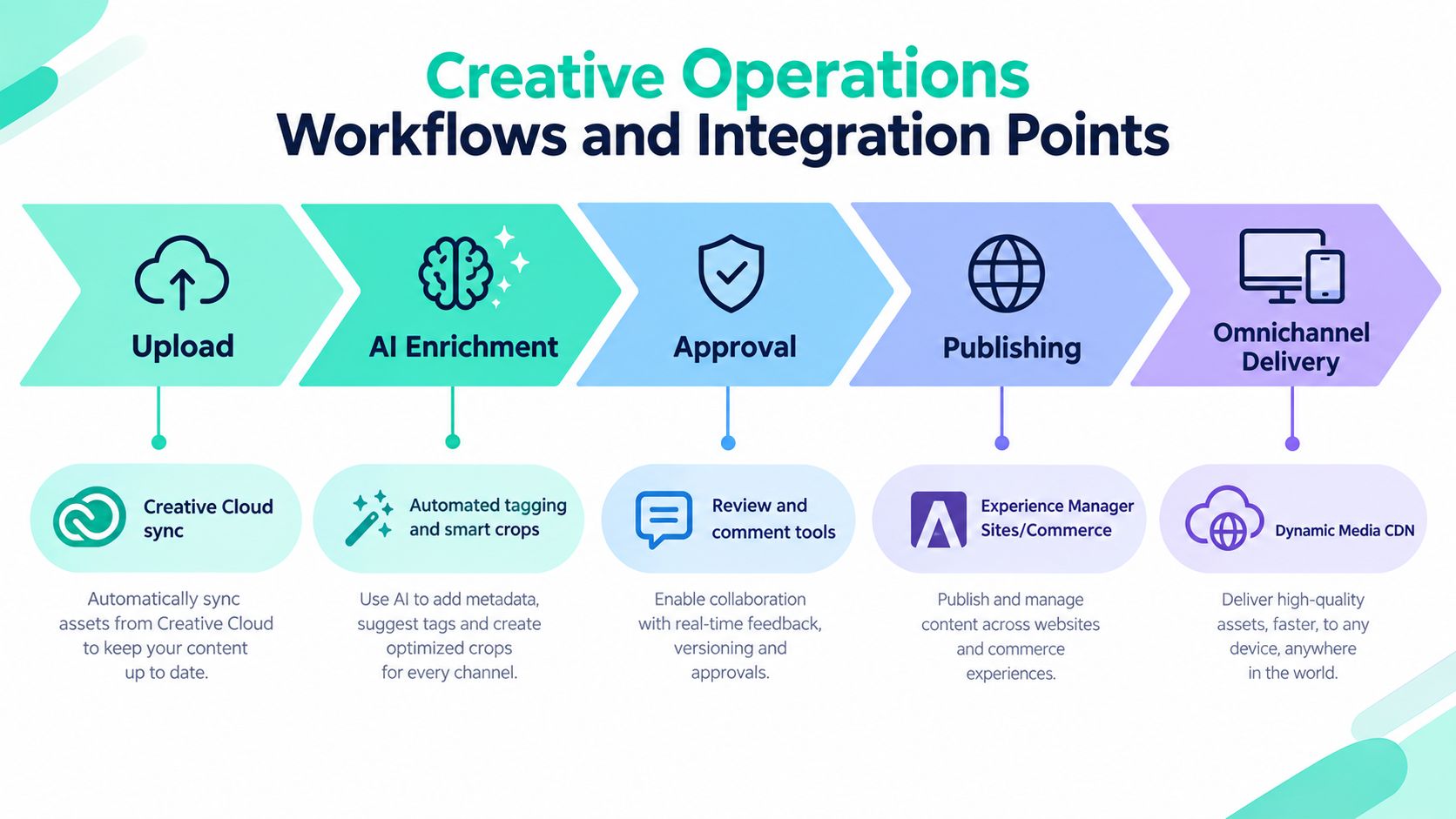
A campaign launch is rarely blocked by the final publish button. The delay usually appears earlier, when an asset lacks verified rights, reliable metadata, or a clear owner. AEM DAM works like a controlled production line: each handoff records who acted, what was checked, and which decision permits the next stage.
Upload and enrichment
Ingestion should capture source details and apply validation before an asset enters wider circulation. AEM Assets updates include malware scanning during upload, adding a security check at the start of the workflow. AI can suggest metadata, recognize visual characteristics, support conversational search, and identify possible reuse.
AI enrichment reduces classification work when suggestions remain reviewable. A detected object or topic is not proof of brand suitability, licensing status, regional permission, or campaign ownership. Assign a human owner to confirm those conditions, especially when low-confidence results could affect publication or reuse.
The workflow should also record which AI fields were accepted, corrected, or rejected. That history gives governance teams a way to tune enrichment rules and measure whether automation is improving metadata quality rather than increasing the number of populated fields.
Approval and publishing
Approval must answer several operational questions. Is this the correct version? Are the rights valid for the intended territory and channel? Does the asset meet applicable accessibility expectations? Is it safe for the target market and aligned with the campaign?
Workflow states make those decisions visible instead of leaving evidence in email or chat. AEM's workflow history supports shared ownership: creative teams assess quality, legal reviews usage conditions, and marketing operations confirms campaign alignment. Each role should review the decision it owns, with explicit escalation for missing information.

Delivery and adjacent systems
After approval, Delivery URLs can expose assets to downstream applications without requiring every client to build its own transformation pipeline. AEM can connect with experience delivery, commerce, analytics, and creative operations tools. Teams mapping these handoffs can use this overview of Adobe Experience Manager integrations to define system boundaries and responsibilities.
SharePoint represents a related integration pattern. Microsoft recommends SharePoint Framework, or SPFx, for custom experiences in SharePoint Online. SPFx web parts and extensions run in the browser and integrate with Microsoft 365 services, supporting enterprise intranets and portal customization.
Power Platform extends internal requests and reporting. Microsoft positions Power Automate, Power Apps, and Power BI as low-code services that connect with Microsoft 365 and SharePoint to automate workflows, build applications, and analyze business data. An intranet could surface approved AEM assets through SPFx, route an internal request with Power Automate, and present operational information in Power BI. The repositories can remain separate. Clear ownership, APIs, permissions, and lifecycle rules determine whether the integration stays governable.
Performance Scaling and Measuring What Gets Used
At enterprise scale, an AEM Assets repository can contain far more files than teams can review manually. A 2025 IDC white paper reported that surveyed AEM Assets customers supported an average of more than 250,000 digital assets per year, including over 80,000 assets uploaded and more than 235,000 downloaded annually, as summarized in Adobe's Asset Insights material. The operational question is therefore not only how to store content, but how to decide which content remains valuable, governed, and available.
Delivery and measurement answer different questions. Delivery URLs explain how an approved binary reaches an application. Usage measurement shows whether the asset still deserves publication, investment, or retention. Treat the repository like an operating register: metadata records what an asset is, usage records where it matters, and lifecycle rules determine what happens next.
Comparing measurement approaches
| Metric | What It Tells You | Governance Action |
|---|---|---|
| Upload activity | Which teams and processes create demand | Review intake rules, duplication, and ownership |
| Download activity | Which assets people retrieve for reuse | Prioritize high-value assets and improve search paths |
| Expiration activity | Which assets require lifecycle attention | Remove or restrict assets that no longer have valid rights |
| Modification activity | Where assets are changing frequently | Review versioning, approvals, and source ownership |
| Publish activity | Which assets reach customer-facing channels | Connect publication to rights and campaign status |
| Link-share activity | How assets move beyond the repository | Check access controls and external sharing practices |
| Disk usage | Where storage is concentrated | Investigate duplicates, oversized binaries, and retention |
AEM reporting covers upload, download, expiration, modification, publish, link-share, and disk-usage activity, as well as top searches and storage usage. Each signal needs an assigned response. A download count alone describes activity. A download pattern combined with reuse, rights, and channel ownership provides evidence for keeping an asset active or retiring it.
Asset Insights support for the Adobe Analytics 2.0 API with OAuth server-to-server authentication in September 2026 followed the retirement of older analytics access, according to Adobe's Asset Insights documentation. For enterprise teams, the implication is practical: connect AEM usage data with analytics and governance controls so measurement can guide decisions rather than sit in a report.
Measurement rule: Ask which assets are used, under what rights, in which channels, and whether that use justifies keeping them active.
Enterprise Migration and Implementation Guidance
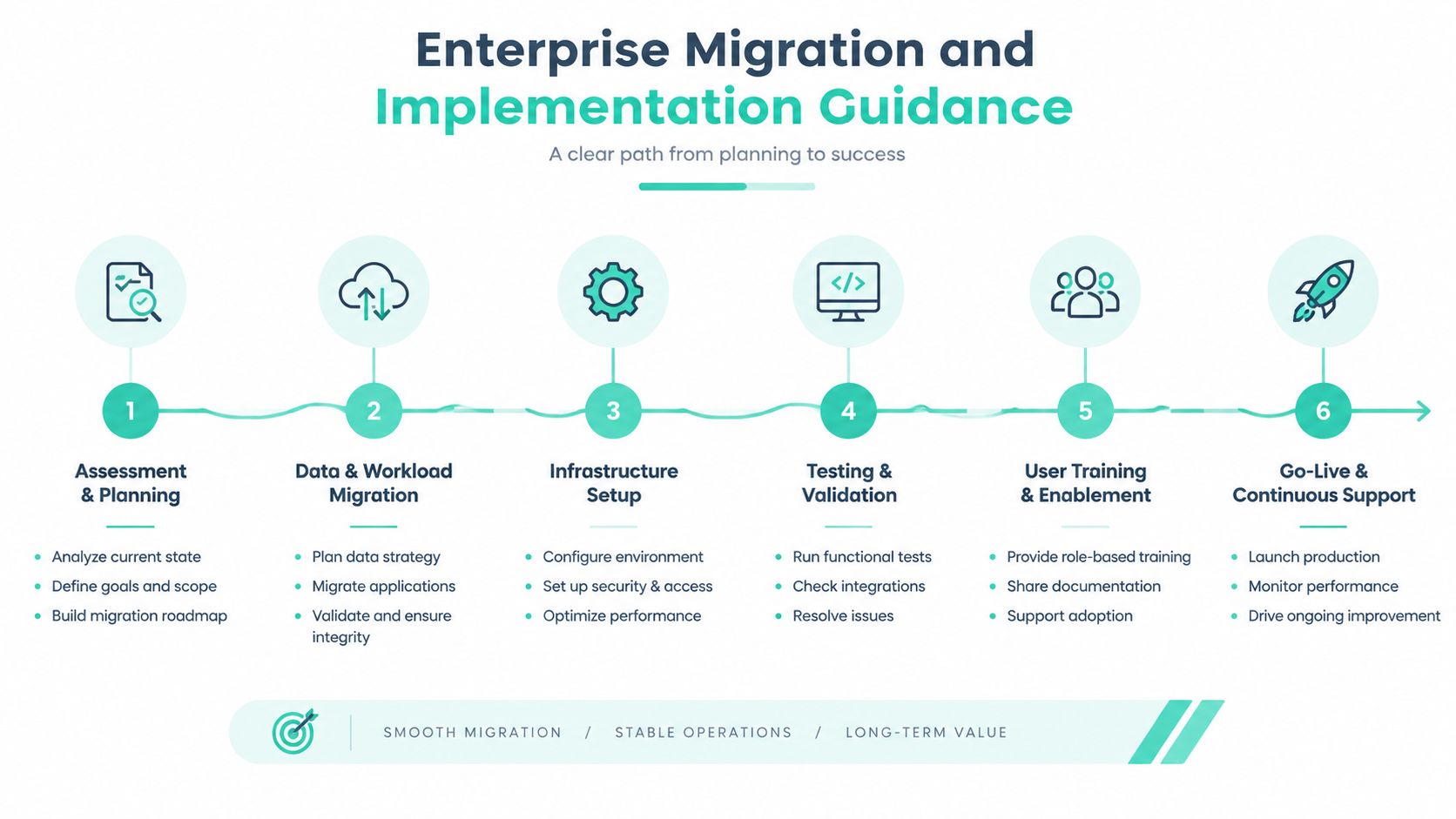
A migration meeting often starts with a request to move every file. A governed program starts with a different question: which assets should continue serving the business? Export the existing inventory, identify duplicates and unknown owners, map rights information, inspect naming patterns, and separate active campaign material from historical files. The audit becomes the filter that determines which binaries deserve a managed future.
Platform history also affects the work. Day Software's CQ platform evolved through the 2000s, Adobe completed its acquisition of Day Software in October 2010 for $240 million, and the product later became Adobe Experience Manager. Older CQ and AEM implementations may therefore contain repository structures, custom workflows, and metadata conventions that do not fit a cloud-native operating model. Treat that history like a building's earlier renovations: document what remains before redesigning the structure.
A phased implementation playbook
Discover the estate. Inventory assets, owners, sources, rights, formats, duplicates, and downstream consumers. Mark unknown values for review instead of importing them.
Define the target model. Establish global metadata, local extensions, taxonomy ownership, permission groups, lifecycle states, and rendition requirements. Keep the model understandable for authors and precise enough for applications.
Map and cleanse. Translate legacy fields into the target schema. Normalize controlled values, resolve conflicting terms, and quarantine assets whose rights or ownership cannot be verified.
Build integrations. Connect AEM Assets with sites, commerce, analytics, creative tools, and internal portals. Define which system owns the source and which systems consume approved representations.
Pilot with a bounded domain. Use one brand, product group, or region to test search, approvals, delivery, analytics, and retirement rules. Gather user feedback and review outcomes to identify operational friction.
Scale with controls. Expand in waves, monitor metadata quality, review AI enrichment, and adjust workflows as teams encounter real exceptions.
AI needs a decision matrix rather than blanket permission. Let AI enrich when it suggests descriptive tags or metadata that a person can validate. Let it transform when the output is reversible, channel-specific, and governed by known rendition rules. Let it recommend when a person still approves reuse, especially for regulated content, sensitive subjects, licensed material, or global campaigns.
For implementation planning, teams can use Adobe AEM implementation guidance to organize migration, integration, and content architecture decisions. Kogifi offers services covering implementation, migration, integration, audits, support, and cloud-native platform work across AEM, Sitecore, and SharePoint.
Next Steps for Governing and Growing Your AEM DAM
AEM Assets provides the repository, while governance turns that repository into an operating system for content. Teams should be able to identify the approved asset, verify its rights, deliver the correct rendition, trace reuse, and retire stale files without disrupting active experiences.
AI increases the need for clear controls. Research indicates that DAM decision-makers expect AI adoption and investment to grow, while foundational readiness still determines how safely teams can expand automation. Strengthen metadata, permissions, workflows, and usage measurement first. Then define which AI actions may suggest changes, which may produce reversible channel-specific renditions, and which require human approval.
Integration and compliance belong in the same operating plan. DAM decision-makers prioritize connections with adjacent systems, and legal or regulatory requirements remain a significant challenge, according to Adobe's Gartner DAM research. Connect AEM Assets with the experience, commerce, analytics, and intranet systems that consume approved content. Compare those requirements with Sitecore AI capabilities, which became available across its DXP, including CMS, DAM, and customer data functions, according to Sitecore's February 19, 2025 newsroom release. Sitecore's platform page describes SitecoreAI as a platform linking content, data, and personalization.
Begin with an inventory, choose a bounded pilot, and define the measurement loop. Track search quality, approval time, reuse, delivery performance, and stale-asset retirement. Document where people must approve AI suggestions, transformations, and reuse decisions.
Kogifi helps enterprise teams design, implement, migrate, integrate, and operate AEM, Sitecore, and SharePoint platforms, including governed DAM workflows, AI enablement, analytics connections, and SharePoint Online intranets built with SPFx and Power Platform. Visit Kogifi to discuss an asset governance and delivery plan for your enterprise estate.