


The popular advice is simple: put shared capabilities in a central hub, connect every brand or region as a spoke, and let the pattern deliver consistency at scale. That diagram is useful for explaining the idea, but it's a poor operating model. In enterprise DXP work, the difficult question isn't where systems connect. It's who can decide, who owns the consequences, and where local teams can move without waiting for the center.
That distinction matters across Sitecore XM Cloud, Adobe Experience Manager, and SharePoint Online. A hub-and-spoke architecture can reduce duplication and create a reliable foundation for multi-brand delivery, but only when governance is designed as carefully as the technology. Without explicit decision rights, the hub becomes a queue, the spokes create workarounds, and the organization ends up with centralized complexity instead of controlled reuse.
Table of Contents
Why Hub and Spoke Architecture Is Harder Than It Looks
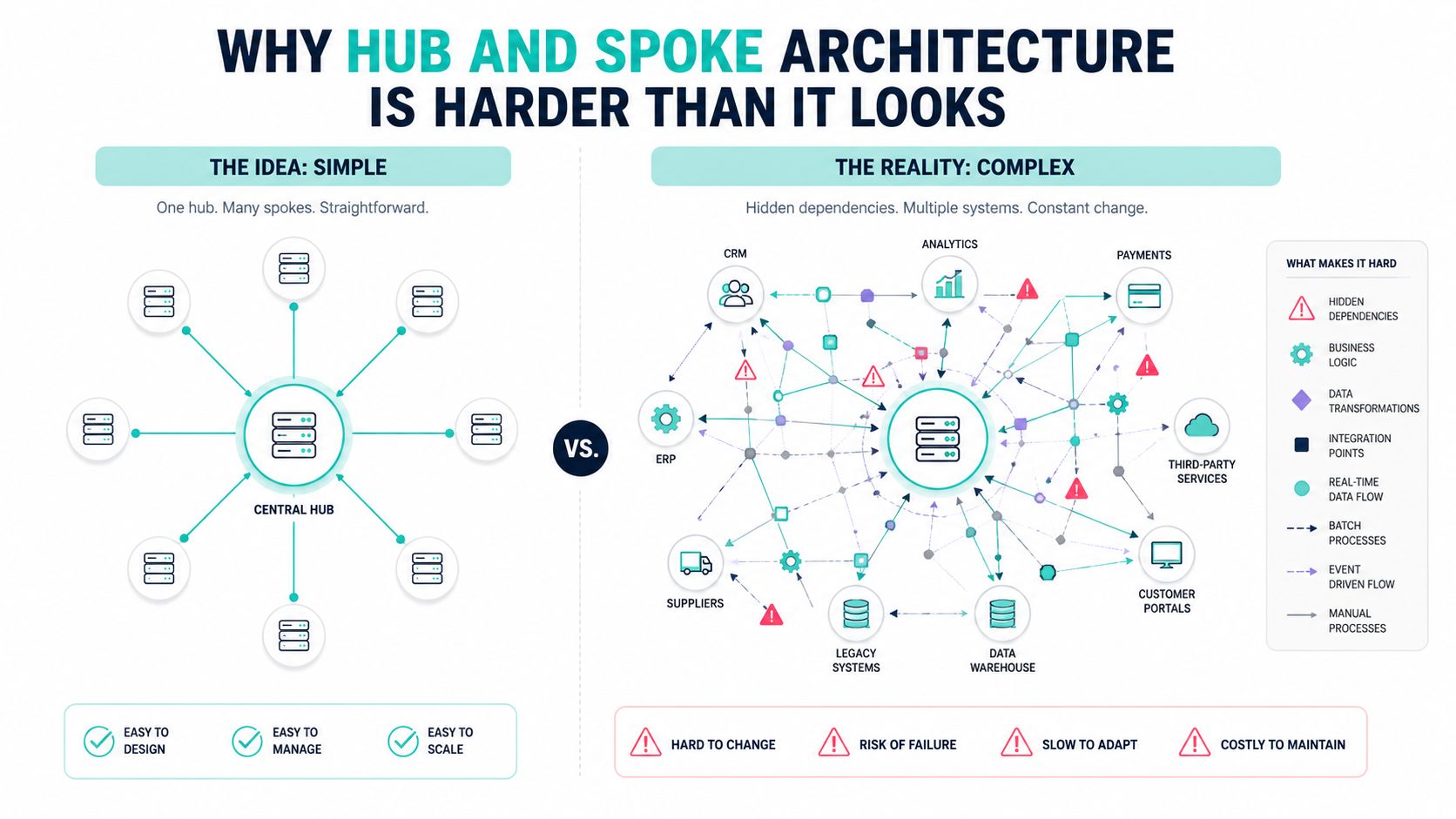
The common misconception is that hub and spoke architecture means centralization by default. In practice, a hub should rarely own every decision. Recent architecture work describes the hub as a center of excellence that automates policy, quality checks, and governance, while spokes retain domain semantics and local backlog ownership. That is materially different from a model where one central team controls every component, workflow, and publishing choice. The recent architecture reference on hub governance frames the pattern around this tension between shared standards and local autonomy.
A multi-brand Sitecore estate makes the problem visible quickly. The hub may own the component library, accessibility rules, analytics conventions, security controls, and release quality gates. A regional marketing team may still need to control campaign content, local legal wording, market-specific navigation, and its own delivery priorities. If the hub approves all of those decisions, local responsiveness disappears. If every spoke can override the shared foundation, the organization loses consistency.
The hub is an operating model
The same principle applies to SharePoint intranets and extranets. A central team might define information architecture, permissions patterns, design standards, search configuration, and reusable SPFx components. Business units still need ownership of department-specific content and local workflows. Teams delivering intranet and extranet solutions encounter this distinction often because portal users experience governance decisions as navigation, permissions, publishing friction, and search quality.
The model works when the organization documents boundaries before it builds abstractions. A decision register should state which policies are mandatory, which assets are reusable but adaptable, and which choices belong entirely to the spoke. It should also identify the escalation path when a local requirement conflicts with a global standard.
Where the pattern breaks
The hub becomes unhealthy when it treats every variation as a defect. Spokes then copy components, bypass release processes, or create local integrations that the center can't observe. The opposite failure is just as damaging. If the hub publishes loosely governed building blocks, every brand interprets them differently and the shared platform stops behaving like a platform.
The architecture is therefore less a static org chart than an execution system for global standards, compliance, and local responsiveness. The diagram is the easy part. Decision rights are the architecture.
Core Architecture Patterns for Enterprise Platforms
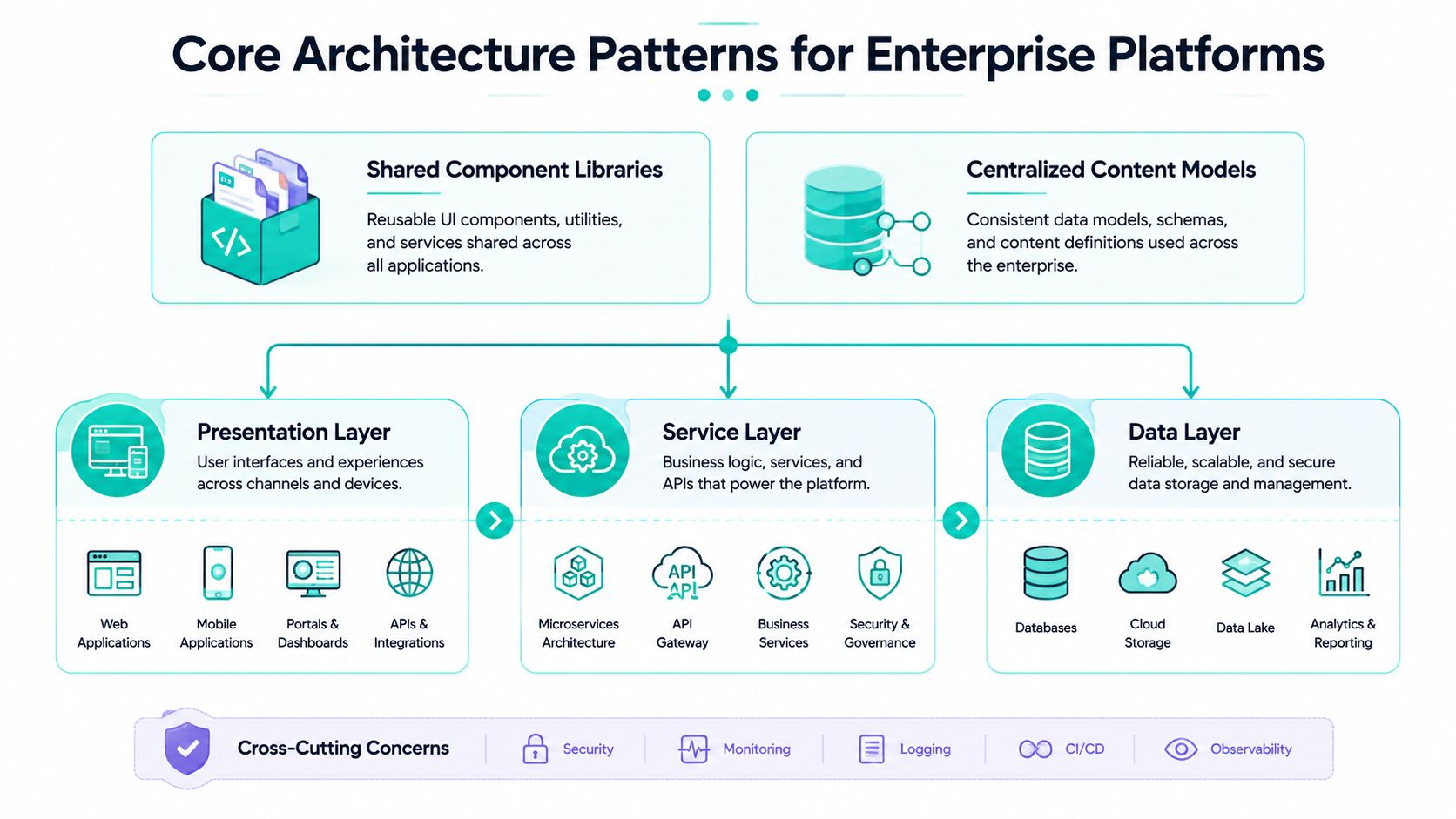
A practical DXP hub usually has four connected layers. The hub provides reusable capabilities and guardrails, while each spoke assembles an experience for a brand, region, business unit, or audience.
At the foundation, shared component libraries and centralized content models define the common language. In Sitecore, that can include Helix-aligned solution structure, SXA components, rendering conventions, field definitions, personalization hooks, and content governance rules. The hub shouldn't force every site into identical page composition. It should make approved composition safe and predictable.
How Sitecore XM Cloud fits the pattern
Sitecore describes XM Cloud as a headless CMS and the foundation of a composable DXP. Its product bundle includes Experience Manager, SXA, the Next.js SDK, Experience Edge, and the Pages editor, while the SaaS model places hosting, monitoring, and maintenance responsibilities with Sitecore. Sitecore's XM Cloud documentation provides the product boundary that makes this topology practical.
A central team can manage shared templates, components, content structures, and delivery conventions. Individual sites can use the Next.js SDK to implement brand-specific presentation while retrieving published content through Experience Edge. This separation lets the organization centralize content and quality rules without forcing every site to share the same front-end codebase.
Sitecore also describes its composable products as cloud-native applications built with microservices, deployed in the public cloud, and licensed as SaaS. Its comparison distinguishes that model from an all-in-one platform that is typically private-cloud hosted. Sitecore's composable versus platform comparison is useful when deciding whether the hub should be a broad platform boundary or a set of independently managed services.
Multi-site delivery needs explicit boundaries
A single Sitecore hub can support many brand sites when teams separate shared capability ownership from site experience ownership. The hub owns the approved building blocks. Spokes own page assembly, campaign priorities, local content, and market context. A practical multi site management guide 2026 can help teams think through site relationships, ownership, and operating processes before creating a large shared estate.
The same logic applies to SharePoint hub sites. The central layer can provide navigation, search conventions, templates, and SPFx capabilities, while associated sites remain accountable for department content. Teams evaluating composable boundaries can also use MACH architecture principles as a reference point for separating independently managed capabilities from shared platform services.
Governance Framework and Decision Rights
The strongest hub-and-spoke implementations start with a decision matrix, not a component backlog. A central team needs authority where inconsistency creates material risk. Local teams need authority where context changes frequently and the cost of escalation exceeds the benefit of uniformity.
The matrix below is deliberately operational. It distinguishes ownership from collaboration, because “shared” without a named final decision-maker usually means unresolved conflict.
| Decision Area | Hub Responsibility | Spoke Responsibility | Shared Responsibility |
|---|---|---|---|
| Component ownership | Define foundations, APIs, accessibility rules, and lifecycle standards | Request variants and provide domain requirements | Approve additions that affect the shared library |
| Content standards | Define content models, metadata, naming, and validation rules | Apply standards to local content | Review exceptions and update guidance |
| Localization policies | Establish translation architecture, required fields, and fallback rules | Adapt content for local language and market context | Resolve conflicts between global terminology and local usage |
| Release management | Own shared release process, quality gates, and compatibility policy | Plan site releases and local content operations | Coordinate changes that affect multiple spokes |
What the hub should control
The hub should own standards that are expensive or risky to vary. That normally includes security patterns, accessibility requirements, shared component contracts, observability conventions, content model integrity, and compatibility rules. It should also maintain a published roadmap so spokes can plan around platform changes rather than discover them during a deployment.
Governance works better when the center automates enforcement. Schema validation, linting, automated accessibility checks, dependency checks, and deployment gates are more reliable than a committee reviewing every page. The center of excellence should spend its time improving the system and resolving exceptions, not manually policing routine work.
What spokes should control
Spokes should own decisions tied to audience, market, and business priorities. That includes local editorial calendars, campaign sequencing, regional content adaptation, approved component composition, and domain-specific backlog items. A spoke shouldn't need hub approval to publish content that already complies with the agreed model.
Measure governance through operating signals rather than meeting volume. Useful indicators include release predictability, exception aging, failed deployment frequency, reuse of approved components, unresolved ownership questions, and the number of workarounds created outside the platform. These are qualitative or process measures unless an organization defines its own baselines. The important point is to make governance observable.
Teams building a durable operating model should pair the matrix with a content governance framework. The framework should define escalation, exception handling, ownership changes, and retirement rules, not just editorial approval.
Implementation Patterns Across Sitecore AEM and SharePoint
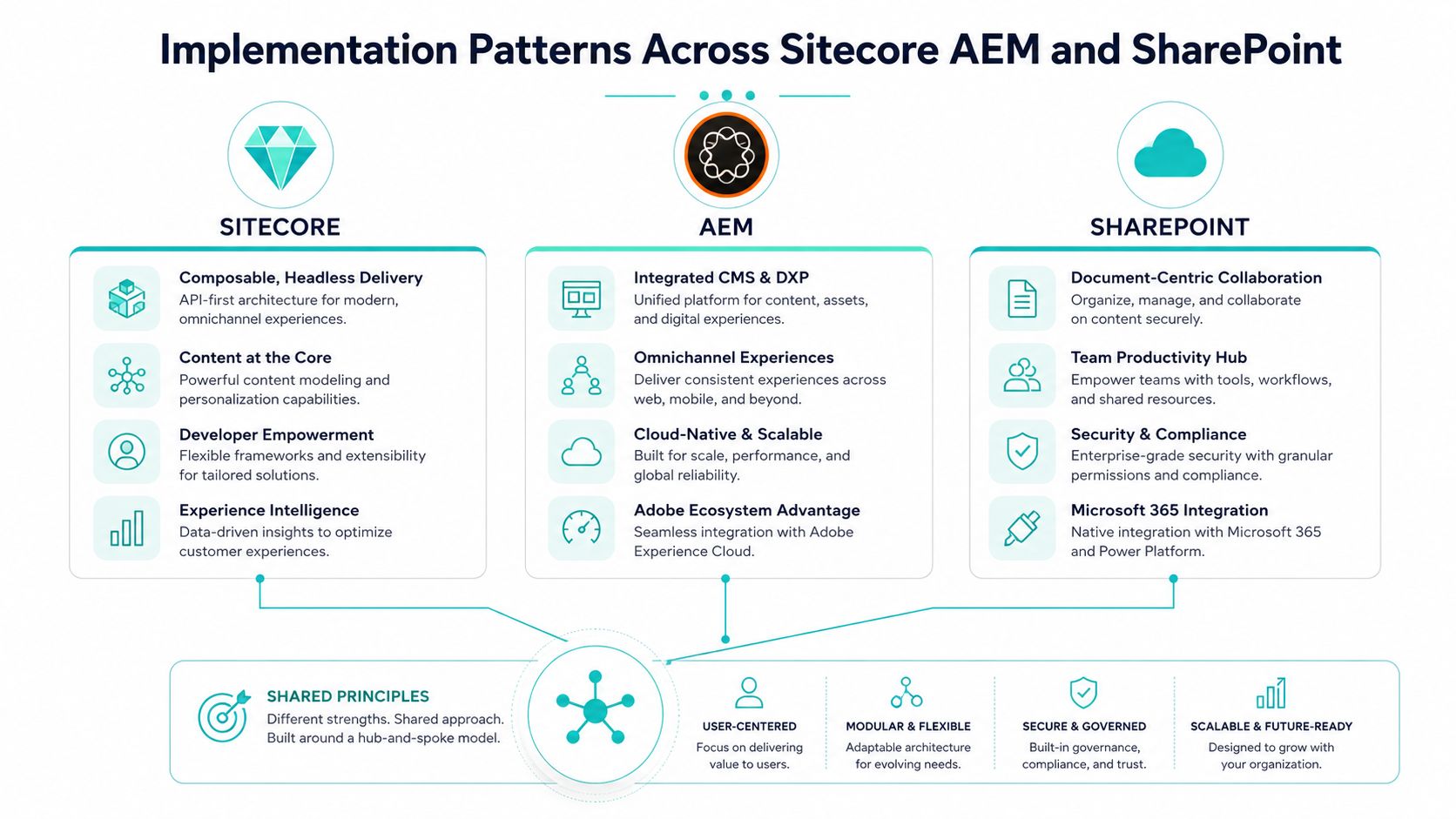
The three platforms support hub-and-spoke architecture differently, so the same governance language shouldn't hide their technical differences.
Sitecore XM Cloud is the natural fit for customer-facing multi-brand delivery when the organization wants headless publishing and independently managed front ends. A hub can maintain Helix-based libraries, SXA conventions, shared content structures, and Experience Edge delivery. Spokes can use Next.js to express brand identity while consuming approved capabilities. The main trade-off is governance discipline. Shared components need stable contracts, clear versioning, and a process for handling brand-specific requirements without turning every variation into a permanent core feature.
AEM can support centralized content operations through reusable content fragments, experience fragments, templates, and multi-site structures. The hub can manage common experience assets and policies, while local sites adapt content and presentation for their markets. This approach works well when teams already operate within a broad Adobe ecosystem, but shared assets need careful ownership. A fragment that appears globally may have different legal, linguistic, or campaign requirements in each region.
SharePoint is strongest in collaboration scenarios
SharePoint Online is better suited to employee intranets, departmental portals, and document-centric collaboration than to highly customized public web experiences. Its hub site model can connect associated sites through navigation, search, and shared structure. Microsoft says SharePoint Online has the broadest and most up-to-date SPFx support, making it the recommended environment for modern SharePoint customizations such as SPFx components in intranet and portal solutions. Microsoft's SPFx guidance for SharePoint Online should anchor that technical choice.
SPFx components can provide reusable web parts and extensions, while Power Platform can support workflows and business automation. The trade-off is that SharePoint's document and collaboration model shapes the architecture. Teams shouldn't force a public-site content pattern onto an intranet that depends on permissions, Microsoft 365 identity, search, and document lifecycle.
The platform choice should follow the experience boundary:
- Choose Sitecore XM Cloud when multi-brand web delivery, headless presentation, and composable DXP services are central requirements.
- Choose AEM when Adobe ecosystem integration and structured experience asset reuse drive the operating model.
- Choose SharePoint Online when employee collaboration, documents, Microsoft 365 identity, and intranet governance define the problem.
Technical Implementation Considerations
Production reliability depends on treating shared releases as a product lifecycle rather than a deployment event. A hub change can affect every spoke, so the pipeline must test shared components against representative site configurations before promotion.
Build a release path that protects spokes
Use separate stages for code validation, shared package creation, multi-site builds, environment configuration, automated testing, and production deployment. Keep site-specific settings outside shared code, and make environment configuration explicit. A spoke should be able to adopt a compatible shared release deliberately, rather than receiving an opaque change because the hub deployed it.
A practical pipeline checks:
- Component contracts: Confirm rendering inputs, output behavior, and backward compatibility.
- Representative sites: Build more than the default brand, including a spoke with local variants and localization requirements.
- Content validation: Test required fields, metadata, links, and publishing dependencies.
- Experience behavior: Exercise navigation, search, forms, analytics events, and personalization integrations.
- Rollback readiness: Keep a tested path to restore the previous compatible application version and configuration.
For a Sitecore XM Cloud and Next.js estate, Experience Edge and the front-end deployment pipeline should be monitored together. Sitecore's own rebuild combined headless XM Cloud with Vercel's globally distributed CDN and Experience Edge, reducing page load times by up to 80% versus the previous XP architecture, according to Sitecore's published rebuild account. That outcome is specific to Sitecore's implementation, so it shouldn't be treated as a universal promise.
Localize without duplicating the platform
Centralize translation models, required metadata, terminology rules, and fallback behavior. Let spokes adapt approved content for their markets when the adaptation changes meaning, compliance, or audience relevance. Copying the entire content model for every region creates long-term drift and makes shared improvements harder to release.
Security follows the same boundary. Centralize identity patterns, API protection, secrets management, audit requirements, and compliance controls. Keep domain permissions and business-specific access decisions with the teams that understand the content. In SharePoint, SPFx permissions and Power Platform connections need review as part of the solution lifecycle, not after the portal is already in use.
Teams assessing isolation and shared services can use this multi-tenant architecture explanation to test whether their boundaries are architectural, organizational, or both.
Real-World Migration Scenarios and Outcomes
Migration stories are useful only when they expose the decisions behind the result. A global manufacturer consolidating more than 40 brand sites is often described as a platform consolidation exercise, but the hard work is deciding which brand differences deserve a reusable variant and which differences should remain local. The migration path typically starts with a component inventory, a content model assessment, and a pilot brand that represents real complexity rather than the easiest site.
The successful pattern is to establish shared foundations first, then migrate spokes in controlled waves. The hub team owns the component contracts and release process. Brand teams own content remediation, page assembly, and acceptance criteria. The organization gets consistency without requiring a single editorial team to understand every market.
A regional intranet has a different center of gravity
A financial services organization building a multi-region intranet faces a different problem. SharePoint Online can provide shared navigation, search conventions, Microsoft 365 identity integration, and SPFx capabilities, but each region may have distinct policies, employee audiences, and document responsibilities. The hub should govern security, information architecture, accessibility, and lifecycle controls. Regional teams should own operational content and local workflows.
The migration risk is permission complexity. If the program treats every associated site as a simple content spoke, it can miss the governance required for confidential material and department-level ownership. A useful migration plan documents audience, content owner, retention expectation, and approval path for each major information area.
Portal modernization exposes integration debt
An energy company modernizing a customer portal may move from a monolithic CMS toward Sitecore XM Cloud with a headless front end and independently managed services. The hub can standardize identity integration, search contracts, analytics events, and design components. The spoke experience can then evolve without rewriting the platform foundation.
The failure mode appears when the migration preserves every old integration as a central dependency. The new hub becomes a compatibility layer for legacy systems, and each additional spoke increases the cost of change. Before selecting a cloud modernization partner, document which integrations are strategic, which are transitional, and which should be retired.
The cloud migration best practices should be applied as an operating discipline, not a checklist. Migration outcomes improve when teams define ownership, test content and integrations early, and give spokes a clear path to raise exceptions. Over-centralization can be corrected, but only after leaders recognize that approval volume is an architectural symptom.
When Hub and Spoke Becomes a Bottleneck
Hub-and-spoke architecture reduces complexity only when the hub has enough capacity and a narrow enough mandate to serve its spokes. Research on hub-and-spoke network design highlights the central trade-off: inter-spoke communication flows through the hub, concentrating inspection, routing, and data collection while also concentrating load and operational risk. Cloud infrastructure considerations for hub-and-spoke models makes that risk relevant beyond network diagrams.
The DXP equivalent is a shared component, content, or approval service that every spoke needs. Warning signs include:
- Release queues: Spokes wait for a central team to approve changes that already fit published standards.
- Local workarounds: Teams duplicate components, bypass pipelines, or create unmanaged integrations.
- Unclear exceptions: Nobody knows who can approve a deviation or when it should become a shared capability.
- Hub overload: The center owns product strategy, content operations, support, testing, and every local request.
- Rising coordination cost: Meetings and dependency tracking consume more effort than the reuse provides.
Capacity planning must include governance work, not only infrastructure. Track the volume and age of exceptions, shared-library requests, failed deployments, and support incidents by spoke. If the hub repeatedly becomes the critical path, split responsibilities, delegate approved decisions, or move a capability into a federated team.
A mesh or federated model may fit better when brands have different operating models, technology stacks, or release cadences. The right answer isn't to defend the pattern. It's to preserve the principle of explicit ownership and choose the topology that matches the organization.
Getting Started with Your Hub and Spoke Strategy
Start with a readiness test. You're more likely to succeed when leaders agree on shared standards, each spoke has a named product owner, the platform can support automated validation, and the organization can resolve exceptions without executive escalation. If those conditions aren't present, buying a new DXP won't solve the operating problem.
Use a phased path:
- Select a representative pilot spoke: Choose a brand or region with meaningful variation, not a trivial proof of concept.
- Create the center of excellence: Assign ownership for components, content models, security, release management, and platform reliability.
- Publish decision rights: Record what the hub controls, what spokes control, and what requires joint approval.
- Expand deliberately: Add brands or regions only after the pilot proves that releases, localization, support, and exception handling work in practice.
- Tune the system: Review governance signals, performance, support demand, and platform cost as the estate grows.
For Sitecore teams, that may mean moving toward XM Cloud, Next.js, Experience Edge, and shared component libraries. For SharePoint teams, it may mean standardizing SPFx delivery, hub site relationships, Microsoft 365 identity, and Power Platform governance. In both cases, the architecture should evolve as ownership and demand change.
A practitioner assessment from Kogifi can map your Sitecore XM Cloud, AEM, or SharePoint estate, define hub and spoke decision rights, and design the migration or stabilization path around your brands and regions. Visit Kogifi to discuss a platform assessment, governance model, or implementation plan with a team experienced in enterprise DXP delivery.