


You're in the meeting where the CMS team wants faster launches, the security lead wants fewer surprises, and the platform group wants one front end that won't turn every release into a fire drill. That's the next js vs angular decision in 2026, not a debate about whose component syntax feels nicer. If your front end sits in front of Sitecore XM Cloud, an AEM estate, or a SharePoint intranet, the wrong choice shows up fast in deployment friction, SSR validation, and the amount of platform glue your team has to own.
| Decision Factor | Next.js | Angular |
|---|---|---|
| Delivery model | Server-first, flexible for content and SEO | Opinionated, structured for long-lived apps |
| Typical enterprise fit | Composable DXPs, marketing sites, search-sensitive properties | Internal tools, governed app portfolios, strict team conventions |
| Release rhythm | Faster minor cadence | Six-month major rhythm |
| Operational shape | More choices, more freedom, more platform decisions | More guardrails, more standardization, less variance |
| Best mental model | Front end as part of a content delivery system | Front end as a standardized application platform |
Table of Contents
- Sitecore XM Cloud and Sitecore Stream
- AEM and enterprise SPA patterns
- SharePoint Online and Microsoft 365
The Real Enterprise Choice Behind Next.js vs Angular
The common mistake is treating this as a frontend taste test. In an enterprise DXP program, you're buying an operating model, because the framework determines who owns SSR, who validates releases, how caches are invalidated, and how tightly the front end fits the content platform beneath it. That's why the question lands differently for a Sitecore XM Cloud build, an AEM program, or a SharePoint intranet.
What the platform team is really deciding
Marketing usually wants speed and search visibility. IT usually wants stability, fewer moving parts, and predictable hosting. Platform teams want a front end that doesn't force them to invent release controls every quarter.
Practical rule: if the content system drives the business, pick the front end that makes content delivery easier to operate, not the one that only looks cleaner in a demo.
That's where the split becomes obvious. Next.js fits content-heavy and search-sensitive properties because it treats server delivery, static generation, and incremental updates as first-class concerns. Angular fits better when the front end is a durable internal application layer, with strong conventions and long-term governance. The decision is usually downstream of the DXP and the release pipeline, not upstream of them.
Why “it depends” is too weak
The lazy answer hides the operational cost. A stack that looks fine in architecture review can become expensive if the team has to hand-roll SSR validation, manage deployment-specific rendering rules, or keep a brittle integration layer alive for years. That's why the framework choice should start with the content platform and the production workflow, then move to the UI framework after that.
A Sitecore XM Cloud program with composable delivery needs different front-end behavior than a SharePoint intranet built for employee productivity. The first one usually rewards a server-first web model. The second one often rewards a controlled SPA pattern, especially when the experience is nested inside Microsoft 365 patterns and governed by internal IT standards.
Architectural DNA of Each Framework
Next.js as a server-first delivery layer
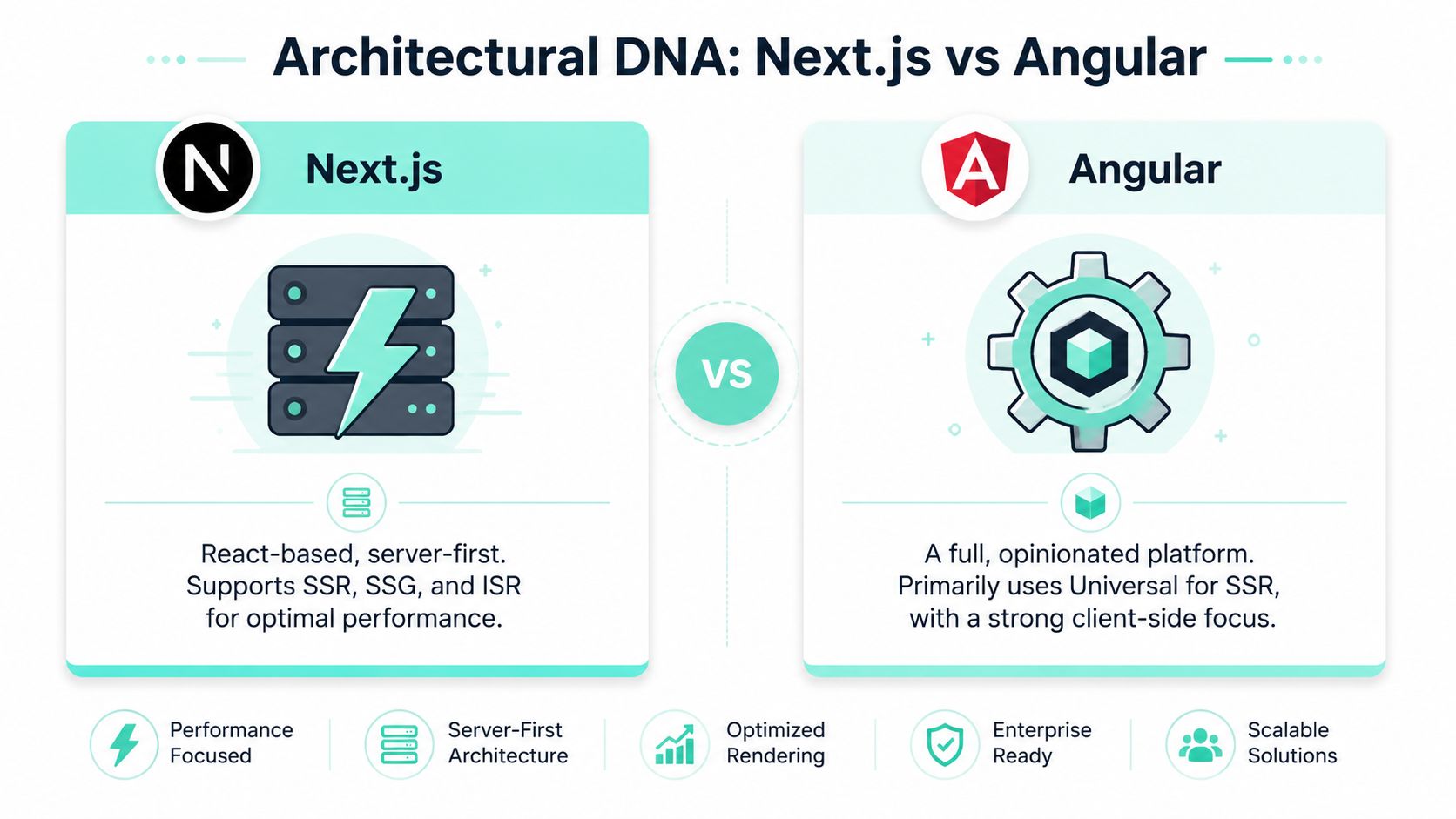
Next.js is a React-based framework built around server delivery. It supports SSR, SSG, ISR, and newer partial prerendering patterns, so it can serve a page from the server, prebuild it, or refresh it incrementally depending on the route and the business need. In enterprise terms, that means the framework assumes content can change often and should not always wait for a full rebuild.
The runtime story also matters. Next.js commonly runs on Node or edge infrastructure, which gives teams more options for where the response is computed and how close it sits to the user. Its mental model is web delivery first, application second, which is why it maps well to content hubs, campaign sites, and product pages that need crawlable HTML from the start.
Angular as a structured application platform
Angular is a TypeScript-first framework with a strong opinion about how teams should build and organize applications. It leans into a strict module system, RxJS, routing conventions, and a batteries-included approach that reduces architectural drift in large teams. The default mental model is not server-first content delivery, it's controlled application delivery.
Angular can absolutely do SSR through Angular Universal, but that's not its natural center of gravity in the same way it is for Next.js. Its strengths show up when many developers need a shared structure for forms, state, routing, and long-lived business logic. That makes it attractive for enterprise SPAs, internal portals, and governed application suites.
The important difference is not whether one is modern and the other isn't. It's whether your content and identity services behave more like a delivery system or more like a transaction-heavy application. That distinction drives almost every downstream trade-off.
For teams building headless commerce or decoupled content sites, the architectural fit becomes even clearer, and this Next.js PWA implementation pattern is a useful example of how the framework behaves when performance and offline-friendly delivery matter together.
Performance and SEO in Production Workloads
The benchmark story that matters
Benchmark data favors Next.js for server-rendered throughput. In one published SSR benchmark, Next.js 14.2 handled 2,570 requests/sec with 1,761,519 µs latency, while Angular 18 handled 356 requests/sec with 1,692,144 µs latency. In a second scenario, Next.js reached 2,794 requests/sec versus Angular's 272 requests/sec, which is the kind of spread that matters when a content platform must absorb traffic spikes without turning the server layer into a bottleneck. The benchmark source is here.
Those numbers don't mean Angular is unusable. They do mean Next.js has a stronger default position for content-delivery workloads where response rate and search crawlability matter. If your public site depends on the server emitting HTML quickly and consistently, the throughput story tilts clearly in one direction.
Bundle size and first load behavior
Recent comparison data also reports a gzipped bundle of about 75 KB for Next.js, versus about 95 KB for Angular, and cites 95+ Core Web Vitals plus under 1.2 seconds average FCP with Partial Prerendering for Next.js. That same comparison notes that Angular's newer zoneless and signals-based architecture narrows the gap, but the default load profile still favors Next.js for fast initial delivery. See the bundle and Web Vitals comparison in this framework analysis.
For enterprise marketing teams, that matters because first load isn't an abstract score. It affects crawl budget efficiency, canonical consistency, and how quickly content is visible when campaigns go live. If your SEO team needs server-generated metadata and structured HTML every time, the default Web delivery model matters more than a component library's elegance.
A public site should be judged by how reliably it serves HTML, not by how pretty the code looks in the editor.
For teams already using incremental static regeneration on content-heavy routes, this ISR implementation guide is a practical reference point. Angular can still work for SEO-sensitive sites, but it asks for more deliberate SSR discipline and more careful pre-render planning.
Developer Experience, Talent, and Governance
Adoption and momentum shape hiring
The adoption signal is strong. In npm usage data for the week ending 2026-05-27, the next package recorded about 39.7 million weekly downloads, while @angular/core recorded about 5.2 million, a gap of roughly 7.6× in favor of Next.js. The same comparison also showed about 139,600 GitHub stars for Next.js versus about 100,126 for Angular, which suggests broader developer momentum for Next.js. Those figures come from this adoption comparison.
That matters in enterprise hiring. A larger talent pool usually shortens recruitment cycles and makes cross-functional staffing easier when a program grows. Angular still has a strong enterprise base, but Next.js has become the easier conversation in many modern web teams because React familiarity lowers the barrier to entry.
Release cadence changes how governance feels
The release rhythms tell a second story. Next.js 16.0 shipped on 2025-10-21, followed by 16.1 in December 2025 and 16.2 in March 2026, which shows a rapid minor-release cycle over about five months. Angular, by contrast, follows a major-release rhythm every six months, typically around May and November, which reflects a more structured enterprise cadence. That contrast comes from the same adoption source above.
Governance teams should read that carefully. Faster cadence can mean fresher capabilities and quicker framework evolution, but it also means you need a cleaner upgrade discipline. Angular's steadier rhythm can fit large organizations that value controlled change windows, especially when multiple squads share a component library and release calendar.
For architects who also hire across data and platform teams, the shape of the team matters as much as the framework. A useful external comparison for structured interview prep is the set of model answers for data engineer roles, because it shows how large enterprises often evaluate operational thinking, not just syntax knowledge.
Integration With Sitecore, AEM, and Microsoft 365
Sitecore XM Cloud and Sitecore Stream
For Sitecore XM Cloud, Next.js is the clean default when the goal is headless delivery, composable publishing, and strong SEO behavior. Sitecore's current AI layer is Sitecore Stream, which the company positions as an embedded AI innovation layer across its product portfolio, not as a standalone point tool. Sitecore says Stream connects AI capabilities to CMS, CDP, personalization, and search products, and is designed to support content creation, campaign planning, and experience optimization inside the same ecosystem. That framing matters because the AI layer isn't isolated, it's meant to work across XM Cloud, XP, Content Hub, and CDP/search workflows.
That setup tends to favor a server-first front end. AI-assisted content and personalization usually land better when the HTML response can be shaped before the browser paints, especially for public sites where SEO and campaign consistency matter. For headless Sitecore programs, the headless architecture pattern gives the right mental model for why Next.js is the default fit.
AEM and enterprise SPA patterns
AEM gives Angular a more credible foothold than many Next.js-only advocates admit. When a team already runs a large SPA estate, uses strict internal conventions, and needs a long-lived enterprise application layer, Angular can be the safer operational choice. It fits especially well when the front end behaves like a governed app shell rather than a search-first marketing surface.
SharePoint Online and Microsoft 365
For SharePoint Online, the conversation shifts again. Angular can fit inside SPFx-centric intranet work, especially when the organization already standardized on TypeScript-heavy application teams and Microsoft 365 workflows. But when the requirement is a modern employee portal that needs simpler content delivery, easier release flow, and a cleaner web front end, Next.js usually feels lighter operationally.
SharePoint programs also tend to care about workflows, permissions, and internal search more than visual novelty. That's why the front end should match the operational burden of the intranet, not just the UI preference of the team.
Migration Paths and Operational Reality
Moving from Angular to Next.js without breaking the estate
The safest path from an Angular SPA to Next.js is a strangler pattern. Keep the old app running, route a narrow set of pages to the new front end, and preserve the content model and identity integration while the new delivery layer proves itself. Don't try to rewrite the whole estate in one sweep, especially if the system already handles personalization, auth, and publishing workflows.
Start with the pages that benefit most from server delivery, usually high-visibility landing pages or content-heavy routes. Then bring shared components across in a governed library so design consistency survives the transition. The point is to change the delivery layer first, not the editorial or identity model.
The operational questions teams skip
The hardest questions are rarely about JSX or templates. They're about who validates SSR responses after deploy, who owns cache invalidation, and how SEO regressions get caught before they reach production. On Azure, server-side rendering adds another layer of CI/CD discipline, because response correctness now depends on both the app build and the runtime path.
If you already have a platform strategy for hosts and rollbacks, this Vercel versus Netlify decision guide is a useful comparison point for deployment thinking. Reverse migration from Next.js back to Angular is possible, but it's rarely the direction enterprise programs choose once content delivery and operational flexibility have improved.
Practical rule: migrate the route that gives you the biggest production pain relief first, then extend outward only after the SSR checks, caching behavior, and rollback path are boring.
Decision Matrix for Common Enterprise Scenarios
The short answer by scenario
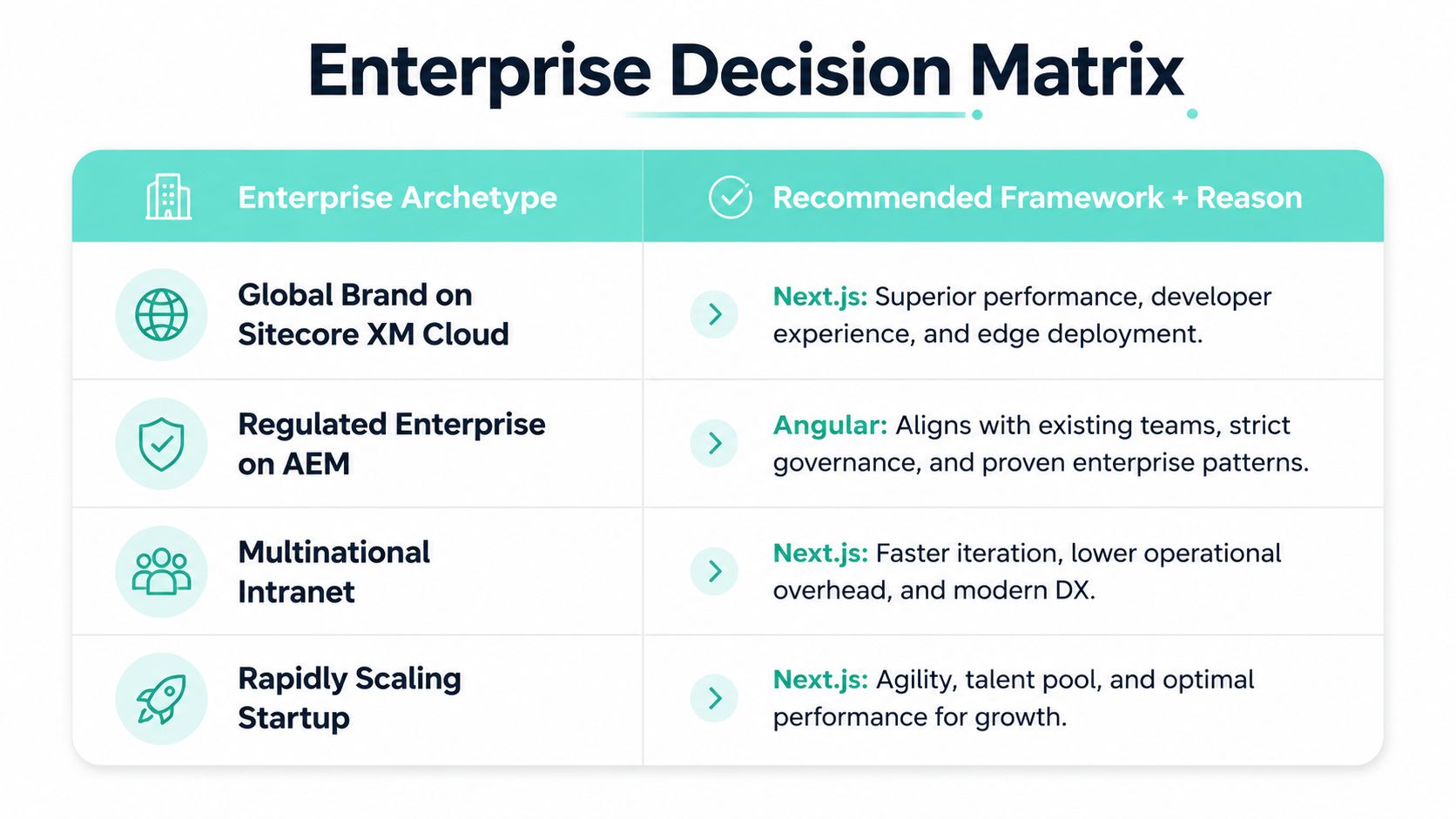
| Scenario | Recommended Front End | Integration Pattern | Primary Reason |
|---|---|---|---|
| Global Brand on Sitecore XM Cloud | Next.js | Headless Sitecore delivery with server-rendered public pages | Better fit for content velocity and SEO-sensitive publishing |
| Regulated Enterprise on AEM | Angular | SPA-centric AEM delivery with strong governance | Works well when teams already run standardized app controls |
| Multinational Intranet | Next.js | SharePoint or Microsoft 365 content surfaces with lighter web delivery | Faster iteration and lower operational drag |
| High-Traffic Marketing Portal | Next.js | SSR, SSG, and edge-friendly publishing | Stronger default for crawlability and performance |
How to read the matrix
Use Next.js when the front end is a public-facing content system, especially on Sitecore XM Cloud or other composable DXP stacks that need SSR, edge caching, and faster campaign deployment. Use Angular when the front end is more like a standardized enterprise application, especially on established AEM or internal portal programs where governed structure matters more than raw web delivery speed.
The decision gets even clearer when you ask who owns the experience after launch. Marketing-led properties usually benefit from a framework that makes content updates and search visibility less expensive to operate. Internal business apps usually benefit from a framework that forces discipline and keeps the team aligned across releases.
Recommendation, Cost Signals, and Quick Answers
The recommendation
For most enterprises modernizing a Sitecore or AEM estate into a composable, SEO-sensitive web platform in 2026, Next.js is the default choice. It earns that position because it pairs better with server delivery, content operations, and the kind of publishing flow that modern digital experience teams run.
Angular still earns its keep when the workload is a long-lived internal SPA, a complex line-of-business tool, or a SharePoint-hosted experience built around SPFx and Microsoft 365 governance. In those cases, the framework's structure is an advantage, not a compromise.
Cost signals without fake precision
Next.js often lowers the operational burden of public sites because its cacheability and server-rendered delivery reduce how much work the platform has to do on every page view. That can translate into a cleaner SaaS operating model for XM Cloud and similar composable stacks, especially when teams want quicker launches without building a lot of extra rendering infrastructure. Angular can still be cost-effective in large internal estates, but its economics usually make more sense where standardization matters more than campaign velocity.
Quick answers
Is Next.js more secure than Angular? The cited July 2026 comparison gives Next.js an 81/100 security score versus Angular at 63/100, with 25 total CVEs for Next.js and 30 for Angular, but the score is composite, not a simple vulnerability count. The same snapshot shows 0 exploited vulnerabilities for both.
Do AI features change the answer? Not much. Sitecore Stream strengthens the case for a front end that can expose content, personalization, and search results cleanly in SSR responses, which usually favors Next.js on public sites.
How should we start? Pick one high-value route, one publishing team, and one deployment path. Pilot the SSR checks, caching behavior, and rollback process before you let the rest of the estate follow.
If you're planning a Sitecore XM Cloud, AEM, or SharePoint modernization and want the front end to fit the platform instead of fighting it, Kogifi builds those operating models end to end. Visit Kogifi to discuss a Next.js or Angular architecture review, a headless migration plan, or a DXP delivery strategy that your teams can run in production.