


An omni channel marketing strategy isn't about just being everywhere. It's about creating a single, continuous conversation with your customers across every single touchpoint.
Think of it this way: whether someone is scrolling through your mobile app, browsing your website, or walking into your physical store, their experience should be seamless. It should pick up exactly where it left off, every single time.
What Is An Omni Channel Marketing Strategy, Really?
Let's cut through the buzzwords. Imagine your customer's journey as an ongoing dialogue. A multichannel approach is like having a bunch of separate, disconnected chats where you have to reintroduce yourself every single time. Annoying, right?
In stark contrast, a true omnichannel marketing strategy weaves all those interactions into one coherent story. It's not just about showing up on multiple platforms; it's about building a unified, intelligent, and deeply customer-centric experience.
The goal is to make the jump between channels so smooth that the customer barely notices. They just feel understood.
The Shift From Channel-First To Customer-First
The real difference boils down to a shift in perspective. Multichannel thinking is all about the company ("How many channels can we use to reach people?"). Omnichannel, on the other hand, is completely focused on the customer ("How can we create the best possible experience for our customer, no matter which channel they use?").
This shift is more than just a minor tweak—it's critical. Today’s consumers don’t think in terms of channels; they think in terms of their immediate needs and problems they're trying to solve. You can learn more about this core concept in our detailed guide on what omnichannel marketing is and how it works.
This new reality is backed by powerful data. A staggering 73% of retail shoppers use multiple channels during their shopping journey. More telling, omnichannel campaigns that use three or more channels see a 287% higher purchase rate compared to single-channel efforts. It's clear: integrated strategies aren't just a "nice-to-have" anymore—they're essential for growth.
Omnichannel vs Multichannel at a Glance
To make the distinction crystal clear, here’s a quick breakdown. This table highlights the fundamental move away from a channel-focused mindset to one that puts the customer at the absolute center of the universe.
Ultimately, omnichannel is about recognizing that your customer sees your brand as one entity, not a collection of separate departments or websites.
The Technology That Powers A Unified Experience
Orchestrating this kind of seamless conversation isn't magic. It requires a central nervous system—a platform that can collect, understand, and act on customer data from every single interaction. This is where a Digital Experience Platform (DXP) like Sitecore becomes absolutely indispensable.
A true omnichannel marketing strategy treats every touchpoint as part of a single, fluid journey. It’s powered by a unified data core that transforms fragmented interactions into a complete customer story, enabling personalization that feels both natural and helpful.
Sitecore's composable DXP acts as this intelligent core. It’s designed to weave together data from your website, mobile app, CRM, and even in-store point-of-sale systems to build one coherent customer profile.
This unified view is the foundation for delivering the kind of personalized, consistent, and meaningful engagement that builds real, lasting loyalty. It's the new standard customers don't just appreciate—they fully expect it.
The Core Components of a Powerful Omnichannel Framework
To build an omnichannel marketing strategy that actually works, you need the right foundation. Think of it like the engine in a high-performance car—every part has to work together perfectly. If even one component is missing or weak, the whole system sputters and stalls, failing to deliver the seamless experience your customers expect.
At the heart of any solid omnichannel setup are four key pieces. These are non-negotiable. When orchestrated by a powerful Digital Experience Platform (DXP) like Sitecore, they transform clunky, disjointed interactions into a smooth, intelligent conversation with your customers.
The Unified Customer Profile: A Single Source of Truth
It all starts with knowing your customer. I don't mean knowing them as a collection of scattered data points—an email click here, a website visit there, a random in-store purchase. I mean knowing them as a single, complete individual. This is where a Customer Data Platform (CDP) becomes your most valuable player.
A tool like Sitecore CDP is built to solve this exact problem. It pulls in data from every touchpoint imaginable—your CRM, mobile app, point-of-sale systems, website analytics—and stitches it all together into one unified customer profile. What you get is a persistent, real-time, 360-degree view of every single person.
Without a unified profile, personalization is just a sophisticated guess. You're making assumptions based on incomplete data, and that leads to irrelevant offers and a disconnected experience.
This single source of truth is what makes real omnichannel marketing possible. It’s what lets you understand past behaviors, anticipate future needs, and make sure every interaction is informed by the full customer story.
The Centralized Content Hub: For Brand Consistency
If the unified profile tells you who the customer is, the content hub makes sure what you say to them is always consistent and on-brand. When your marketing assets are scattered across different folders, platforms, and departments, your brand message inevitably gets fractured. It's a recipe for confusion.
This is where a solution like Sitecore Content Hub or even a well-organized SharePoint repository steps in. These platforms act as a central library for every marketing asset you have, from product images and campaign slogans to official brand guidelines.
With everything in one place, you can ensure that:
- Consistency is locked in across your website, mobile app, email campaigns, and even the digital displays in your physical stores.
- Workflows are streamlined, so your teams can collaborate on creating, approving, and distributing content without tripping over each other.
- Assets are easy to find and reuse, which saves a ton of time and prevents people from reinventing the wheel.
A centralized hub guarantees that no matter where a customer runs into your brand, they get a consistent, high-quality experience that feels familiar and reinforces who you are.
AI-Powered Personalization: Delivering Relevance at Scale
So you’ve got a unified view of your customer and a library of consistent content. The next challenge is delivering the right message to the right person at exactly the right moment. Trying to do this manually is a fool's errand—it’s simply impossible at scale. This is where AI-driven personalization becomes the real engine of your omnichannel framework.
Tools like Sitecore Personalize tap into the rich data from your CDP to drive real-time, one-to-one interactions. It goes way beyond basic segmentation and into the realm of predictive personalization, using machine learning to figure out the next best action or offer for each individual user.
For instance, Sitecore Personalize can:
- Dynamically change your website content based on a user's past browsing behavior.
- Trigger a personalized email with a tempting offer right after someone abandons their shopping cart.
- Send a push notification to a mobile app user about a special deal on an item they just looked at online.
This kind of intelligent automation makes sure every touchpoint is not just consistent, but deeply relevant. It’s how you make customers feel like you truly get them.
Seamless Channel Integration: Connecting Digital and Physical
Finally, a true omnichannel strategy has to close the loop between the digital and physical worlds. The framework is broken if a customer's online activity is invisible when they walk into your store. The final piece of the puzzle is seamless channel integration, making sure data and experiences flow freely between every single touchpoint.
This means connecting your core DXP with other critical systems, like your inventory management platform and your point-of-sale (POS) terminals. This integration unlocks powerful experiences like "buy online, pick up in-store" (BOPIS), lets store staff see a customer's online wishlist, or even triggers a digital offer on their phone based on a visit to a physical location.
It's the final component that makes the customer journey feel truly effortless, erasing the lines between channels and creating one unified brand experience.
Building Your Strategy with Sitecore's DXP
Architecting a world-class omnichannel marketing strategy is one thing on paper, but making it a reality requires the right tech. This is where a composable Digital Experience Platform (DXP) like Sitecore becomes the blueprint for execution. Each part of the platform is a specialized tool designed to solve a specific piece of the omnichannel puzzle, all working together to create a seamless whole.
Think of it like building a high-performance engine. You start with the core block and then layer on specialized systems for fuel injection, data processing, and performance tuning. Each component has a distinct job, but it's how they integrate that delivers true power and reliability.
The Foundation: Your Core Web Experience
Your primary website is the chassis of your entire omnichannel vehicle. Products like Sitecore Experience Platform (XP) or the cloud-native Sitecore XM Cloud serve this foundational role. They are robust content management systems that power your websites and core digital properties, making sure your online presence is stable, scalable, and ready to connect with other systems.
This core is where your brand lives online. It’s the central hub that all other channels will connect back to. Getting this foundation right is non-negotiable—it's the first and most critical step before you can start orchestrating more complex, multi-channel customer journeys.
Unifying Customer Data with Sitecore CDP
With the foundation in place, the next layer is intelligence. A killer omnichannel strategy runs on data—clean, unified, and real-time. This is exactly what Sitecore CDP (Customer Data Platform) is built for. It acts as a central data hub, pulling in customer information from every conceivable source.
Imagine data flowing in from:
- Your Customer Relationship Management (CRM) system
- Mobile app interactions and usage patterns
- E-commerce transaction histories
- Even in-store point-of-sale (POS) systems
Sitecore CDP doesn’t just collect this data; it stitches it all together into a single, persistent, 360-degree customer profile. Suddenly, a bunch of fragmented interactions become a cohesive story, letting you see the complete journey of each individual. This unified view is what you need to craft a truly personalized customer experience across every omnichannel touchpoint.
Delivering One-to-One Interactions with Sitecore Personalize
Once you have that rich, real-time profile, the next step is to act on it. This is where Sitecore Personalize comes in. It takes the unified data from the CDP and uses it to deliver dynamic, one-to-one interactions at a massive scale. We're not just talking about showing someone their name; we're talking about predictive personalization.
The system analyzes behavior to anticipate needs and serve up the most relevant content, offer, or experience right in the moment. It’s the brain of the operation, making intelligent decisions that make each customer feel seen and understood.
A customer browses a product on their phone during their lunch break. That evening, they get a perfectly timed email with more details and a special offer on that exact item. When they visit a physical store on the weekend, the sales associate is already aware of their interest and can offer a hands-on demonstration. This entire journey feels effortless, orchestrated seamlessly by these interconnected Sitecore components.
This is the power of a connected DXP in action. It turns abstract data into tangible, valuable customer interactions that drive conversions and build real loyalty.
This framework shows how these key components—profile, content, AI, and integration—form the pillars of a successful strategy.
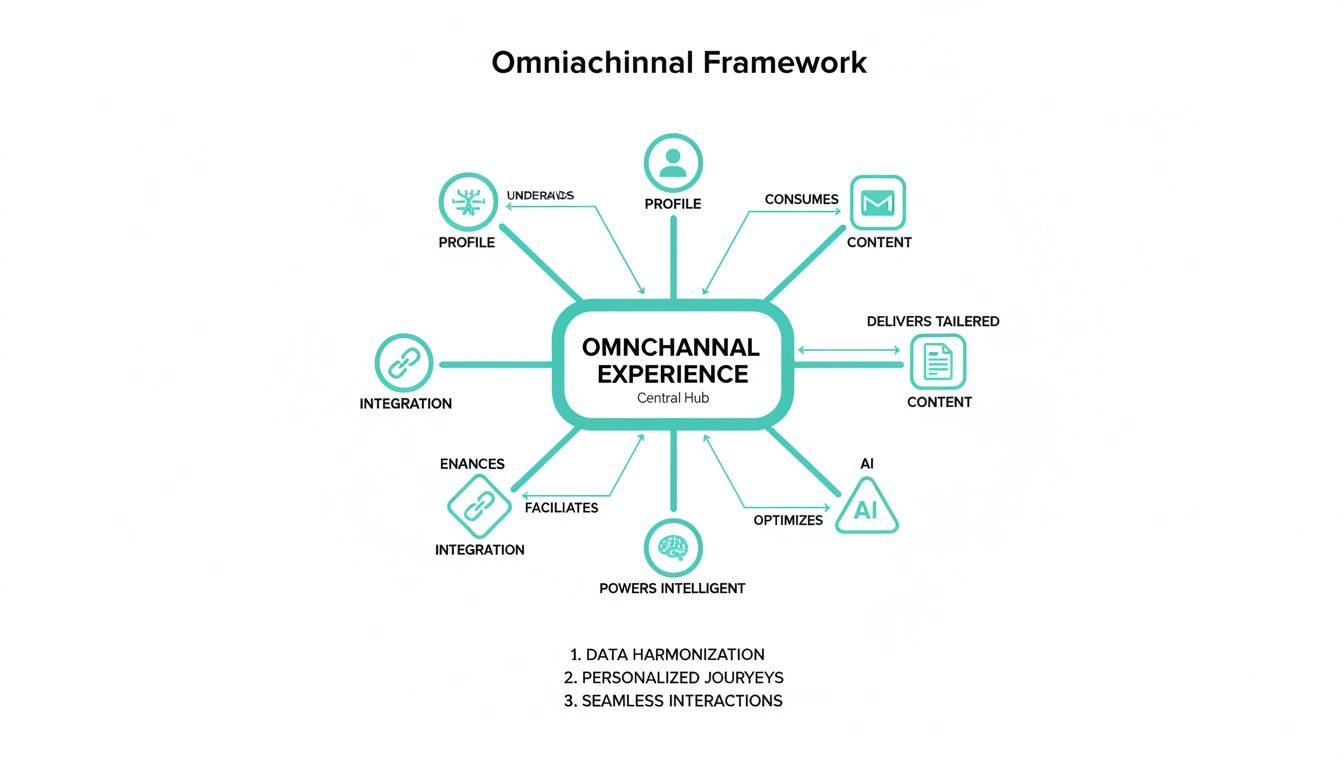
This visual makes it clear: a true omnichannel experience is built on the interplay between understanding the customer (profile), delivering the right message (content), using intelligence to make it relevant (AI), and making sure all your systems are talking to each other (integration).
Ensuring Brand Consistency with a Content Hub
The final piece of this strategic puzzle is guaranteeing absolute message consistency. Your personalization efforts will fall flat if your brand voice, visuals, and messaging are all over the place. This is where Sitecore Content Hub becomes invaluable, acting as the single source of truth for all your marketing assets.
By centralizing everything from product images and campaign copy to brand guidelines and legal disclaimers, Content Hub makes sure the right message is delivered with perfect consistency, every single time. For organizations that also use SharePoint for internal documents, integrating it with a public-facing hub like Sitecore's creates a powerful internal-to-external content pipeline. This ensures everyone from product developers to frontline marketers is working from the same script, transforming a collection of channels into one genuine omnichannel strategy.
Integrating SharePoint for Enterprise Content Cohesion
A truly effective omnichannel marketing strategy is about more than just a consistent customer-facing experience—it demands rock-solid internal alignment. While platforms like Sitecore manage what the customer sees, the accuracy of that experience hinges on the content being created and managed behind the scenes. This is where SharePoint comes in, not just as a tool, but as a strategic advantage.
Think of SharePoint as the company's internal library or its central nervous system. It’s the repository for all the critical, non-marketing assets that keep the business running. It houses the foundational truths of your business—the kind of detailed information that customer-facing teams rely on every single day.
The Internal Source of Truth
For any large organization, SharePoint often serves as the single source of truth for a massive range of operational content. While these assets aren't typically customer-facing, they heavily influence the customer experience.
- Detailed Product Specifications: The engineering documents, feature lists, and technical data sheets that every product description is built upon.
- Official Brand Guidelines: The definitive rulebook for logo usage, color palettes, and brand voice that absolutely must be followed on every channel.
- Comprehensive Sales Training Materials: In-depth guides and playbooks that ensure the entire sales team tells the same story about product value.
- Customer Support Knowledge Bases: The detailed scripts and troubleshooting guides that support agents use to solve problems accurately and consistently.
When this crucial information stays locked away in SharePoint, marketing and sales teams can easily end up using outdated or incorrect details. A tiny discrepancy in product specs between a website and a sales brochure might seem minor, but it can create serious friction and erode customer trust.
An omnichannel strategy falls apart when internal teams aren't working from the same playbook. Integrating your internal knowledge repository with your customer experience platform isn’t a technical convenience; it’s a fundamental requirement for operational excellence and brand integrity.
Synchronizing SharePoint with Sitecore Content Hub
The solution is synchronization. By connecting your SharePoint repository with a platform like Sitecore Content Hub, you create a seamless pipeline of information. This integration ensures that the approved, authoritative content living in SharePoint flows directly into the system that manages all your marketing assets.
This connection transforms your omni channel marketing strategy from a fragmented effort into a truly cohesive operation. Suddenly, every team—from marketing and sales to product development and customer support—is working from the same script. This synchronization is a core part of managing the complete content life cycle, from its internal creation all the way to external delivery.
The result is a powerful synergy. Marketing teams can pull approved product details straight into their campaigns, completely confident in their accuracy. Support teams have instant access to the latest information, enabling them to provide better service. But most importantly, the customer receives a consistent and trustworthy message at every single touchpoint, which does more to strengthen their relationship with your brand than any single campaign ever could.
The Measurable Business Impact of an Omnichannel Approach
An omnichannel marketing strategy isn't just about making customers happier; it's a direct route to beefing up your bottom line. Forget abstract benefits for a moment. This approach delivers tangible ROI by turning those smooth customer journeys into real revenue growth, deeper loyalty, and a much higher customer lifetime value (CLV).
When powerful platforms like Sitecore and SharePoint are synced up, they do more than just connect the dots for your customers—they create serious business value. Sitecore is brilliant at capturing and acting on customer data in real time, from every single touchpoint. This lets you serve up hyper-relevant interactions that don't just boost conversions but also plug the revenue leaks that fractured customer journeys always cause.
Driving Revenue and Customer Loyalty
The numbers don't lie. Companies that excel at omnichannel customer engagement retain on average 89% of their customers, compared to 33% for companies with weak omnichannel customer engagement. This loyalty translates directly into financial gains.
Get it right, and you could be looking at a significant revenue uplift, a major increase in customer loyalty, and an impressive jump in customer lifetime value (CLV).
This financial upside is a direct result of having the right tech in place. For example, Sitecore CDP meticulously builds a rich, unified profile for each customer. Then, Sitecore Personalize steps in to deliver tailored offers that actually resonate. This is how you stop churn in its tracks and encourage repeat business, directly boosting that all-important CLV.
An investment in a unified platform like Sitecore is an investment in your financial future. By eliminating the friction in the customer journey, you reduce service costs, increase retention, and turn casual buyers into loyal brand advocates.
Reducing Operational Friction and Costs
Beyond just growing revenue, a well-integrated strategy streamlines how your teams work, which naturally cuts down on costs. Think about it: when SharePoint acts as your internal knowledge hub and is perfectly synchronized with Sitecore Content Hub, your operational efficiency goes through the roof.
This alignment means your teams aren't wasting precious time hunting for the right information or fixing inconsistencies. The impact on your bottom line is immediate:
- Lower customer service costs because your agents have accurate, easy-to-find information at their fingertips.
- Less marketing waste since campaigns are built on correct product data and brand guidelines from the get-go.
- Minimized churn that's often caused by frustrating, inconsistent customer experiences.
Ultimately, a well-executed omnichannel marketing strategy becomes an engine for sustainable growth. It creates a powerful cycle: better customer experiences lead to higher loyalty, which drives more revenue and provides richer data to make your personalization even smarter.
Of course, tracking these outcomes properly is everything. To make it all count, you have to get your analytics set up right. You can learn more by exploring our guide on measuring digital marketing effectiveness.
The ability to turn raw data into smart, actionable insights is what separates the most successful omnichannel campaigns from the rest. It's a core principle of data-driven growth marketing, and it draws a clear, undeniable line from smart technology investment to measurable, long-term financial success.
Your Practical Roadmap to Omnichannel Implementation
Making the shift to a true omnichannel marketing strategy isn't just a tech project; it’s a full-blown business transformation. Getting it right demands a clear, step-by-step approach that builds momentum and proves its worth along the way.
This roadmap breaks the entire process down into manageable steps, making it achievable for any organization that's serious about putting its customers at the center of everything.
Audit Your Channels and Tech Stack
First things first: you have to start with an honest look at where you are right now. This means taking a complete inventory of every single customer touchpoint—both online and in the real world—and the technology that makes each one tick.
This audit is more than just a checklist. It's about finding the cracks and disconnects between your channels. You might find that your e-commerce platform and your in-store POS system don't talk to each other, or that the data from your mobile app is stuck in its own little world, totally cut off from your CRM. Spotting these fractures is the first move toward building bridges between them.
A successful omnichannel implementation isn't about adding more channels. It's about making the ones you already have work together seamlessly. Your initial audit provides the blueprint for that integration.
Map Your Critical Customer Journeys
Once you have a solid handle on your channels, it’s time to see them through your customers' eyes. Instead of getting bogged down trying to map every single interaction, zero in on the 2-3 most critical customer journeys that have the biggest impact on your bottom line.
This could be the path from someone first discovering your product to making their first purchase, or the journey a customer takes from a service question to a happy resolution. Mapping these key routes helps you understand what your customers need, what drives them, and what frustrates them at every turn. That insight is gold for designing an experience that feels natural and helpful, not clunky and frustrating.
Select the Right DXP Foundation
Your tech foundation is everything; it can make or break your entire strategy. A composable Digital Experience Platform (DXP) like Sitecore gives you the flexibility to build a solution that fits your exact needs, rather than forcing you into a rigid, one-size-fits-all box. You get to pick and choose the best tools for the job.
- Sitecore XM Cloud: This is your content management hub, the core for all your digital experiences.
- Sitecore CDP: Think of this as the central brain that unifies all your customer data into a single, coherent view.
- Sitecore Personalize: This is the engine that powers those real-time, one-to-one interactions that customers love.
This modular approach means you can start with just the pieces you need right now and then add more capabilities as your strategy grows and evolves.
Prioritize Data Integration
The heart of any great omnichannel strategy is a unified view of the customer. That makes data integration an absolute top priority. The goal is to get information flowing freely between all your systems, with a powerful tool like Sitecore CDP sitting right in the middle.
Connecting your CRM, e-commerce platform, and even your SharePoint repositories to your DXP isn't optional—it's essential. This is what turns a bunch of fragmented data points into the rich, 360-degree customer profiles you need to deliver real personalization.
Launch Targeted Pilot Programs
Finally, don't try to boil the ocean. A massive, high-risk, big-bang launch is a recipe for disaster. Instead, kick things off with small, targeted pilot programs.
Pick a single, high-impact customer journey and a specific customer segment to focus on for your first run. This lets you test out your new, integrated system in a controlled environment, prove its value with real numbers, and learn valuable lessons along the way. A successful pilot builds confidence internally and creates the momentum you need to scale your omnichannel marketing strategy across the whole company.
Common Questions About an Omnichannel Marketing Strategy
Even with the best game plan, questions pop up. Here are some quick, practical answers to the common hurdles people run into when putting together a sophisticated omichannel marketing strategy, especially when using powerful platforms like Sitecore and SharePoint.
What Is the Biggest Implementation Challenge?
Almost every time, the biggest wall you'll hit is data integration. It's the classic problem of organizational silos. Marketing has its data, sales has theirs, and customer service has another set entirely. This creates a choppy, incomplete picture of the customer.
Getting this right takes two things. First, you need a strong tech foundation—something like Sitecore CDP is perfect for this—to pull data from everywhere into one clean, unified customer profile. Second, and just as important, you need buy-in from the top down to tear down those departmental walls and get everyone focused on the same customer-centric mission.
How Does Sitecore Specifically Enable This Strategy?
Sitecore’s composable DXP isn’t just a collection of tools; it’s practically purpose-built to pull off a true omnichannel experience. Think of it as a team where every player has a specific, crucial job:
- Sitecore CDP: This is your data quarterback. It gathers and unifies customer information to create that all-important 360-degree view.
- Sitecore Personalize: This is your offense. It takes that unified data and uses AI to deliver sharp, real-time personalized interactions on any channel.
- Sitecore Content Hub: This is your brand guardian, making sure your messaging and visuals are perfectly consistent everywhere.
- Sitecore XM Cloud: This manages the core digital storefront, the central hub that connects the entire journey.
You see how they work together? It's not about managing channels in isolation. It's about orchestrating a fluid, interconnected journey that feels completely natural to the customer—which is the whole point of an omnichannel marketing strategy.
Can Smaller Businesses Implement an Effective Omnichannel Strategy?
Absolutely. You don't need a massive enterprise budget to make this work. The principles are the same, you just apply them on a different scale.
For a smaller business, the trick is to focus laser-tight on the handful of channels that truly matter to your customers. Maybe that’s just your e-commerce site, your email list, and your main Instagram account. The goal is to make the experience between those specific channels completely seamless.
A composable platform like Sitecore shines here because you can start small. Begin with the essentials, like personalization and content tools, and then bolt on more advanced features as your business grows and your strategy gets more ambitious.
Ready to transform your customer experience? Kogifi specializes in architecting and implementing powerful Digital Experience Platforms using Sitecore and SharePoint to drive your business forward. Learn more about how we can build your winning omnichannel strategy.