


You can usually spot an enterprise omnichannel content strategy failure before anyone calls it that. A global marketing team has a Sitecore site for acquisition, an AEM knowledge portal for product education, and a SharePoint intranet for employees, yet every team still publishes its own version of the same message. The customer sees one tone on the website, another in the help center, and a third from support or sales. The business calls that “multi-platform,” but the core issue is a missing operating model.
At enterprise scale, omnichannel isn't a publishing preference, it's an architecture decision. The strongest programs connect content, data, workflow, governance, and personalization into one system that can serve customers and employees without rebuilding every touchpoint by hand. That's why Sitecore, AEM, and SharePoint keep showing up in the same conversation. They solve different parts of the estate, but they only work when the content model and governance are designed to travel across channels from day one.
Table of Contents
Why Most Omnichannel Programs Stall Inside the Enterprise
A common failure pattern shows up in almost every large rollout. Marketing wants one brand story, product teams want faster launches, regional teams want local control, and IT is stuck maintaining duplicated content across a Sitecore marketing estate, an AEM portal, and a SharePoint intranet. Everyone agrees the experience feels fragmented, but each team keeps optimizing its own channel because that is how the system was built.
The problem is rarely the strategy deck. The problem is the operating model underneath it.
Practical rule: if every team owns its own content copy, taxonomy, and approval path, you do not have omnichannel content, you have coordinated duplication.
The historical shift matters here. Modern omnichannel strategy is about consistent experiences across websites, mobile apps, email, social media, stores, and other channels, connected through a central data or content layer. That evolution reflects a hard lesson from enterprise delivery, a single content repository and a unified customer view became necessary once brands moved beyond web-only publishing into mobile, kiosks, conversation layers, and hybrid online-offline journeys. Industry guidance now emphasizes integrating content, data, and teams, then measuring cross-channel behavior instead of isolated channel metrics, which is the only way to keep personalization and governance aligned at scale (Contentstack guidance on omnichannel strategy).
Where the breakdown actually happens
When teams structure content channel by channel, they create separate editorial habits, separate component libraries, and separate approval chains. That is why the experience fractures even when the brand guidelines are technically the same. The content exists in multiple places, but the customer journey does not.
Independent research in Springer defines omnichannel business as the “synergetic management of the numerous available channels” so customer experience and performance across channels are optimized (Springer study). That definition is useful because it puts pressure on orchestration, not presence. Sitecore's own guidance is similar, describing omnichannel as a cohesive brand experience across all channels while tailoring content to each channel's characteristics without losing message consistency (Sitecore content strategy guidance).
A post-mortem analysis of enterprise project failures makes the pattern even clearer: teams usually do not fail because they lack content, they fail because governance, ownership, and delivery are split across too many systems (a post-mortem analysis of enterprise project failures). In practice, that means the bottleneck is not “we need more pages.” It is “we need one content backbone, one set of reusable components, and one governance model that survives regional variation.” That is where most programs stall, and that is why the rest of the work has to start with discovery.
Defining Goals, Audiences, and Journeys Across Channels
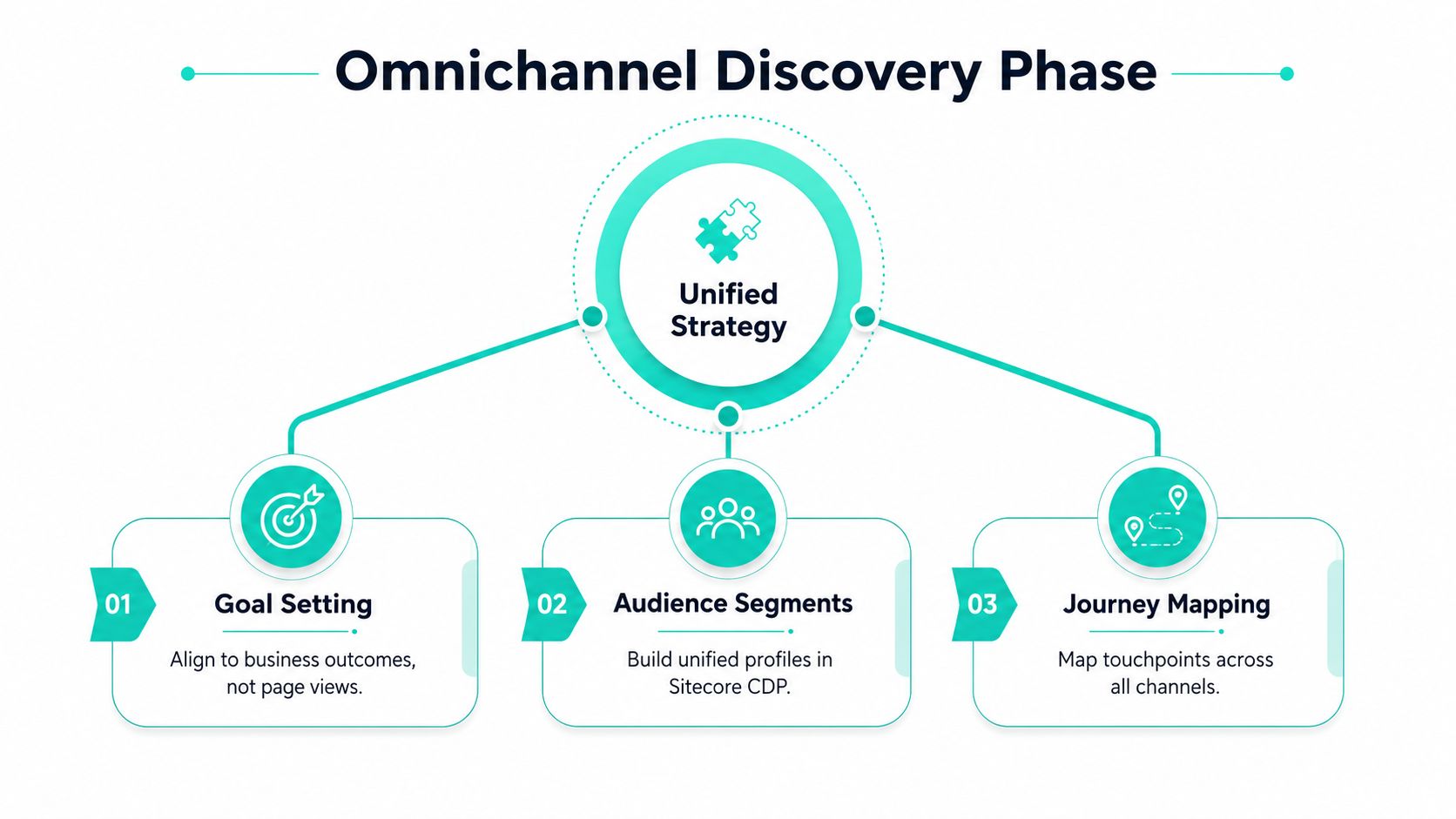
The first mistake is to define goals in channel language. “Increase website traffic” or “grow intranet engagement” doesn't tell you whether omnichannel is necessary. Better goals sound like business outcomes, customer progress, or employee task completion. If the target outcome spans web, email, app, in-person service, and internal knowledge, then you likely need omnichannel coordination, not just better publishing.
Start with platform-agnostic goals
A good omnichannel goal can survive platform change. If the goal disappears when you swap Sitecore for AEM or the intranet from SharePoint to another system, the goal was too implementation-specific. Keep the language centered on outcomes, journey completion, and content reuse across touchpoints.
The best discovery artifact isn't a channel list, it's a decision log that shows which audience problem requires coordinated delivery and which one only needs a better single-channel workflow.
Audience definition should also be unified, not siloed. Sitecore's experience data, AEM's customer data integrations, and SharePoint user profiles all matter, but they should feed a shared view of behavior. The point isn't to make every system identical. The point is to prevent each system from becoming its own truth. That's especially important when the same person can be a prospect on the public site, a customer in the portal, and an employee in the intranet.
Map journeys across the whole estate
Cross-channel journey mapping works best when it includes the boring touchpoints, not just the glamorous ones. A buyer might start on a marketing page, move into an email, visit an AEM knowledge article, then rely on a SharePoint-hosted internal support process. If those touchpoints don't connect, the customer feels the break even if each page is individually polished.
A practical way to pressure-test the discovery work is simple:
- Business outcome alignment: each goal should tie to an action that matters outside the CMS.
- Shared audience signal: the same segment should be identifiable across the platforms that matter.
- Journey continuity: one person should be able to move from one channel to another without the story resetting.
- Content demand clarity: the journey should reveal what reusable assets are needed, not just what pages need rebuilding.
For teams that need a structured baseline, Kogifi's discussion of omnichannel marketing definitions is a useful companion point of reference. The larger lesson stays the same, strategy only becomes real when the audience model and journey model are shared across teams.
Building Channel-Agnostic Content Models and Workflows
Once goals and journeys are clear, the content model has to support reuse without making editors miserable. Enterprise teams usually choose between three patterns: Sitecore XM Cloud component libraries, AEM Content Fragment Models, and SharePoint content types plus hub sites. All three can support omnichannel delivery, but they behave differently in editorial practice.
| Capability | Sitecore XM Cloud | AEM | SharePoint Online |
|---|---|---|---|
| Structured reuse | Strong with reusable components and Helix-based patterns | Strong with Content Fragments and fragment models | Strong for content types, page templates, and knowledge structures |
| Workflow fit | Good for marketing governance and modular page composition | Good for complex enterprise publishing and asset-driven workflows | Good for intranet publishing, approvals, and employee communication |
| Channel delivery | Strong headless and hybrid delivery | Strong enterprise delivery across web and related experiences | Strong internal delivery and Microsoft 365-connected experiences |
| Best ownership | Marketing-led digital experience programs | Large content operations and integrated Adobe estates | Employee-facing content and operational knowledge |
The content modeling question is not “which platform is best.” It's “which platform should own the backbone for which audience and channel.”
Design for reuse, not repetition
Sitecore's Helix-based thinking works well when marketing needs a disciplined component library that can be reused across brand sites and channel variants. XM Cloud helps when the team wants modular content with headless delivery and a cleaner separation between authoring and presentation. AEM excels when a broader Adobe ecosystem needs to stay tightly connected, especially in content-heavy programs where fragment structure and asset management matter. SharePoint Online is strongest when the goal is internal information distribution, policy content, process content, and employee knowledge.
That's also where the operating model matters. CMSWire notes that omnichannel content creation requires connecting the systems used for creating, publishing, and managing content, often with APIs that move information between the syndication platform and other systems. It also points out that omnichannel mindset has to reach all content teams, not just marketing, but product guides, online help, knowledge bases, and training materials too (CMSWire on omnichannel content strategy). That lines up with what happens in real enterprises, where the information ecosystem is broader than the public site.
Workflow is the hidden architecture
Workflow decides whether reuse ships. If marketing has one approval path, product another, and the intranet a third, content gets rewritten to fit local process rules. That destroys reuse faster than bad templates do.
Operational truth: channel-agnostic content fails when the workflow is still channel-specific.
Kogifi's explanation of content as a service is relevant here because it reflects the same principle in delivery terms. Content needs to be authored once, structured well, and made available to multiple experiences without forcing every team to rebuild it. In practice, that means editorial rules have to live alongside the model, not outside it.
Choosing and Composing the DXP Architecture
A real omnichannel program usually falls apart when the enterprise tries to force one platform to carry every audience and every content type. The architecture decision works better as a composition exercise. In practice, that often means a Sitecore XM Cloud marketing backbone with a Next.js headless front end, an AEM layer for product or knowledge content where Adobe ecosystem integration matters, and SharePoint Online for employee-facing experiences. That mix looks complex on paper, but it is cleaner than running several disconnected systems and pretending they form one strategy.

Match the platform to the experience type
Sitecore XM Cloud fits well when the business needs a flexible backbone for customer-facing content, especially where modular delivery, component reuse, and headless front ends need to support more than one experience. AEM makes sense when the enterprise wants tight integration with the broader Adobe stack and already has mature content operations built around that ecosystem. SharePoint Online works best for intranets, operational communications, and knowledge experiences where Microsoft 365 identity and governance are already central.
The practical rule is simple, do not force one platform to do all the jobs. Marketing content, product knowledge, and employee content often need different operating assumptions even when they share brand standards.
Sitecore guidance on how to structure content for omnichannel success aligns with that reality. The point is not just editorial consistency. It is about having a backbone that can serve different front ends without losing control of the source content.
Compose, don't consolidate blindly
Headless delivery through APIs is what makes mixed estates workable. It lets the content backbone stay stable while front ends change with audience needs. The trade-off is real, every integration, identity layer, personalization service, and analytics feed adds governance overhead.
A practical composition model usually looks like this:
- Customer acquisition and conversion: Sitecore XM Cloud plus a modern front end.
- Product knowledge and content-rich experiences: AEM where enterprise publishing depth matters.
- Employee communication and internal workflow: SharePoint Online with SPFx and Power Platform.
For teams working through that mix, personalizing customer experiences across platforms depends on more than a front-end pattern. The architecture has to keep content models, permissions, and delivery rules aligned, or personalization turns into another source of drift.
Kogifi is one option for enterprises that need this kind of mixed architecture across Sitecore, AEM, and SharePoint estates. The useful part is not the brand label. It is the operational reality that the platforms can be composed without turning the program into new silos.
The wrong move is to standardize by flattening everything into one tool. The better move is to define which platform owns which audience, which content type, and which integration path, then keep the seams explicit.
Personalization and AI Integration Across the Stack
A content program starts to work harder once AI helps it recognize relevance, not just push assets into more channels. Personalization is the point where omnichannel strategy stops being a distribution plan and starts acting like a relevance engine. The business case is easy to see in the same Firework omnichannel statistics roundup, which reports stronger purchase rates across multiple channels, higher engagement with personalized marketing, better customer satisfaction, lower acquisition costs, and more repeat purchases when brands tailor experiences across touchpoints. The point is not channel volume, it is coordinated personalization.
Use AI to connect, not fragment, the experience
Sitecore AI features are most useful when they support recommendations, segment targeting, and generative assistance inside a governed content model. That matters because AI output is only as good as the structure beneath it. If content is fragmented, AI speeds up the fragmentation.
AEM teams often rely on Adobe Sensei-style patterns for insight and automation inside the Adobe stack. SharePoint teams work differently, with Microsoft 365 Copilot and Viva knowledge patterns fitting employee search, retrieval, and summarization more naturally. Each stack can support personalization, but the harder part is keeping the signals compatible when the same audience moves across customer and employee channels. For teams working through that problem, our guide to personalizing customer experiences shows how the personalization layer has to stay aligned with content models and delivery rules, or the experience splits apart.
Keep brand voice stable while scaling output
AI should cut repetitive production work, not create a second brand voice. Editorial rules need to govern generated variants, summary snippets, calls to action, and search-friendly rewrites. The same personalized offer should not sound like it came from three different companies just because it passed through three platforms.
If the content model cannot support reuse, AI will amplify inconsistency faster than it improves speed.
A stronger setup uses shared audience definitions, shared metadata, and shared approval logic across the stack. That is what lets a Sitecore campaign, an AEM knowledge journey, and a SharePoint intranet message reinforce each other instead of drifting apart. The personalization layer should learn from behavior across channels, not from one estate in isolation.
Governance, Localization, and Accessibility at Scale
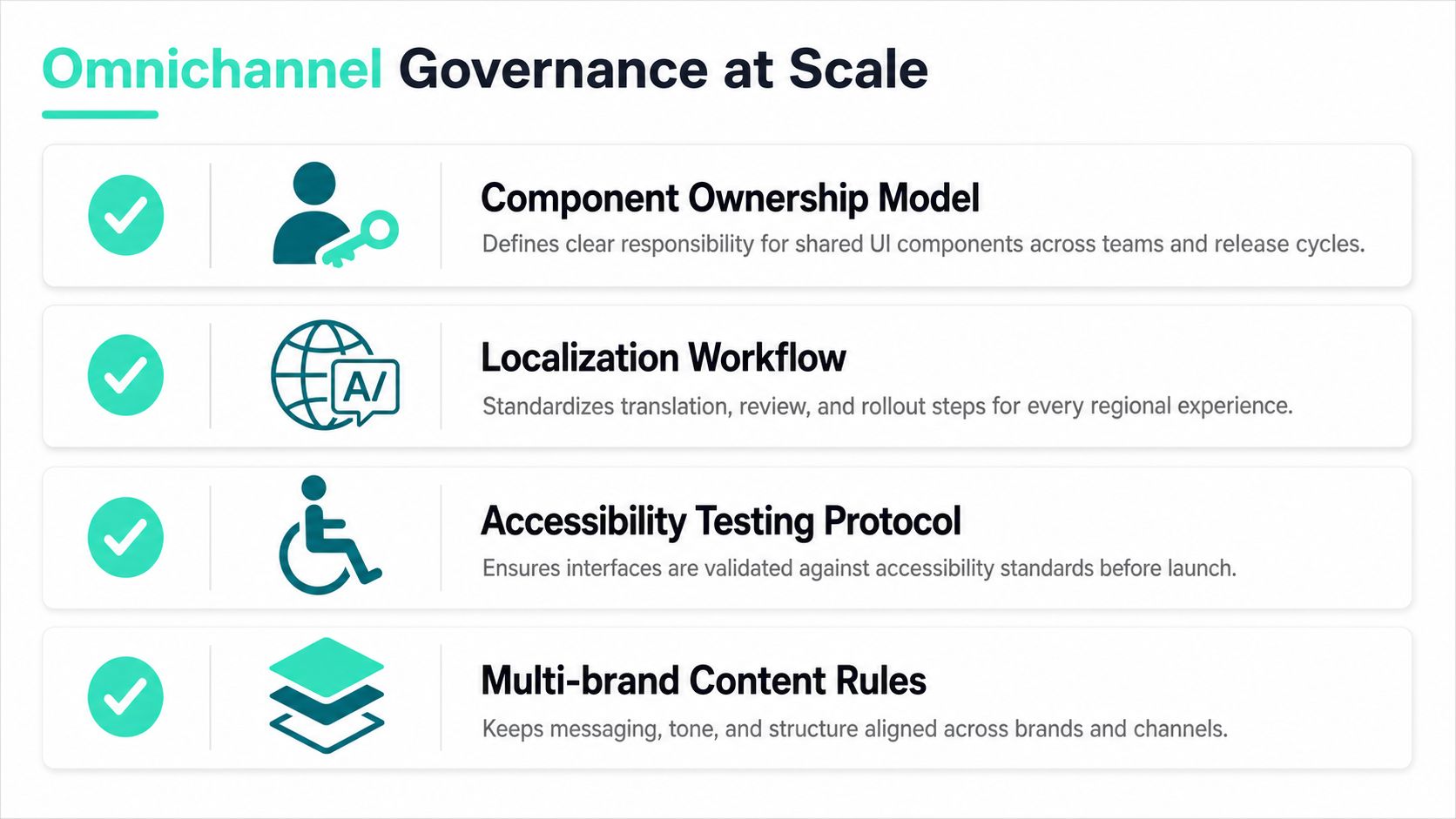
The part most omnichannel articles skip is the part enterprise teams spend the most time on. Once multiple brands, regions, and platform owners are involved, governance becomes the difference between a coordinated program and a slow-moving bottleneck. Centralized workflow and governance are required to keep content coordinated across owned, earned, paid, and shared channels, especially when local teams need room to adapt without breaking brand rules.
Local speed needs strong guardrails
Sitecore hub-and-spoke setups work well when a central team owns core components and local teams assemble approved variants. AEM can support multi-brand and multilingual workflows when asset, fragment, and approval structures are organized carefully. SharePoint hub-and-spoke patterns do the same thing for intranets, where local offices or business units need their own pages but the central team still controls navigation, policy content, and identity standards.
The governance model should answer four questions clearly:
- Who owns each component: central brand, region, or business unit.
- What can be localized: copy, imagery, legal text, or layout.
- Which approvals are mandatory: legal, compliance, accessibility, or brand.
- What must never change: terminology, core claims, and accessibility structure.
That structure matters because the fastest teams aren't the ones without rules. They're the ones whose rules are explicit enough to let people move without asking for permission on every edit.
Accessibility belongs in the content model
WCAG-aware design fails when accessibility is treated as a QA step at the end. It has to be part of the component and content rules from the start. That means alternative text patterns, heading logic, link labeling, contrast-safe design decisions, and keyboard-friendly interactions need to live in the same governance system as brand rules and localization rules.
The same is true for multilingual delivery. Translation alone doesn't solve global content, because region-specific terminology, legal language, and local search behavior all need oversight. SharePoint intranets are especially sensitive here because employees depend on them for operational clarity, and ambiguity inside an intranet becomes a support problem very quickly.
Enterprise omnichannel succeeds when local markets can move fast inside boundaries that are enforceable. If the boundary only exists in a slide deck, the content estate will drift.
Migration, Roll-Out, and Continuous Optimization
The cleanest migration path is phased, not heroic. Start by inventorying the current content estate, then separate the content that must move first from the content that can wait. That's the difference between a manageable rollout and a stall caused by trying to replatform everything at once.
The research guidance on omnichannel implementation consistently points to audit, channel strategy, architecture choice, structured content, and reusable workflows as the starting sequence. The same logic applies when the target mix includes Sitecore XM Cloud, AEM, and SharePoint Online, the content backbone has to be rebuilt in layers, not all at once.
Roll out in the order the business feels risk
Start with one high-value journey, one content type, and one platform boundary. For example, move a marketing campaign stream into Sitecore XM Cloud, a knowledge area into AEM, or a policy and employee comms area into SharePoint Online. Each one teaches different lessons about modeling, governance, and analytics.
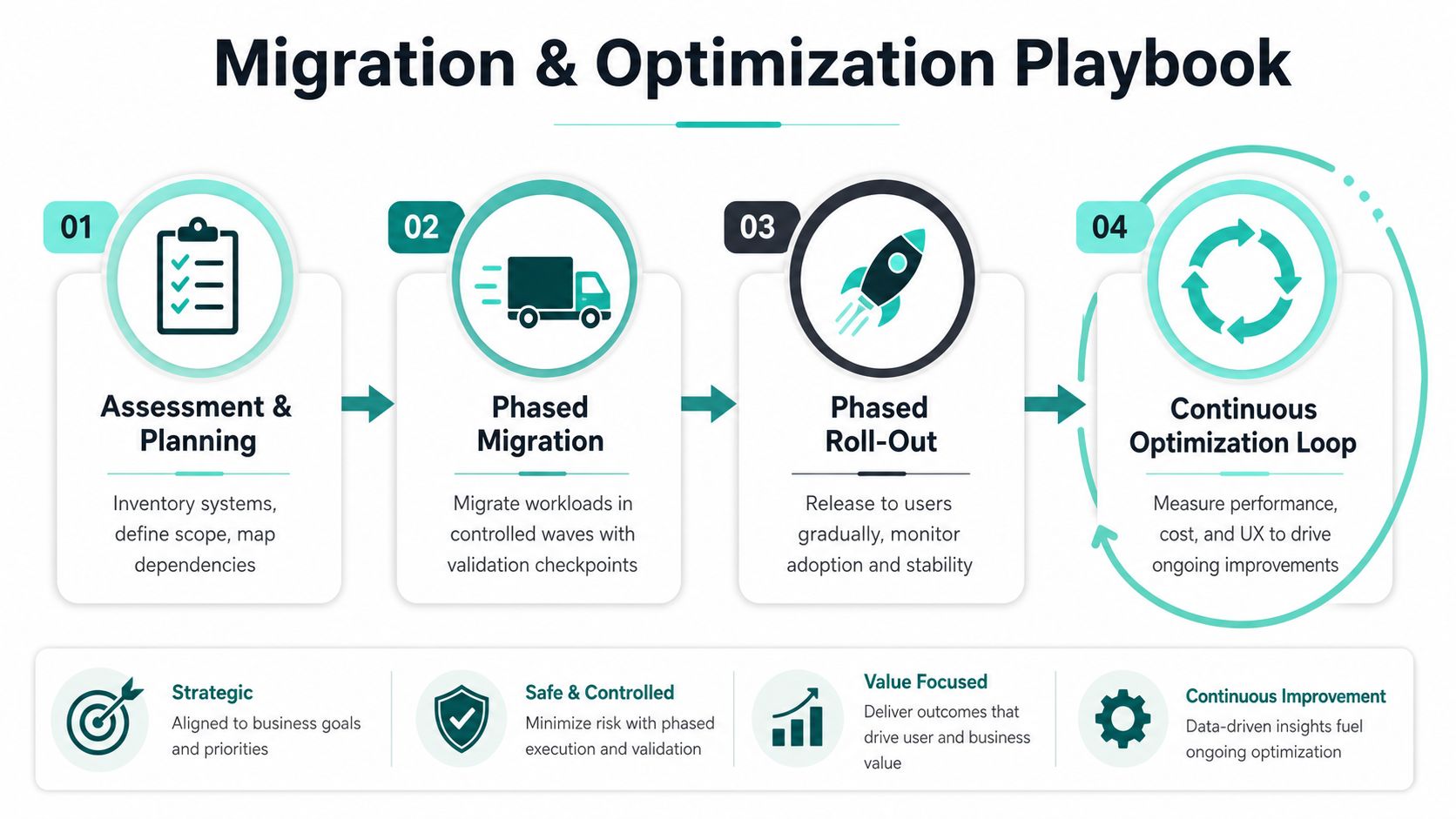
The rollout itself should follow a simple pattern:
- Assessment and planning. Inventory content, owners, dependencies, and duplicate assets.
- Phased migration. Move reusable content first, not the most visible content first.
- Phased roll-out. Launch by audience or journey, not by internal team preference.
- Continuous optimization. Feed analytics and feedback back into the content model.
That final step matters because omnichannel programs fail when teams freeze the model after launch. The better approach is to keep tuning the structure based on how people move across channels.
Measure the journey, not the page
Multi-touch attribution is the right lens when content influences decisions across several channels. The measurement architecture should include first-touch, last-touch, and multi-touch views together, plus offline and online signals where they matter. That's how teams avoid over-crediting a single page or a single campaign.
Optimization rule: if your reporting only proves which channel got the click, it won't tell you which channel moved the customer forward.
Use a 90-day rhythm. Review channel combinations, content reuse patterns, and journey drop-offs every cycle, then adjust the model, not just the creative. When the content system is right, optimization gets easier because the signals are clearer. If the system is wrong, no amount of reporting fixes the underlying fragmentation.
If your enterprise is trying to connect Sitecore, AEM, and SharePoint into one coherent experience layer, Kogifi can help assess the content model, migration path, and governance rules before the next rollout creates more silos. Start with the estate you already have, map one critical journey, and build the backbone that can support the channels you need.