

You're probably sitting in a steering committee right now, looking at a shortlist of Sitecore vendors that all sound the same. Each one says they can implement XM Cloud, handle personalization, support search, and “drive digital transformation,” but only one of them will live inside your marketing operation after launch. That's the actual decision. A Sitecore development agency is not a software reseller, it's the team that will shape governance, upgrade risk, and total cost of ownership for years.
Sitecore itself is a serious enterprise platform. In October 2024, the company said it had surpassed $500 million in annual recurring revenue, and it described XM Cloud as the fastest-growing product in its history, while also naming global brands such as L'Oréal, Microsoft, and United Airlines as users of its composable DXP (Sitecore newsroom). That scale matters because the agency you choose won't be building a brochure site, it'll be operating inside global content governance, personalization, and cloud delivery. Pick on brand polish alone, and you'll pay for it later in release friction, rework, and support debt.
Table of Contents
- The Decision Point and Why Agency Choice Matters
- Start with the tier, then test the bench
- Match the team shape to the project shape
- Ask for specifics that expose real delivery habits
- Separate commercial transparency from sales polish
The Decision Point and Why Agency Choice Matters
The first shortlist usually arrives under pressure. Procurement wants three names, marketing wants speed, IT wants lower risk, and everyone wants the same thing without fully agreeing on what “the same thing” means. That's why the best shortlist is built before any demo. It should contain only agencies that can prove they've delivered Sitecore in enterprise conditions, not just listed the platform on a services page.
A sitecore development agency should be evaluated as a governance partner, not a feature vendor. If the agency can't handle content model discipline, release coordination, and supportable architecture, then a slick demo won't save the program. The cost of choosing poorly shows up later as launch slips, unstable integrations, content-authoring chaos, and a platform that becomes harder to run every quarter.
Practical rule: if the agency cannot explain how it will keep the estate supportable after go-live, it's not ready for an enterprise contract.
That's the mental model you want. The shortlist should narrow fast, ideally to vendors that can answer architecture questions without hand-waving and commercial questions without hiding behind vague rate cards. After that, the actual work starts, because Sitecore selection is really about deciding who will own the operational shape of your digital estate.
Evaluating Sitecore Partner Credentials and Delivery Capacity
Start with the tier, then test the bench
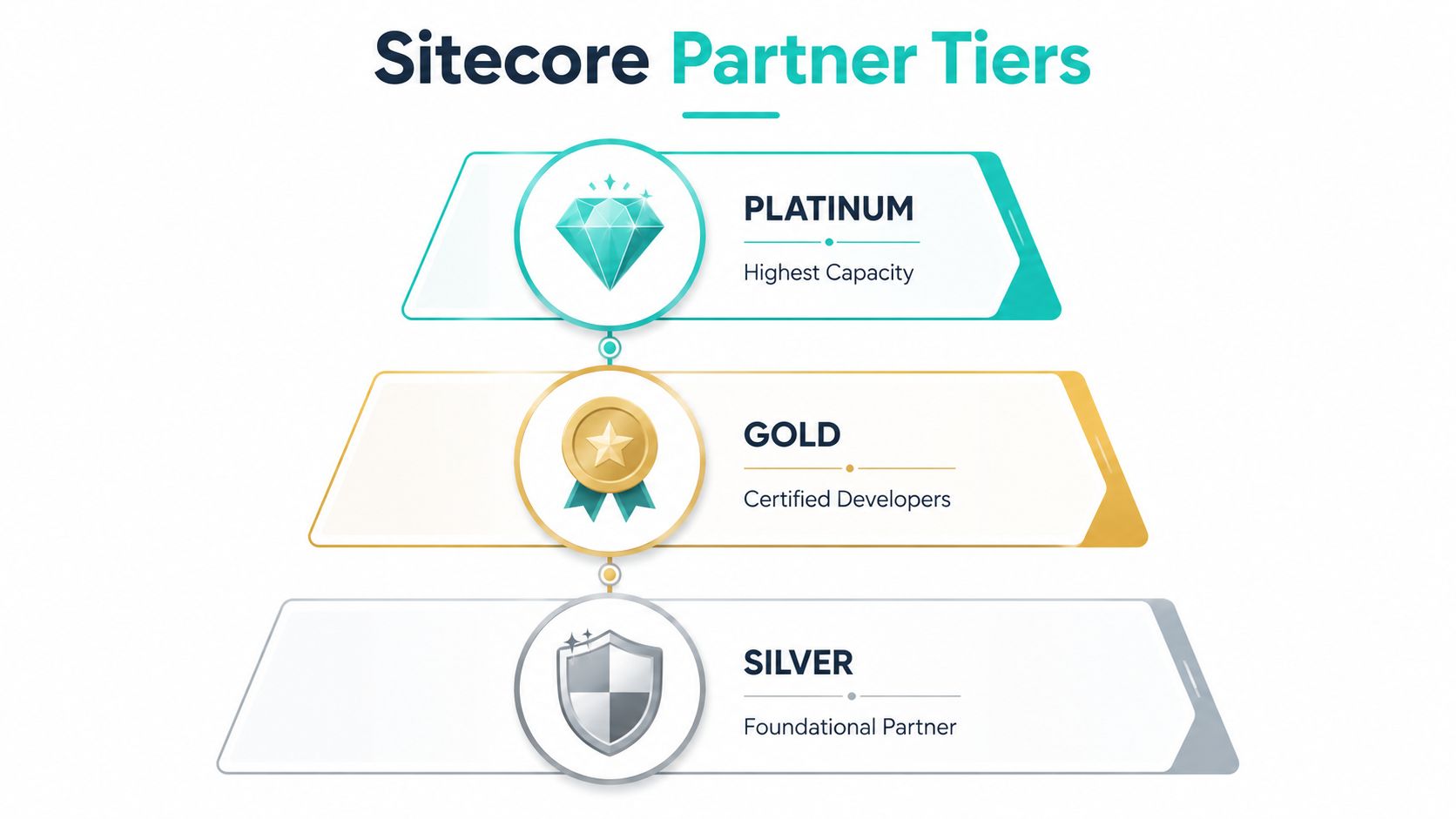
Sitecore's partner program is tiered Silver, Gold, Platinum, and that gives you a basic filter, not a verdict. The partner label tells you the agency has passed a formal threshold, but the delivery outcome depends on who is staffed on the project. The baseline qualification across tiers is the Sitecore XM Developer Certification, which covers architecture, template development, publishing, analytics, security, and workflow (Qedge).
That means you should ask for names, not logos. If the agency can't show certified developers, certified architects, and a stable bench for XM Cloud or XP work, the partner badge isn't enough. Staff tenure matters because enterprise implementations fail when the team is constantly reshuffled or everything gets subcontracted out.
A mature shortlist usually shows a few clear signs:
- Named certified people. You want the actual delivery leads, not a generic résumé deck.
- Repeatable governance patterns. Standard component libraries, workflow enforcement, and role-based security are better than one-off heroics.
- Honest delivery mix. Ask how much work is handled in-house versus by subcontractors.
- Platform depth. XM Cloud capability is not the same as XP maintenance, and both are not the same as content operations support.
The anti-pattern is easy to spot. If the agency leans hard on recycled case studies, has no certified architects on staff, or talks around upgrade history, move on. A sitecore development agency should reduce uncertainty, not add a second layer of it.
Match the team shape to the project shape
The right team structure depends on what you're buying. A pure build project needs different depth from a long-running multi-brand estate, and both differ from a migration program. If your vendor can't explain how it staffs discovery, build, stabilization, and hypercare without handoffs turning into blame-shifting, the delivery model is weak.
Use this internal resource only as a supplementary check on partner selection criteria, not as your primary filter: how to choose the best Sitecore partner. The test is still whether the agency can show disciplined delivery habits, not how polished the marketing copy looks.
Bottom line: credentials matter, but certified capacity matters more than partner tier alone.
Mapping the Sitecore Product Portfolio an Agency Should Cover

A credible Sitecore development agency should cover more than one product line. Enterprise estates rarely stay inside a single box. They mix XM Cloud, XP, Content Hub, Search, Personalize, and the broader composable DXP stack, and the agency needs to understand how those pieces work together in production, support, and governance. If the team only speaks in isolated product talking points, it is not ready for enterprise delivery.
That portfolio view matters because Sitecore is not just a content tool. It is an operating model for content management across sites, apps, and customer experiences, with SaaS and composable architecture changing how teams launch, govern, and scale digital work. An agency should be able to explain how that model affects release flow, ownership, support boundaries, and total cost of ownership. If it cannot, the marketing copy is doing the heavy lifting.
Test the product knowledge where work actually breaks
XM Cloud is the clearest test of modern delivery because it forces discipline. Teams need controlled workflows, content serialization, branching strategy, head application security, and a realistic understanding of Experience Edge constraints. XP still matters for estates that remain on older patterns or need a phased path, but the agency should explain where each product fits in a roadmap instead of treating them like interchangeable labels.
Use this lens when you compare agencies:
| Sitecore Product Coverage to Verify With Your Shortlist | ||
|---|---|---|
| Product | Primary Use | Agency Skill to Test |
| XM Cloud | Cloud-first content delivery and modern composable builds | Controlled workflows, serialization, headless delivery |
| XP | Legacy enterprise experience management | Support, stabilization, migration planning |
| Content Hub | Content operations and governance | Taxonomy design, workflow alignment |
| Search | Enterprise findability | Indexing strategy, relevance tuning |
| Personalize | Experience orchestration | Audience logic, journey design |
Watch the front-end stack too
The ecosystem has moved hard toward headless delivery. In a 2025 ranking article, Stanga1 reported that 92.5% of Sitecore Commerce stores use Next.js (Stanga1). That number tells you what experienced agencies already know, the front end is no longer a decorative layer. A serious partner should be comfortable with API-driven commerce, shared component libraries, and cloud-native front ends.
If your roadmap includes Microsoft 365 or SharePoint alongside Sitecore, the agency should also show that it can handle adjacent digital workplace work without breaking the enterprise content model. That usually decides whether one partner can own the estate or whether you need two.
The RFP Checklist That Actually Predicts Delivery Quality

Most RFPs ask the wrong questions. “How many years have you been in business?” doesn't tell you whether the team can serialize content correctly. “What's your hourly rate?” doesn't tell you whether they'll create a supportable architecture. Your RFP should force the agency to prove technical discipline, commercial clarity, and post-launch accountability.
Ask for specifics that expose real delivery habits
Use questions that make weak teams uncomfortable:
- Helix discipline: How do you separate features, foundations, and project layers in your component model?
- Serialization strategy: What tools and conventions do you use to keep content and code in sync across environments?
- Search indexing: How do you set up and validate Solr or Azure search, and how do you handle rebuilds?
- Experience Edge constraints: What do you do when caching and rate limits affect launch behavior?
- Upgrade history: Show a recent Sitecore upgrade or migration and explain what broke, what didn't, and why.
- Incident response: What does your response and resolution model look like after go-live?
If the answers are vague, the team probably lacks the habits you need. The issue is not whether they can build something impressive in a sandbox. The issue is whether they can keep it working when deployment pressure, content volume, and business urgency all collide.
Separate commercial transparency from sales polish
Commercial detail should be explicit, not buried. You want to know who does what, how much is in scope, what support includes, and how change requests are handled. A clean proposal shows pricing, ownership, assumptions, and escalation paths without drama.
Strong agencies don't hide complexity, they name it early and show how they'll manage it.
That's also where you can spot whether the vendor is optimized for delivery or for selling hours. The best proposals read like an operating plan. The weak ones read like a brochure with a rate card attached.
Testing AI and Personalization Expertise Beyond Marketing Slides
Sitecore now positions itself as an agentic experience platform with AI at the core, and that changes what you should expect from the agency. Sitecore says its AI offering, SitecoreAI™, integrates content management, customer data, and personalization capabilities inside an enterprise environment (Sitecore LinkedIn). If the agency treats AI as a slide deck topic, it's behind. It should be demonstrating how AI connects to journey orchestration, content operations, and enterprise search.
Ask for implementation, not aspiration
You want evidence of actual personalization work. That means discussion of audience modeling, decisioning logic, content variations, and the operational rules around who approves what. It also means understanding how AI is used in the workflow, not just in a demo environment. If the team can't explain how personalization fits into governance and measurement, it won't survive enterprise review.
A solid agency should also be able to explain how AI affects adjacent Microsoft 365 and SharePoint work when the digital workplace sits beside the customer experience layer. That overlap matters in real programs, because the same enterprise often needs public web, internal communications, and operational knowledge sharing to follow compatible governance patterns.
Look for proof that survives scrutiny
Don't accept generic claims about “better engagement.” Ask for named reference clients, concrete platform choices, and a clear description of what changed operationally. If they can't share measurable outcomes, they should at least show where AI and personalization were embedded in content workflows, search relevance, or omnichannel orchestration.
For a deeper angle on how this gets operationalized, see AI personalization in DXP implementation. Use that lens carefully, because the difference between competence and buzzwords is whether the agency can connect personalization to content production, not just campaign ideas.
Practical rule: if the agency can't describe how AI fits into authoring, search, and approval workflows, it doesn't have enterprise AI capability.
Migration, Cloud, and the XM Cloud Versus XP Decision
Migration is where budgets get justified or burned. A sitecore development agency worth hiring should be able to tell you, without theatrics, whether your current XP estate should stay put for now or move into XM Cloud. The right answer depends on your operating model, not on the novelty of the technology.
Choose architecture based on operational reality
XM Cloud makes sense when the business wants cloud delivery, composable patterns, and faster release mechanics. XP can still be the right call when full control over the stack is more important than managed-service convenience, or when the estate has too much inertia for a clean transition. The agency should discuss content serialization, Helix reuse, front-end decoupling, and Experience Edge planning as part of that decision.
That's where a real migration team separates itself from a generic implementer. It won't treat the move as a lift-and-shift exercise. It will map dependencies, identify what must be refactored, and plan for the fact that search, caching, and deployment behavior don't always survive a naive migration intact.
A practical delivery pattern starts with a sandbox that mirrors production, then installs the platform, databases, search, and license. After that comes project structure, serialization, indexes, rebuilds, functional testing, performance testing, security testing, UAT, and only then a low-traffic launch with smoke testing and rollback planning. Skipping environment parity or search setup is how teams end up discovering broken search or deployment drift at go-live (SAM Solutions).
Don't ignore regional delivery constraints
Global programs often fail on local requirements, not architecture diagrams. The Middle East and Saudi Arabia market often adds bilingual content, accessibility expectations, and hub-and-spoke governance across multiple brands or business units. A team that can't balance those constraints will create a platform that looks modern but is miserable to operate.
If you want a structured way to compare the product choice itself, this XM Cloud versus XP guide is a useful companion. For a real-world example of a composable web estate built around digital commerce and enterprise delivery, WearView is a practical reference point for how modern front-end experiences are presented in a business context.
Post-Launch Reality, SLAs, TCO, and the Agency That Stays

The worst mistake in Sitecore procurement is acting like go-live is the finish line. It isn't. The relationship after launch decides whether your platform becomes stable, expensive, and boring in a good way, or unstable, expensive, and constantly escalated. The best agency is often the one that simplifies the estate over time through composable architecture, reusable component libraries, and supportable upgrade paths.
Judge the operating model, not just the launch plan
Post-launch, ask about response times, escalation paths, monitoring, patching, and quarterly review cadence. Ask who owns hosting, who tunes performance, and who signs off on release trains. A mature agency should also make the total cost of ownership visible, including support effort and the maintenance burden created by custom code.
The post-go-live process should include SLA review, TCO audit, quarterly business reviews, and clear escalation paths. If the vendor can't define those plainly, the engagement is undercooked. This is also where a more conservative partner can outperform a flashier one, because supportability matters more than novelty once the site is live.
Use one final pressure test before you sign
The final shortlist should answer these questions cleanly:
- How do you keep releases predictable after launch?
- What does your support coverage look like when traffic or incidents spike?
- How do you reduce future upgrade risk?
- Which parts of the estate can be reused instead of rebuilt?
That's where public content on agency selection often goes soft, even though enterprise buyers care most about post-go-live efficiency, upgrade risk, and cloud-cost control (Cylogy). It's also why hypercare matters so much, because the first weeks after launch expose whether the team really knows the platform or just knew how to get it out the door. If you want that transition done properly, hypercare guidance is worth reading before you finalize the contract.
The agency you want is the one that lowers complexity, protects governance, and stays accountable when the slide deck is gone.
If you're comparing Sitecore partners for XM Cloud, XP, AI personalization, or SharePoint-adjacent work, Kogifi can scope the architecture, delivery model, and post-launch support with enterprise governance in mind. Visit Kogifi to review the services and start a direct conversation about your platform roadmap.