


A familiar enterprise pattern goes like this. The organization invests in a major redesign, upgrades its CMS, launches a polished experience on a modern DXP, and watches traffic arrive. Dashboards look active. Content teams are publishing. Campaigns are driving visits. But the business still asks the same hard question: why aren't qualified leads, sales conversations, renewals, or service completions moving at the same pace?
That gap is where conversion rate optimization matters.
For enterprise teams, what is conversion rate optimization isn't really a question about button colors or isolated landing page tweaks. It's a question about whether your digital estate is turning attention into business value. On a Sitecore stack, that means understanding where journeys break, where relevance drops, where content doesn't match intent, and where measurement itself is too weak to support confident decisions.
In practice, CRO becomes the operating discipline that protects your DXP investment. It forces clear definitions, cleaner data, stronger experimentation, and smarter personalization. It also changes how marketing, product, analytics, and IT work together. Instead of debating opinions, teams test hypotheses against real behavior and then scale what proves itself.
For Sitecore teams, this matters even more because the platform can do more than publish content. With the right setup, Sitecore can observe behavior, orchestrate personalization, support experimentation, and help teams move from static journeys to adaptive ones. Add AI into that environment and CRO stops being a side activity. It becomes one of the engines that makes the whole platform perform.
Table of Contents
- Data and insight before design changes
- Structured experimentation beats random testing
- AI-powered personalization changes the operating model
- Phase one starts with trustworthy measurement
- Phase two focuses on prioritized opportunities
- Phase three scales process across teams
- Phase four embeds personalization into delivery
Why CRO Is a Strategic Imperative for Enterprises
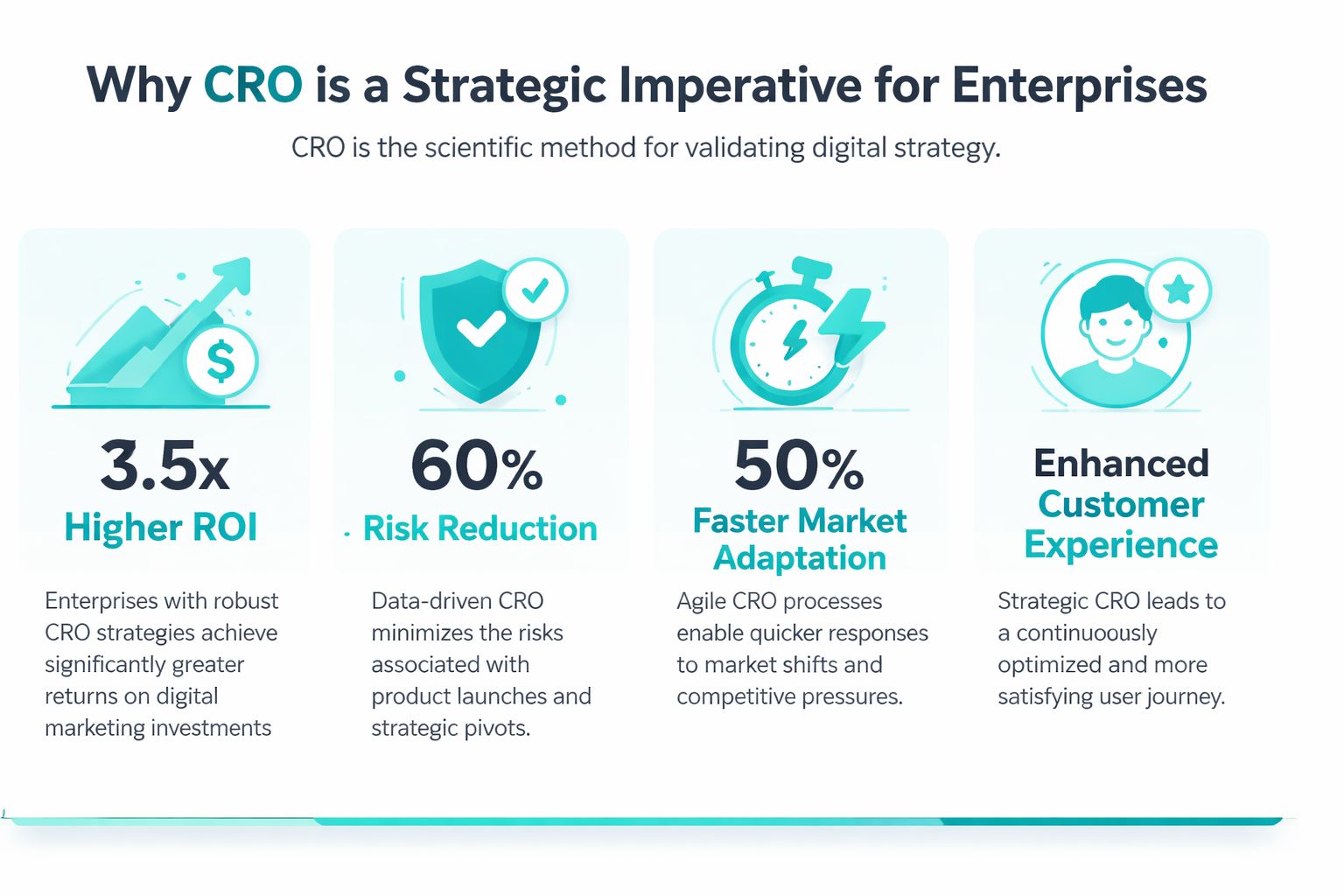
At enterprise scale, CRO is how digital leaders prove that experience investment is doing real work. A redesign can look excellent and still fail commercially. A content-rich Sitecore implementation can publish at scale and still create friction in critical journeys. CRO closes that gap by tying experience decisions to measurable outcomes.
The starting point is simple but often mishandled. Conversion rate = (conversions ÷ total visitors or sessions) × 100. The important part is choosing the right denominator for the business question, because comparing visitors in one place and sessions in another can distort performance across channels, devices, or funnel stages, as explained in Contentsquare's CRO guide.
That formula matters because enterprise organizations rarely have one conversion. They have a set of business actions across acquisition, service, partner engagement, and retention. A healthcare group may care about appointment requests and service navigation. A manufacturer may care about distributor inquiries, gated asset downloads, and quote requests. A public institution may care about task completion, accessibility, and reduced support dependence.
CRO validates investment decisions
When leaders ask whether the DXP is paying off, CRO gives a disciplined answer. It connects content structure, UX choices, personalization, and technical performance to business outcomes. It also makes weak assumptions visible. If teams can't define the conversion event cleanly or can't trust the measurement path, they aren't optimizing. They're interpreting noise.
A useful way to frame enterprise CRO is this:
- It reduces guesswork: Teams stop shipping changes because a stakeholder prefers them.
- It protects budget efficiency: Existing traffic becomes more valuable when journeys convert more cleanly.
- It informs platform governance: Patterns from tests tell teams what should become part of design systems, component libraries, and content rules.
A short reference on tying digital work back to financial outcomes is Kogifi's guide to measuring digital ROI.
Later in the buying cycle, CRO also helps marketing leaders align with IT and product. Instead of vague requests for “better engagement,” teams can define the conversion event, identify the friction point, and decide whether the issue sits in content, architecture, workflow, personalization, or measurement.
Here's a concise walkthrough that captures the shift from traffic thinking to conversion thinking:
Practical rule: If your team can't say exactly what action should happen next for a given audience, you're not ready to optimize that journey.
The Three Pillars of Modern Enterprise CRO
Enterprise CRO works when three things operate together. You need evidence, you need a test discipline, and you need a delivery platform capable of acting on what you learn. Remove one pillar and the program weakens fast.
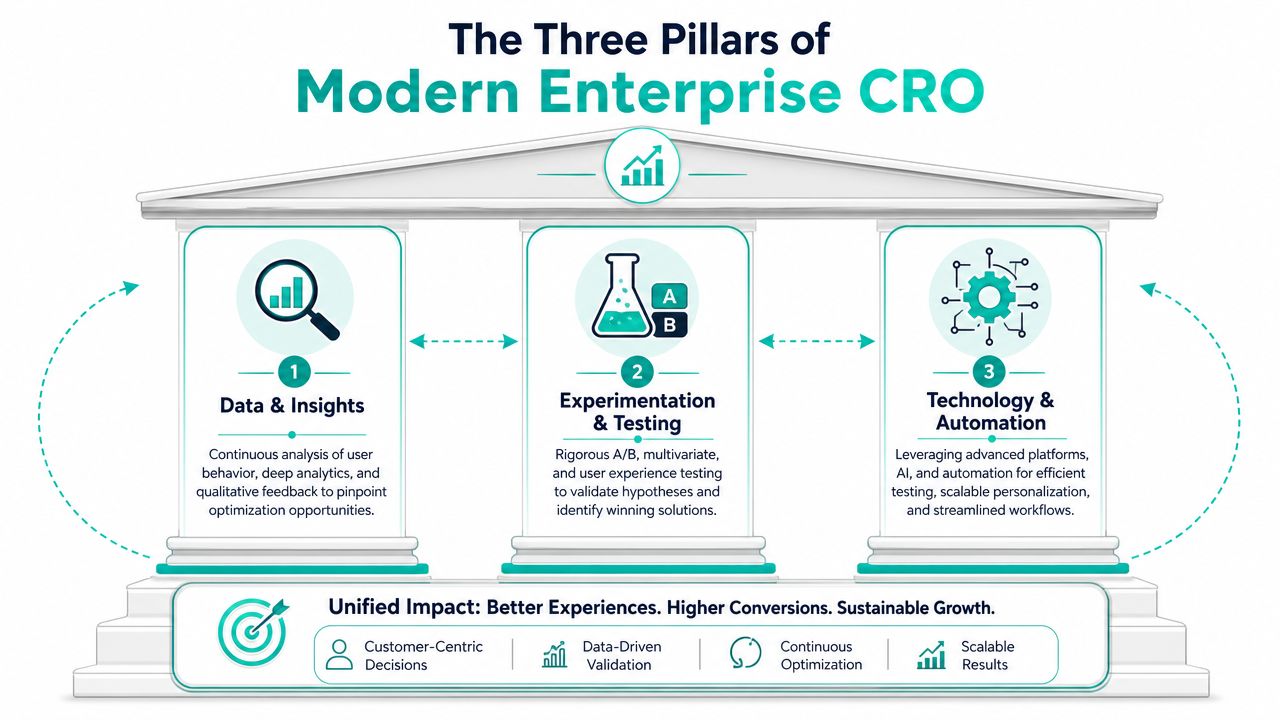
Data and insight before design changes
Most failed optimization programs fail early. They jump from a dashboard dip to a redesign request without understanding user behavior. Enterprise teams need both quantitative and behavioral evidence.
That means reading funnels alongside signals such as scroll depth, hesitation, rage clicks, and abandonment patterns. It also means resisting the temptation to treat page-level analytics as a full explanation. As outlined in Dynamic Yield's CRO planning lesson, strong CRO teams combine funnel analysis with behavioral evidence, then move into testing with a pre-defined hypothesis, a primary metric, guardrails, and enough sample size and time to establish confidence.
For Sitecore environments, this first pillar usually touches more than the website. It often includes search behavior, content entry points, taxonomy quality, personalization rules, and handoffs into CRM or service systems. If a multilingual site has strong traffic but weak progression into product detail or enquiry paths, the issue may be relevance, navigation logic, or content governance rather than page design alone.
Structured experimentation beats random testing
Testing is where many enterprise teams say they do CRO. In reality, they often run isolated experiments with weak hypotheses and unclear success metrics.
A disciplined test program looks different:
| Element | Weak approach | Strong enterprise approach |
|---|---|---|
| Hypothesis | “Change hero banner” | “If we reduce message ambiguity for returning visitors, more of them will progress to the next decision step” |
| Success metric | General engagement | One primary conversion metric plus guardrails |
| Audience | Everyone mixed together | Segment-aware, based on journey context |
| Interpretation | Winner picked quickly | Result reviewed for causality and side effects |
This matters in Sitecore because mature teams don't just test pages. They test audience treatment, content sequencing, offer relevance, and component behavior across journeys.
For teams working across commerce and mobile experience patterns, the principles used in enterprise DXP programs also show up in practical resources on boosting Shopify mobile sales. The stack may differ, but friction patterns such as intent mismatch, form burden, and mobile interaction issues translate well.
AI-powered personalization changes the operating model
The third pillar is where enterprise CRO moves beyond classic A/B testing. Testing asks, “Which version performs better?” Personalization asks, “Which experience should this person see right now?”
That's a different operating model. Instead of choosing one global winner, the organization can route different users into different experiences based on behavior, referral context, geography, customer status, or predicted intent. Sitecore is especially strong here because personalization can sit close to content operations rather than as a disconnected overlay.
A useful decision point is this:
- Use testing when you need to validate a hypothesis and isolate cause.
- Use personalization when you already know experience needs to vary by audience or context.
- Use AI-enabled decisioning when the volume and variability exceed what teams can manage manually.
For teams considering adaptive allocation models alongside standard testing, Kogifi has a technical primer on multi-armed bandit testing and where it fits in modern optimization programs.
When personalization starts before measurement discipline is in place, teams scale inconsistency instead of performance.
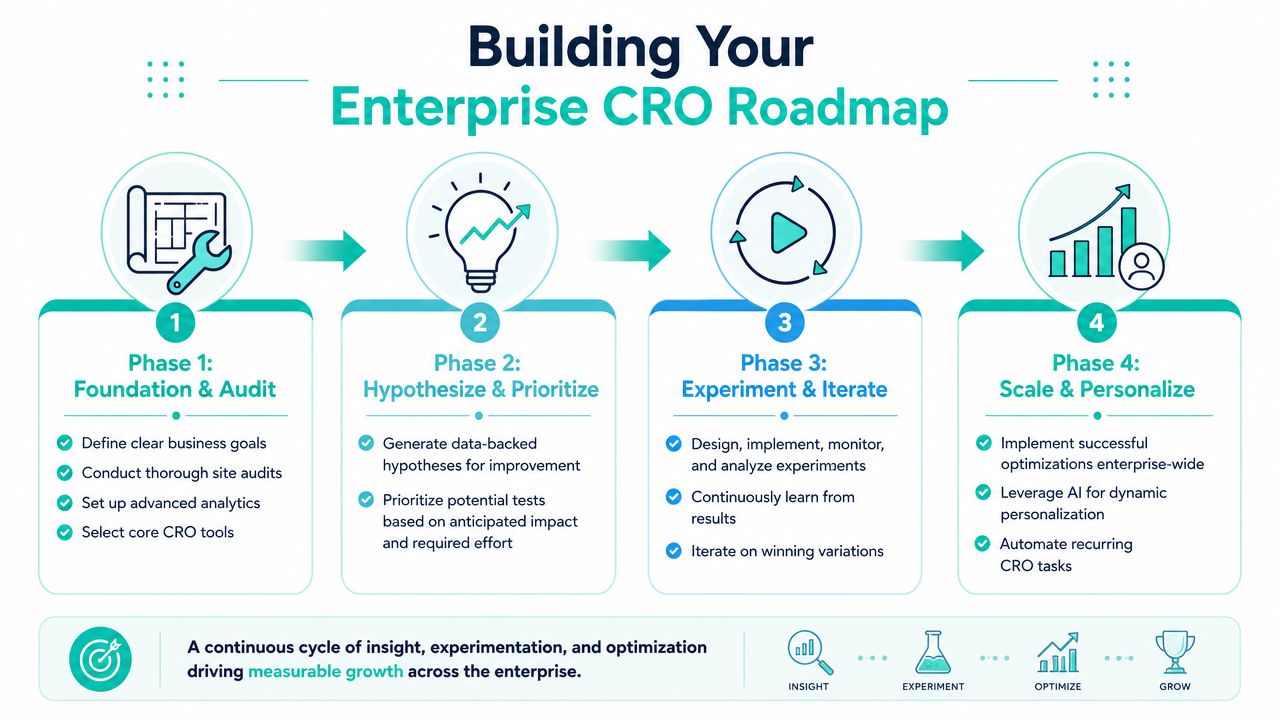
Building Your Enterprise CRO Roadmap
A real CRO program isn't a queue of disconnected experiments. It's a maturity model. Enterprise organizations need sequencing because the hard part usually isn't coming up with ideas. It's creating a system where ideas can be measured, prioritized, tested, implemented, and governed across many teams and properties.
Existing explainers often focus on forms and purchases, but enterprise DXPs are frequently responsible for multi-step, multilingual, content-heavy journeys involving role-based personalization and offline-to-online handoffs, which calls for a more sophisticated roadmap, as noted in Optimizely's CRO glossary.
Phase one starts with trustworthy measurement
Before teams optimize anything, they need a measurement model that can survive scrutiny. Enterprise journeys often span domains, channels, regions, and devices. They also involve consent constraints and partial visibility.
The first phase usually includes:
- Defining core conversion events: Not just macro outcomes, but the steps that indicate progression.
- Mapping data ownership: Which system owns visitor behavior, identity, form events, CRM outcomes, and content metadata.
- Aligning reporting logic: Marketing, analytics, product, and regional teams need the same definitions.
This is also where many programs discover that their dashboards are not decision-grade. Client-side tags may be incomplete. Attribution may break between content and commerce. Journey stitching may be inconsistent. If the measurement layer is weak, even successful tests become difficult to trust.
Phase two focuses on prioritized opportunities
After the audit, teams should resist the urge to fix everything. Early momentum comes from a narrow set of high-friction journeys with visible business importance.
A useful prioritization lens looks like this:
| Priority lens | What to ask |
|---|---|
| Business value | Does this journey influence lead quality, revenue, service completion, or retention? |
| Friction severity | Is there clear behavioral evidence of confusion or abandonment? |
| Delivery effort | Can the team act without a major replatforming decision? |
| Learning value | Will the result teach something reusable across other journeys? |
In Sitecore programs, these early opportunities often sit in campaign landing flows, pricing or product discovery pathways, gated content journeys, and localized versions of high-value pages. Kogifi's article on conversion optimization strategy is a practical reference for this prioritization step.
Phase three scales process across teams
Once the organization sees useful wins, the next challenge is governance. Who proposes tests. Who approves them. Which metrics count. How are results documented. Which patterns become standardized components or content rules.
A mature enterprise roadmap usually introduces:
- A testing calendar: So campaigns, releases, and experiments don't conflict.
- A review forum: To evaluate hypotheses, guardrails, and implementation readiness.
- A reusable component approach: Winning treatments become repeatable, not one-off fixes.
CRO transitions from episodic to operational. Teams stop “doing some tests” and start running an optimization program.
Phase four embeds personalization into delivery
The final phase is less about volume of tests and more about embedded intelligence. At this point, the organization can distinguish stable truths from audience-specific truths. It knows where global consistency matters and where audience adaptation creates value.
For Sitecore teams, this phase usually brings together CDP, personalization, content operations, and experimentation. The platform starts acting on intent signals more directly. Marketing teams can coordinate offers and content variants. Product and IT can support more resilient delivery patterns. Editorial teams can produce content for decision models instead of for static page templates alone.
Activating Your Roadmap with Sitecore AI
Sitecore changes CRO from a separate workstream into part of the experience stack itself. That matters because enterprise optimization breaks down when data sits in one place, testing in another, personalization in a third, and content operations somewhere else entirely.

Sitecore turns signals into actions
In a Sitecore ecosystem, behavior isn't just reported. It can be used to shape the next interaction. Sitecore CDP helps unify customer context. Sitecore Personalize can then use that context to alter content, offers, and pathways in real time. That closes the loop between observation and action more effectively than a stack built from disconnected tools.
For enterprise leaders, that creates a practical shift:
- Analytics become operational: Signals influence decisions, not just reports.
- Content becomes dynamic: Teams can serve different journeys from the same governed content base.
- Experimentation becomes scalable: Tests can evolve into audience-level treatments rather than ending as one universal winner.
Sitecore AI offers significant value. It helps teams move beyond manually defined segments and static rules. Instead of relying only on predetermined audience logic, teams can use behavior and context to support next-best content or next-best action decisions. That's especially useful in long consideration journeys where a visitor's needs change across sessions.
Where Sitecore AI changes CRO in practice
In enterprise environments, the biggest CRO bottlenecks are usually speed, complexity, and governance. Sitecore AI helps with all three when it's deployed carefully.
Consider a common scenario. A global B2B organization has one product family, many regions, multiple stakeholder roles, and content split across campaign pages, product detail, resources, and contact paths. A generic optimization program might test headline variants on a few pages. A Sitecore-led program can do more. It can detect audience context, personalize modules, vary recommendations, and adapt the path while keeping content operations manageable.
That doesn't remove the need for discipline. AI doesn't rescue weak measurement or unclear hypotheses. It amplifies the system you already have. If your taxonomy is inconsistent, if your journey definitions are vague, or if your content model is too rigid, AI will expose those weaknesses fast.
A practical checklist for Sitecore activation looks like this:
- Connect behavior to identity carefully: Anonymous and known-user transitions matter in enterprise funnels.
- Model content for reuse: Personalization works better when content is modular, tagged, and governable.
- Define decision points: Don't try to personalize every component. Focus on high-impact moments.
- Protect editorial control: AI should support decisioning, not create unmanaged content chaos.
For organizations evaluating how personalization should fit into their content architecture, Kogifi has a useful overview of content personalization approaches.
Sitecore is most effective for CRO when teams treat personalization as a governed capability inside the DXP, not as a set of ad hoc campaign tricks.
Extending CRO Beyond Marketing with SharePoint Solutions
CRO principles also apply inside the enterprise. The difference is that the conversion event isn't usually a sale or a lead. It might be finding a policy, completing a workflow, discovering the correct form, or using the intranet instead of bypassing it.
Internal journeys have conversions too
In SharePoint environments, optimization starts by defining what success means for employees. If a user lands on the intranet homepage, what should happen next. If a new process launches, how will teams know employees understood it and completed the intended action. If a document hub exists, can users find the right asset without escalating to support or sending another internal email.
Those are conversion questions.
The method stays familiar. Review search behavior. Look at drop-off points in task flows. Collect user feedback. Identify where navigation labels create confusion. Test alternative layouts, content grouping, or task-first page structures. On intranets, small clarity improvements often matter more than visual redesigns.
Why this matters for enterprise operating efficiency
SharePoint optimization is often ignored because it doesn't sit inside the marketing budget. That's a mistake. Internal friction creates downstream cost, delays, and poor adoption of business-critical processes.
A strong enterprise optimization practice applies the same discipline externally and internally:
- Define the action clearly: What should the employee complete, find, or understand.
- Measure the path: Where does confusion appear in navigation, search, or workflow steps.
- Improve the experience: Adjust information architecture, content design, and page logic.
- Retest over time: Internal user behavior changes when policies, org structures, and tools change.
For organizations running both Sitecore and SharePoint, this creates a useful advantage. The same optimization mindset can improve customer journeys and employee journeys without treating them as separate disciplines.
Your First Steps in Launching an Enterprise CRO Program
Most enterprise teams don't need more ideas. They need a starting point that produces confidence. That's especially important in a privacy-constrained environment where weak client-side analytics can create false certainty.
A major gap in mainstream CRO advice is measurement quality. In enterprise settings, teams often need stronger experiment design and server-side measurement because client-side analytics can be distorted by consent loss and ad blockers, as noted in Wikipedia's CRO overview.
Start with one journey, not the whole estate
Choose one journey with clear commercial or operational value. It might be a demo request path, a product discovery journey, a service application flow, or a partner resource route. Don't start with the homepage unless the homepage is clearly the friction point.
Then ask four direct questions:
- Can we define the conversion event cleanly
- Can we trust the measurement path
- Can we identify behavioral friction with evidence
- Do we have the platform capability to test and personalize responsibly
This immediately separates organizations ready to act from those still dealing with reporting ambiguity.
Build the business case around confidence
The strongest internal case for CRO isn't “we should test more.” It's “we need a reliable system for deciding what improves business outcomes.” That framing lands with both marketing and IT because it addresses cost, governance, and risk at the same time.
A useful first-step checklist is short:
- Audit data maturity: Validate whether numbers are complete enough to support decisions.
- Map one high-value journey: Include content, systems, audiences, and handoffs.
- Review platform capability: Check what your Sitecore environment already supports for experimentation, personalization, and measurement.
- Assign ownership: Someone must own the program, not just the next test.
If the answers are uneven, that's normal. It usually means the organization doesn't need more tools first. It needs a clearer operating model.
If your team is trying to turn Sitecore, SharePoint, or a broader DXP estate into a measurable growth engine, Kogifi can help assess journey friction, measurement quality, personalization readiness, and platform fit so your CRO program starts with a realistic roadmap instead of disconnected tests.