


Your team probably knows the symptoms already. Marketing has content in Sitecore, product documents in SharePoint, campaign assets in another repository, and customer data scattered across CRM, analytics, and commerce systems. A regional team launches a page with the wrong taxonomy. Another team personalizes against stale profile data. Legal asks for a retention answer, and nobody can give a confident one without emailing five platform owners.
That's usually when someone asks, what is Enterprise Information Management, and do we need it? In a modern DXP estate, the answer is yes. Not because EIM is fashionable, but because cloud platforms, composable architecture, and AI features all depend on governed information. If your metadata is weak, your content model is inconsistent, or your permissions don't line up across systems, the platform may still run, but it won't scale cleanly.
Table of Contents
- How Sitecore turns governed information into usable experiences
- Where SharePoint becomes the operational backbone
Why Your Enterprise Is Drowning in Information Chaos
A common enterprise pattern looks like this. The global brand site runs on Sitecore. Internal teams rely on SharePoint Online. Regional marketers keep copies of assets in local drives because they don't trust the main repository. Content authors create near-duplicates because they can't find the approved version. Security teams define access rules in one place, while platform teams model content in another.
That's not just untidy architecture. It directly affects delivery. New site launches slow down because nobody agrees on source content, product naming, or taxonomy. Personalization misses because the audience attributes behind it aren't consistent. Search underperforms because assets, pages, and documents aren't tagged in a way the platform can use.

What the chaos usually looks like
- Content sprawl: Teams publish the same message in several formats, but no one owns the canonical version.
- Broken discoverability: Search returns too much, too little, or the wrong thing because metadata is patchy.
- Weak governance: Retention, consent, auditability, and access controls exist as policy documents, not enforceable platform behavior.
- DXP friction: Sitecore or SharePoint becomes the place where information problems surface, even when those problems started upstream.
This is where Enterprise Information Management matters. EIM is the operating model for handling information across systems, teams, and lifecycles. It gives structure to content, data, records, metadata, permissions, and policy so that digital platforms can consume trusted inputs instead of inherited chaos.
Most platform problems blamed on CMS limitations are really information management failures. The platform exposes them. It doesn't create them.
The market growth around EIM shows that enterprises are treating it as a mainstream investment, not a side initiative. The global Enterprise Information Management Solution market was valued at approximately USD 17.8 billion in 2024 and is projected to grow to about USD 69.4 billion by 2034, reflecting a CAGR of 14.6%, according to Market.us research on the Enterprise Information Management Solution market.
Why this matters more in composable delivery
Composable and cloud-native stacks improve flexibility, but they also expose inconsistency faster. In a monolith, teams sometimes hide bad information practices inside one platform. In a composable model, content, customer data, search, DAM, and analytics move across APIs. Weak naming, poor metadata, and unclear ownership don't stay contained. They spread.
That's why EIM isn't an IT clean-up project. It's the discipline that lets digital teams move faster without losing control.
The Core Components of Enterprise Information Management
EIM isn't one product. It's a coordinated set of practices that make enterprise information usable, governed, and reusable across systems. If you try to solve it with only a CMS upgrade or only a migration to Microsoft 365, you usually end up preserving the same problems in newer tools.
Think of EIM like running a digital library
The simplest way to explain it is as a digital library built for enterprise operations.
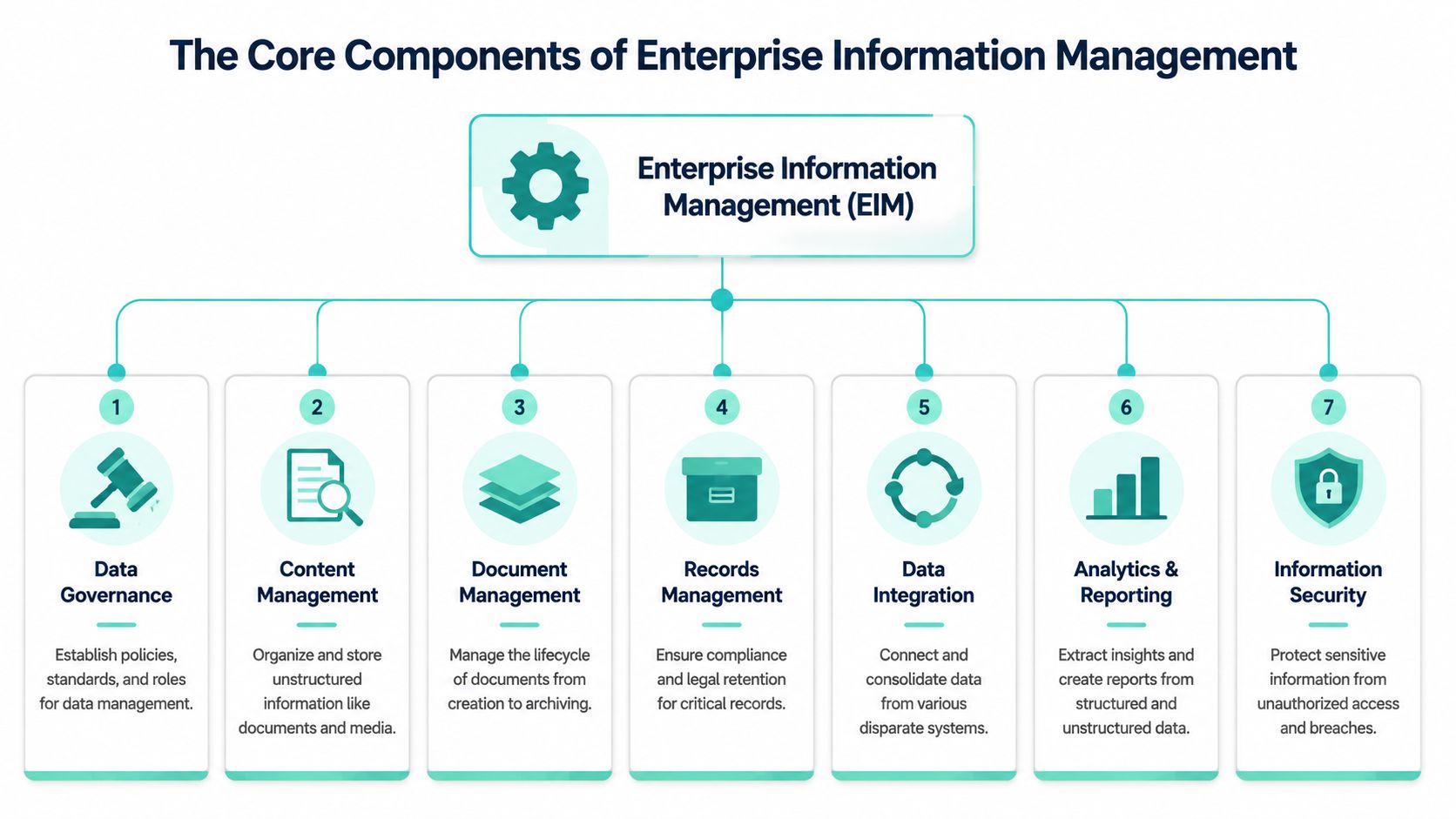
- Content management: This is the collection itself. Web pages, PDFs, policies, images, campaign assets, product sheets, knowledge articles.
- Master data management: This keeps core business entities consistent. Customer, product, location, brand, supplier.
- Metadata management: This is the catalog. It tells you what the thing is, who owns it, where it belongs, what it relates to, and how it should be used.
- Taxonomy: This is the shelving system. It defines categories, hierarchies, tags, and relationships so users and systems can locate information predictably.
- Integration: This is how materials move between the library, front desk, archive, and research rooms. In digital terms, it's the connection between Sitecore, SharePoint, CRM, DAM, search, analytics, and identity services.
- Governance: These are the rules. Naming standards, lifecycle policy, stewardship, approval paths, retention, and audit controls.
- Security: This determines who can see, edit, approve, publish, retain, or dispose of information.
The important point is interdependence. Strong content management with weak metadata still produces clutter. Good taxonomy without governance becomes optional. Tight security without integration creates bottlenecks.
What strong foundations look like in practice
The clearest definition of EIM is that it integrates data governance, metadata management, and master data management into a unified framework. The practical payoff comes when teams treat metadata as a first-class design element and embed schemas and lineage into platform architecture, as described in the AHIMA guide to Enterprise Information Management and information strategy.
That point gets missed constantly in DXP projects. Teams spend months debating component libraries and front-end frameworks, then leave metadata design until late delivery. The result is familiar. Reusable components exist, but authors can't classify content consistently enough to drive search, personalization, or archive rules.
If your team is working through policy, retention, and ownership questions in parallel with platform work, F1Group's information governance services are a useful reference for the governance side of the equation. For the platform layer, a practical next step is to tighten your understanding of metadata management in enterprise systems.
Practical rule: If a field, tag, or classification affects search, personalization, permissions, reporting, or retention, it isn't “just CMS config.” It's part of your EIM design.
EIM vs ECM MDM DXP Clearing the Confusion
Teams often talk past each other because they're using related terms as if they mean the same thing. They don't. That confusion gets expensive during platform selection and even more expensive during migration.
A simple way to separate the terms
EIM is the broad discipline. ECM focuses on managing enterprise content and documents. MDM keeps key business entities consistent. DXP delivers customer-facing digital experiences using the information it receives. In practice, EIM sits above the others as the operating model that aligns them.
| Term | Primary Focus | Typical Scope | Relationship to EIM |
|---|---|---|---|
| EIM | Managing information as an enterprise asset | Structured and unstructured information, metadata, governance, lifecycle, access, integration | The overarching strategy |
| ECM | Managing documents and content | Document repositories, records, workflows, authoring, archive controls | One important capability inside EIM |
| MDM | Maintaining trusted core entities | Customer, product, supplier, location, reference data | Another capability inside EIM |
| DXP | Delivering digital experiences | CMS, personalization, search, analytics, engagement tools | A consuming layer that depends on good EIM |
This distinction matters a lot in Sitecore estates. Sitecore can author, assemble, personalize, and deliver excellent experiences. It can't, on its own, resolve enterprise-wide ownership conflicts around customer definitions, document retention, regional taxonomies, or duplicated records spread across business systems.
The same is true in SharePoint. SharePoint can provide strong collaboration and document management, but if departments use different naming standards, separate sensitivity models, and inconsistent document types, the platform turns into a neatly organized set of silos.
A lot of published guidance still underplays the day-to-day connection between governance and platform design in composable stacks. That gap leads to fragmented logic and duplicated components as platforms scale globally, as noted in this overview of enterprise information management. In delivery terms, that shows up as different teams implementing similar rules in different ways across forms, content types, components, and workflows.
For teams sorting out where ECM fits into the broader architecture, this primer on enterprise content management solutions is a useful comparison point.
If your DXP team owns templates, search facets, and personalization rules, they already influence information governance whether they call it EIM or not.
The Business Benefits and KPIs of a Strong EIM Strategy
A strong EIM strategy pays off in places that digital teams feel every week. Content gets reused instead of recreated. Search gets more reliable. Regulatory conversations become easier because teams can explain ownership, lineage, and retention without assembling a small task force.
Where the value shows up first
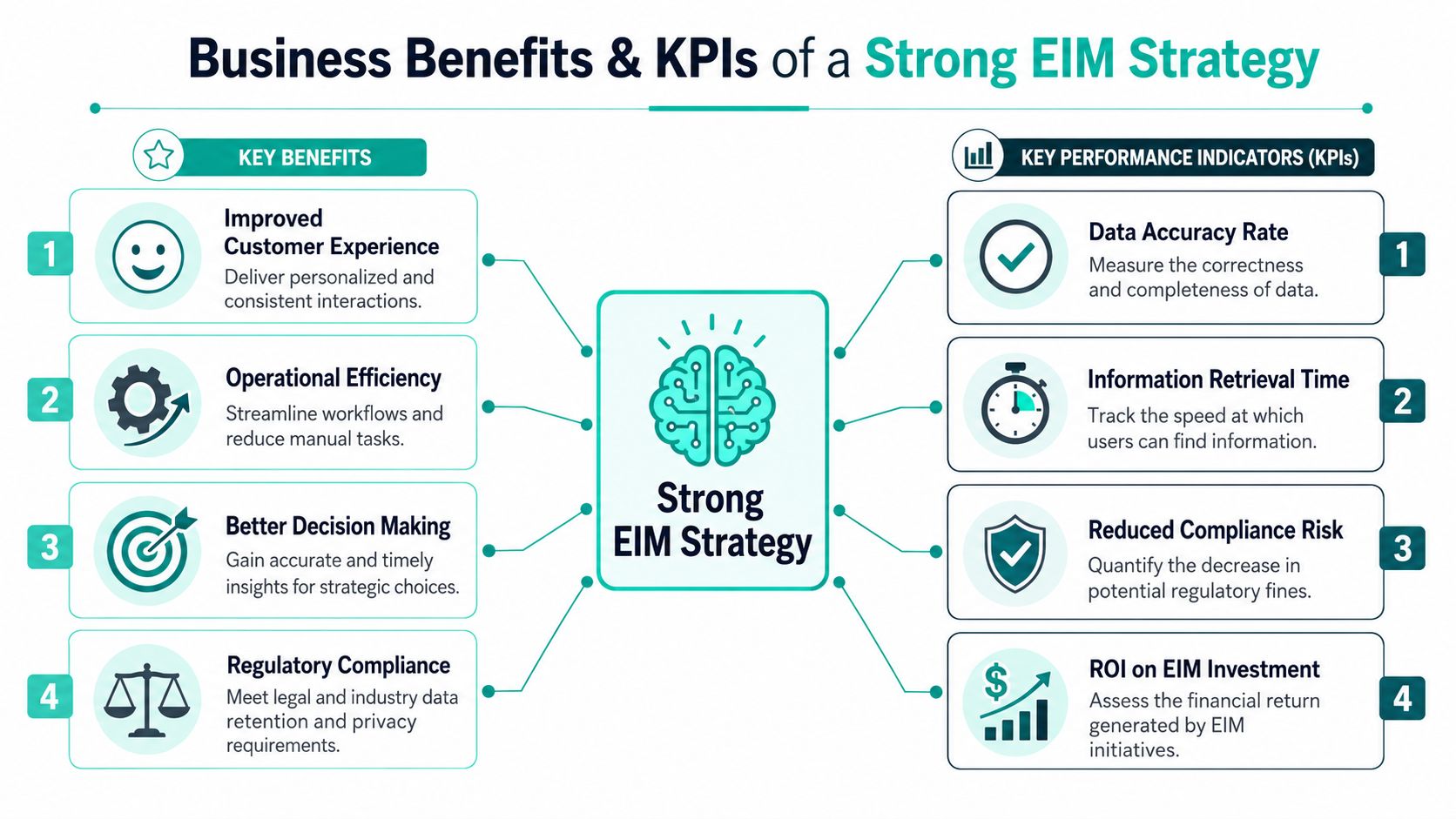
The governance benefits are not theoretical. Over 60% of organizations implementing EIM frameworks saw measurable improvements in data governance maturity within three years, and EIM-enabled organizations reduce the risk of non-compliance by up to 40% compared with peers using siloed approaches, according to research published via ScienceDirect on EIM readiness and governance outcomes.
For enterprise marketing and digital teams, that usually translates into four practical gains:
- Faster publishing operations: Authors spend less time hunting for approved assets, clarifying ownership, or recreating existing content.
- Better personalization inputs: Audience logic becomes more trustworthy when profile attributes, consent handling, and taxonomy are consistent.
- Lower compliance friction: Retention and access rules are easier to apply when content types and records are clearly defined.
- Stronger reporting: Analytics improves when content classifications are stable enough to compare performance across brands, regions, and channels.
KPIs that digital teams can actually use
Not every team needs the same scorecard. A global Sitecore program and a SharePoint intranet rollout won't measure success in identical ways. But these KPIs are practical because teams can own them:
- Content retrieval time: How long it takes authors, editors, or employees to find the right asset or document.
- Content reuse rate: How often approved content, components, or assets are reused rather than rebuilt.
- Publishing cycle time: The elapsed time from content request to approved publication.
- Metadata completion rate: Whether required classifications are applied before content can move downstream.
- Compliance exception volume: The number of retention, access, or audit issues raised during reviews.
- Search refinement success: Whether users find relevant results through filters, facets, and managed properties instead of repeated manual searching.
A mistake I see often is choosing only executive KPIs like “customer experience improvement” without any operational measures underneath. That leaves teams with a vision statement, not a management system.
Good EIM KPIs tie business outcomes to platform behavior. If nobody can connect a compliance target to a field, rule, workflow, or repository owner, the KPI won't drive change.
EIM in Action with Sitecore and SharePoint
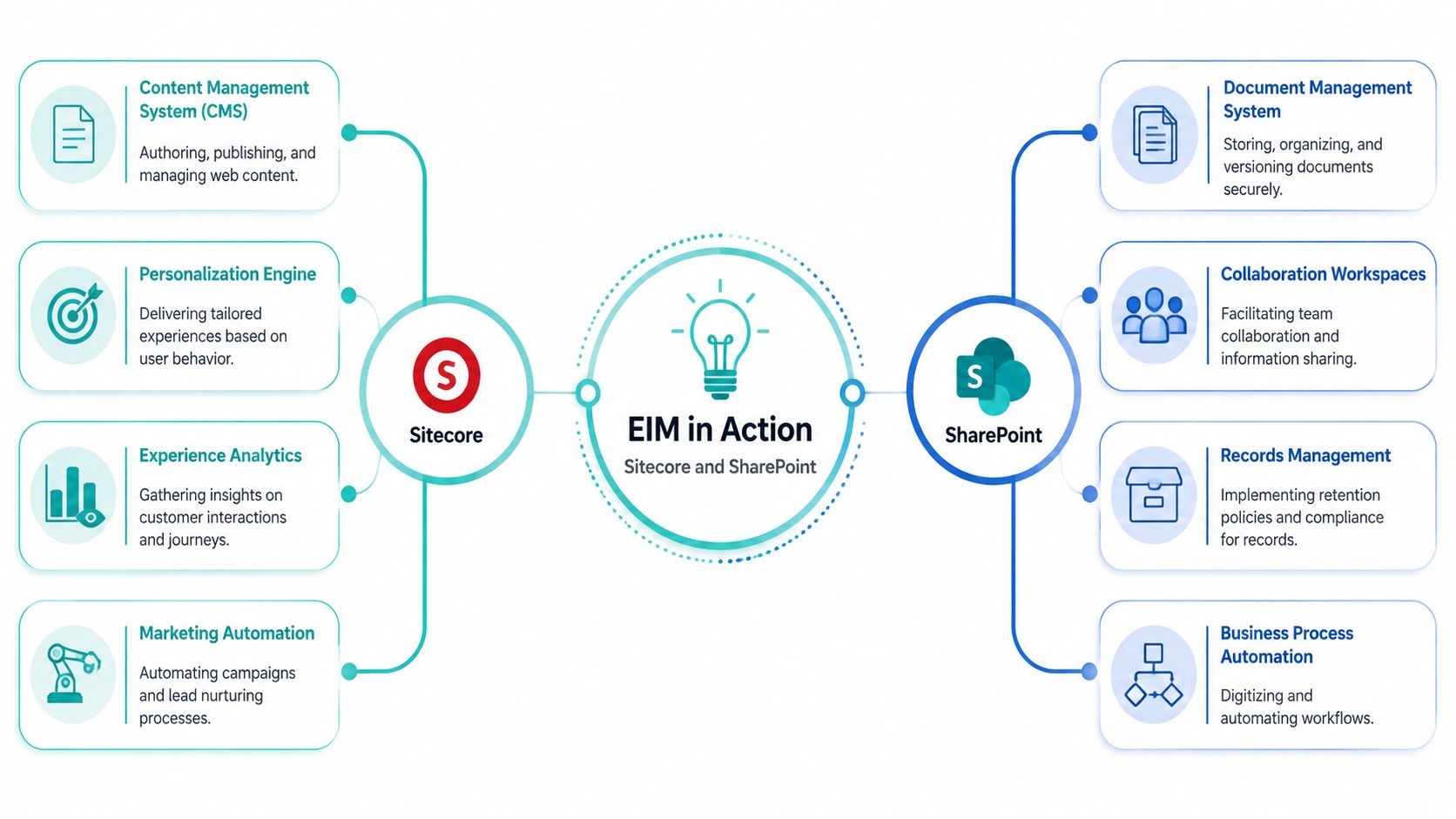
The value of EIM becomes obvious when you map it to the tools teams already use. In modern delivery, Sitecore handles experience orchestration and content delivery, while SharePoint often governs internal documents, collaboration, and operational knowledge. They solve different problems, but they work better when they share a common information model.
How Sitecore turns governed information into usable experiences
In Sitecore ecosystems, EIM starts with structure. Sitecore Content Hub can act as the metadata-rich control layer for assets, product content, and taxonomy. That matters because Sitecore XM Cloud, Search, and Personalize all perform better when the source material is consistently classified and owned.
Sitecore AI capabilities also depend on this foundation. AI-assisted content operations, intelligent retrieval, automated recommendations, and experience orchestration are only as good as the metadata, access model, and lineage behind them. If two business units use different labels for the same content type or apply inconsistent audience signals, AI won't create clarity. It will scale inconsistency.
The practical pattern that works is simple:
- Model content intentionally: Define content types, reusable fields, taxonomy terms, and ownership before component rollout gets too far.
- Separate canonical content from presentation: Don't bury business meaning inside page-specific rendering decisions.
- Connect metadata to downstream behavior: Tags should drive search facets, personalization rules, content lifecycle, and reporting.
- Tie access to identity and stewardship: Editing rights, approval flows, and publish privileges should reflect real operational ownership.
Content lifecycle design becomes part of EIM, not a side concern. Teams planning authoring, review, reuse, archive, and retirement flows should look at content life cycle planning for enterprise platforms.
Where SharePoint becomes the operational backbone
SharePoint Online is rarely the flashy part of the stack, but it often carries the operational load. Policies, SOPs, templates, contracts, project records, and internal knowledge usually live there. If it's implemented as a dumping ground, enterprise knowledge disappears into folders and duplicate libraries. If it's designed with content types, managed metadata, versioning, retention, and automation, it becomes a stable EIM backbone.
SharePoint works especially well when teams use it for governed collaboration rather than uncontrolled storage. Document sets, records handling, approval flows, Microsoft 365 permissions, and Power Platform automations can support clear ownership and consistent lifecycle handling.
The technical payoff of EIM is strongest when metadata management is tightly coupled with IAM and data lineage tools. Organizations that systematically apply metadata tagging to 80%+ of core content report up to a 25-30% reduction in information retrieval time, according to Investopedia's technical overview of Enterprise Information Management.
Sitecore should excel at engagement. SharePoint should excel at governed collaboration. EIM is what stops each platform from being forced into the other's job.
Implementing EIM During a DXP or Cloud Migration
The worst time to ignore EIM is during a migration. Teams are already moving content, rebuilding templates, rationalizing integrations, and redefining hosting or delivery models. If they postpone governance and information modeling until after launch, they usually migrate disorder into a more expensive stack.
A rollout model that works
A practical implementation model has four phases.
Discovery and audit
Inventory content types, repositories, taxonomies, approval paths, duplicate assets, retention classes, and access patterns. Don't limit this to public web content. Include documents, forms, knowledge articles, media, and operational records that influence the experience layer.Information modeling
Define the shared language. This includes content models, metadata schemas, taxonomy, ownership, naming rules, lifecycle states, and cross-system mapping between Sitecore, SharePoint, CRM, DAM, search, and analytics.Phased rollout
Start with high-value domains. Product content, regulated documents, or key customer journeys usually justify the effort fastest. Don't aim for total enterprise perfection before launch. Aim for strong patterns that can scale.Continuous governance
Treat governance as an operating rhythm. Review taxonomy drift, orphaned content, field misuse, permission sprawl, and workflow bottlenecks on a schedule.
A migration also needs architecture discipline. If your team is moving to XM Cloud, Azure services, or a composable front end, these cloud migration best practices are worth aligning with your EIM decisions.
A vendor and solution checklist
When evaluating platforms or implementation partners, look for these capabilities:
- API-first architecture: Information should move cleanly across systems without manual re-entry.
- Cloud-native scalability: The platform should support distributed teams, multiple brands, and evolving workloads.
- Metadata support: You need strong content types, managed fields, taxonomy controls, and search-friendly structure.
- Governance controls: Retention, auditability, permissions, approval workflows, and stewardship should be enforceable, not merely documented.
- Identity alignment: Access should map to real business roles and integrate with enterprise identity services.
- Operational visibility: Teams need logs, lineage awareness, and enough reporting to spot drift before it spreads.
What doesn't work is the technology-first shortcut. Buying better tooling without defining ownership, taxonomy, and policy only gives you a cleaner interface for the same confusion.
EIM The Foundation for Your Future Digital Experience
If you strip away the acronyms, Enterprise Information Management is a straightforward idea. Treat information as an enterprise asset, not as an accidental byproduct of separate systems. In practice, that means structured models, trusted metadata, clear ownership, lifecycle controls, and platform behavior that reflects policy instead of bypassing it.
That's why the question what is Enterprise Information Management matters so much in modern DXP work. Sitecore can deliver advanced personalization, search, and AI-assisted experiences. SharePoint can govern collaboration and corporate knowledge at scale. But neither platform can compensate for unmanaged information spread across disconnected teams and inconsistent rules.
The organizations that get this right don't treat EIM as a one-time governance exercise. They build it into content design, component architecture, security decisions, search tuning, migration planning, and operating model reviews. That's what makes a composable stack usable over time.
For digital teams planning Sitecore AI adoption, XM Cloud modernization, or a SharePoint knowledge architecture refresh, EIM is the part that turns platform investment into durable capability. Without it, the stack stays fragmented. With it, the stack starts behaving like a system.
If your organization is trying to bring order to Sitecore, SharePoint, or a broader composable DXP estate, Kogifi can help you design the information models, governance controls, and implementation patterns that make those platforms work as a connected enterprise system.