


Experience design is the systems-level discipline that engineers the entire customer journey across products, channels, and time. It matters now because organizations that treat it as a business function, not just a visual one, can influence both near-term conversion and long-term performance, with benchmarks like Forrester's often-cited $100 return per $1 invested in UX and McKinsey's reported outperformance by 32 percentage points in revenue growth and 56 percentage points in total shareholder returns over five years shaping how executives think about the work. Adobe's compilation also points to a 400% possible lift in conversion from intentional UX.
If you're already shipping websites, intranets, and portals, the pain probably isn't page quality. It's that the journey between those touchpoints still feels stitched together, with each team optimizing its own surface while the user experiences one broken relationship. That's the gap experience design fills for an enterprise DXP team, and it's why the platform discussion has to start with systems, not screens.
Table of Contents
- Research should produce a decision, not just insight
- Prototypes should be buildable, not decorative
- Testing should tie behavior to evidence
- Sitecore XM Cloud is built for composable orchestration
- AEM tends to express the same idea through content velocity
- SharePoint Online turns internal journeys into managed workflows
- Start with task and journey metrics
- Add operational metrics so the full picture is visible
- Don't separate web analytics from business data
- Treating experience design as visual polish
- Skipping accessibility audits
- Ignoring localization as a translation problem
- Bolting service design onto a monolithic CMS
Why Experience Design Is the Missing Layer in Enterprise Digital Teams
Most enterprise teams don't lack talent, and they usually don't lack tools. They have web editors, product owners, brand teams, analytics dashboards, and sometimes a service design function tucked inside operations or CX. What they often lack is a shared discipline that connects those efforts into one coherent journey.
That's why a well-designed homepage can coexist with a confusing sign-up flow, a helpful support portal can sit beside a disconnected intranet, and a polished campaign page can still leave users unsure what to do next. Experience design is the missing layer because it treats those assets as parts of one system, not separate deliverables. Kogifi's own framing of enterprise UX design makes the same point, that the core problem is usually orchestration across touchpoints, not a lack of visual polish. Kogifi's enterprise UX perspective is useful here because it maps the gap between page-level execution and journey-level design.
The symptom is inconsistency, not ugliness
A lot of enterprise friction comes from contradictory decisions. Marketing wants more conversion paths, operations wants fewer support calls, IT wants stable components, and local teams want room to adapt content for region and language. Without a systems lens, each request gets solved locally, and the user ends up absorbing the inconsistency.
Practical rule: If users need to relearn the interface every time they move from one property to another, the problem isn't the page design. It's the experience architecture.
This is also why teams sometimes confuse a redesign with progress. A redesigned page can be better branded and still fail at task completion, because the surrounding journey, handoffs, and back-office processes never changed. Experience design asks a more useful question, what should the user be able to do, across which touchpoints, and with what level of continuity?
The enterprise lens changes the brief
Once you adopt that lens, the brief changes. Instead of asking for a prettier interface, you start asking for consistent navigation models, reusable content patterns, aligned service touchpoints, and a measurement plan that spans channels. That is the difference between isolated output and an experience strategy.
The practical payoff is simple. Teams spend less time debating page art direction and more time aligning the rules that govern the whole journey. That shift is what makes experience design a business function, not a finishing step.
How Experience Design Connects Journeys to Business Outcomes
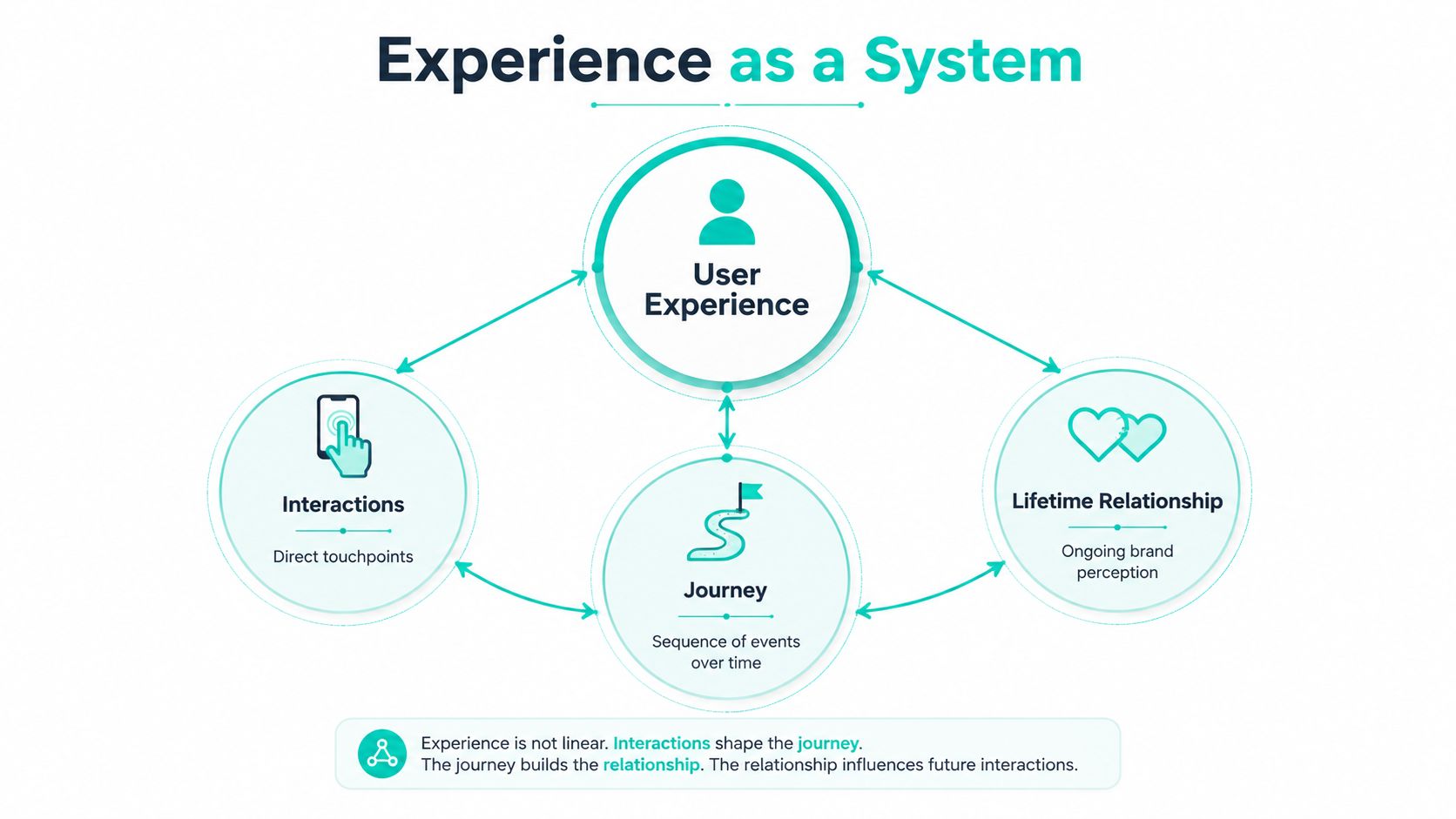
A user does not experience an enterprise as a set of departments. They experience it through a chain of decisions, content, interfaces, service handoffs, and follow-up touchpoints that either move the relationship forward or create friction.
NNGroup describes experience design as covering individual interactions, the user's journey over time, and the lifetime relationship with the organization. ISO 9241-210 defines user experience as a person's perceptions and responses resulting from the use or anticipated use of a product, system, or service. Put together, those definitions make one thing clear, experience design is not a screen-level exercise, it is the work of shaping both behavior and perception across the full relationship. NNGroup's experience design framing and the ISO definition embedded in the same body of guidance are the right reference points for this mental model.
The system view that enterprise teams need
In practice, that means the discipline has to connect several layers at once.
- Information architecture, so users can find what they need without re-learning the structure on every channel.
- Interaction design, so each action feels predictable and low-friction.
- Service blueprinting, so the backstage processes support the promised frontstage experience.
- Content strategy, so messaging, terminology, and guidance stay coherent across journeys.
- Measurement systems, so teams can see whether the experience is improving.
Understanding how to connect those journeys to measurable outcomes is covered in our guide on analytics and customer journey mapping.
If one of those layers is missing, the journey fractures. A well-structured content model will not save a broken approval workflow. A polished interface will not fix a content architecture that forces teams to duplicate pages for every market. Experience design becomes a cross-functional discipline because it forces product, content, operations, analytics, and governance to work from the same journey model.
The platform implication for composable delivery
This systems view matters most in composable stacks because the platform itself becomes part of the experience. Reuse, personalization, governance, and omnichannel delivery stop being abstract goals and become platform mechanics. That changes the way you design content models, component libraries, and release processes.
Experience quality depends less on a single page template than on how well the stack supports consistency across the journey.
In Sitecore XM Cloud, AEM, or SharePoint Online, that usually means the same thing in practice. One team needs to reuse a pattern safely, another needs to localize it without breaking brand rules, and a third needs to see whether the interaction changed adoption or conversion. The architecture has to support all three. That is the technical side of experience design, a disciplined way of aligning platform behavior to human intent.
Experience Design Versus UX Service Design and Customer Experience
These terms overlap, but they're not interchangeable. Enterprise teams get into trouble when they use them as if they were synonyms, because each one optimizes a different layer of the relationship.
UX design is strongest at the interaction level. It focuses on usability, clarity, and whether the person can complete a task without friction. Service design looks at the frontstage and backstage mechanisms that deliver the service, including handoffs, support, operations, and process reliability. Customer experience is broader still, it tracks the relationship and perception over time, across channels and moments that may never touch a screen.
A useful way to separate the roles
Experience design sits above all three as the systems discipline that coordinates them. It doesn't replace UX, service design, or CX. It organizes them so the user doesn't feel the seams.
| Discipline | Primary focus | Typical enterprise question |
|---|---|---|
| UX design | Individual interactions and usability | Can the user complete the task cleanly? |
| Service design | Delivery system and backstage operations | Can the organization fulfill the promise reliably? |
| Customer experience | Relationship and perception over time | How does the user feel about the brand across touchpoints? |
| Experience design | Whole journey orchestration | Do all of the pieces work together as one system? |
That distinction matters in planning. If a team only has UX capability, it may produce strong screens but miss operational friction. If it only has service design, it may improve the process but leave the digital journey awkward. If it only has CX reporting, it may describe the problem without changing the mechanics that created it.
How to read your own org chart
Most enterprises already have pieces of the puzzle. The question is whether those pieces are coordinated by one journey model and one measurement framework. If the answer is no, experience design is the missing governance layer, not another job title.
The strongest programs I've seen make the roles explicit. UX owns usability decisions, service design owns delivery fidelity, CX owns relationship insight, and experience design keeps the whole system aligned to business goals. That's the operating model that keeps the work from collapsing back into isolated output.
The Iterative Process That Turns Experience Design Into Measurable Improvement
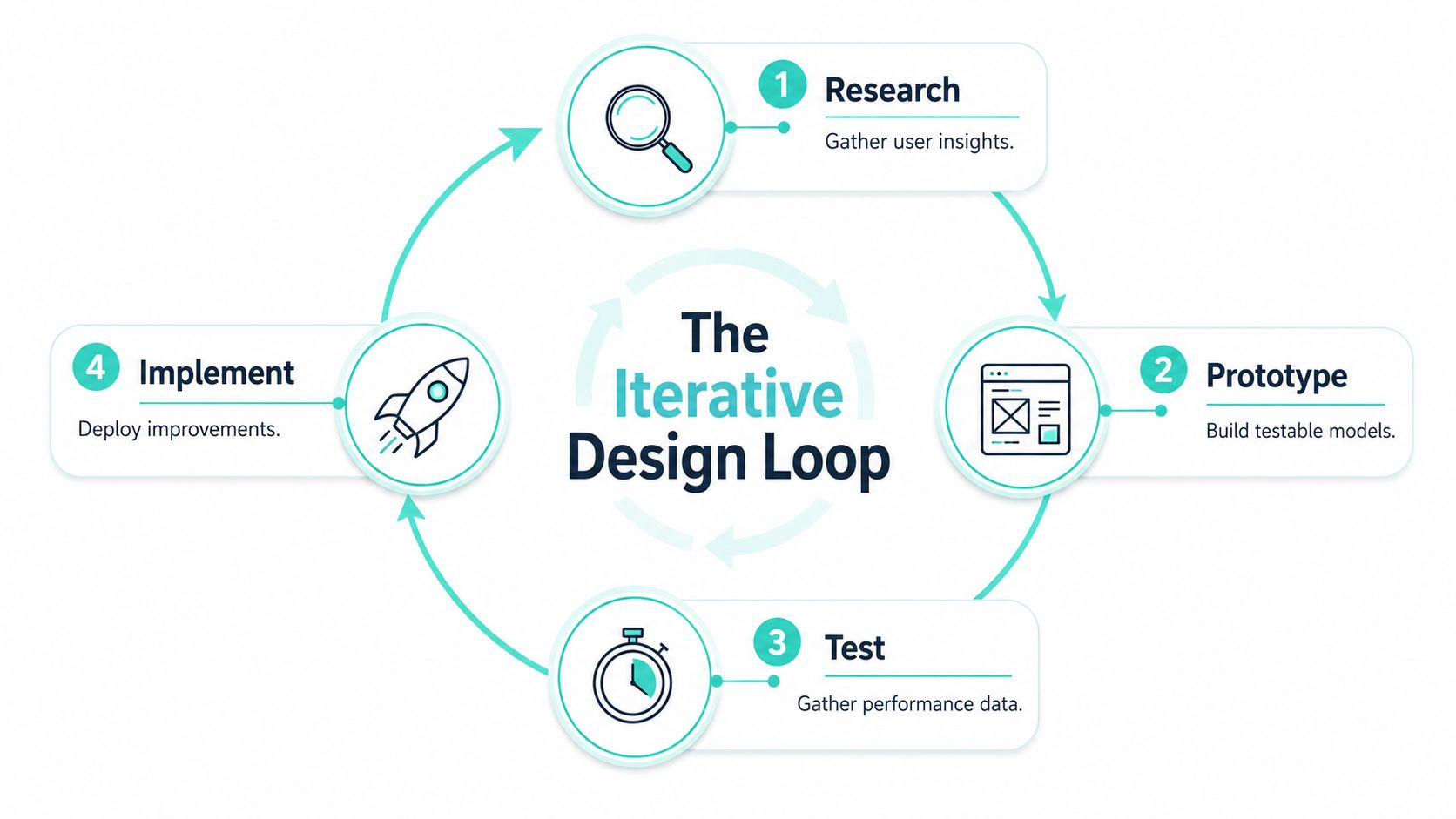
A project fails quickly when experience design is treated as the last mile. In enterprise delivery, it works better as an iterative loop, where each stage creates something concrete that can be checked before the next layer goes live. Qualtrics describes the core loop as defining the problem, prototyping solutions, and testing them with real users, while Foolproof treats experience design as measurable against physical and emotional outcomes, not just subjective preference. Qualtrics on experience design and Foolproof's measured approach point to the same discipline, validate before you commit.
Research should produce a decision, not just insight
Research should end with a problem definition the delivery team can act on. In enterprise work, that usually means a research-backed opportunity brief, a defined audience segment, and a content model that reflects real tasks instead of internal org charts. If research does not change the backlog, it probably stopped at observation.
Prototypes should be buildable, not decorative
Prototype work should result in reusable component specifications, not presentation-only mockups. Accessibility-aware interaction patterns belong here too, because they reduce rework later and force teams to confront keyboard flow, content hierarchy, and state behavior before implementation starts. Engineering and design start to use the same language at this point.
Testing should tie behavior to evidence
Testing has to do more than confirm taste. It should show whether the design improved task completion, reduced confusion, or increased adoption. That evidence can shape the next release, which is why experience design is a loop and not a one-time workshop.
For teams building the underlying system, an experimentation platform helps turn those test cycles into a repeatable operating rhythm. Kogifi's experimentation platform perspective is relevant because it connects research, release, and measurement instead of treating them as separate functions.
The cause and effect is straightforward. Better early research lowers downstream rework. Better prototyping reduces implementation risk. Better testing gives leadership evidence, not opinions. That is what turns experience design into an engineering discipline.
How Experience Design Maps Onto Sitecore XM Cloud AEM and SharePoint
A strong experience strategy only matters if the platform can express it. Sitecore XM Cloud, AEM, and SharePoint Online all support experience design, but they do it through different mechanics, and each one pushes teams toward a different operating model.
Sitecore XM Cloud is built for composable orchestration
Sitecore positions XM Cloud as its cloud-native, SaaS-based CMS for composable digital experience delivery. Its documentation says it uses the same Sitecore content architecture as Sitecore XP, shifts delivery to a cloud service model, and includes headless capabilities through the Sitecore Content SDK with integration to modern front ends such as Next.js. That makes it a strong fit when the experience design problem is really a composability problem, because the platform is designed for API-first delivery rather than monolithic page building. Sitecore's XM Cloud architecture details are the clearest public reference in the brief.
AEM tends to express the same idea through content velocity
Adobe Experience Manager is usually strongest when the enterprise needs structured content operations, component reuse, and the ability to move quickly across many properties. The design lesson is the same one, consistency across journeys, but the execution differs. AEM programs often live or die on how well teams standardize content models, authoring practices, and component governance so local teams can ship without fragmenting the experience.
SharePoint Online turns internal journeys into managed workflows
Microsoft documents SharePoint Online as part of Microsoft 365 and supports intranet and collaboration scenarios through SharePoint Framework (SPFx), the client-side model for extending SharePoint with custom components. Microsoft also says Power Platform can connect to SharePoint data and workflows, which makes it useful for approvals, document management, and automation in employee-facing journeys. That combination turns SharePoint from a static publishing surface into an orchestrated workplace experience.
| Capability | Sitecore XM Cloud | Adobe Experience Manager | SharePoint Online |
|---|---|---|---|
| Content delivery model | Cloud-native, composable, headless-capable | Structured enterprise content operations | Managed Microsoft 365 intranet and collaboration service |
| Experience mechanics | Reuse, personalization, omnichannel delivery | Content velocity and component governance | SPFx extensibility plus Power Platform workflows |
| Best fit | Customer-facing digital journeys | High-volume content ecosystems | Employee portals, approvals, and document-centered workflows |
| Implementation signal | Modern front ends, shared component libraries | Strong authoring and content reuse discipline | SPFx components and workflow automation |
For teams evaluating replatforming, that difference matters more than brand preference. Kogifi's AEM versus Sitecore comparison is relevant when the question is how to match the platform to the experience model, not just which CMS has the longer feature list.
The KPIs That Prove Experience Design Is Working
If experience design can't be measured, it becomes a style debate. The useful KPIs are the ones that tie user behavior to business outcomes and that your teams can instrument without hand-waving.
Start with task and journey metrics
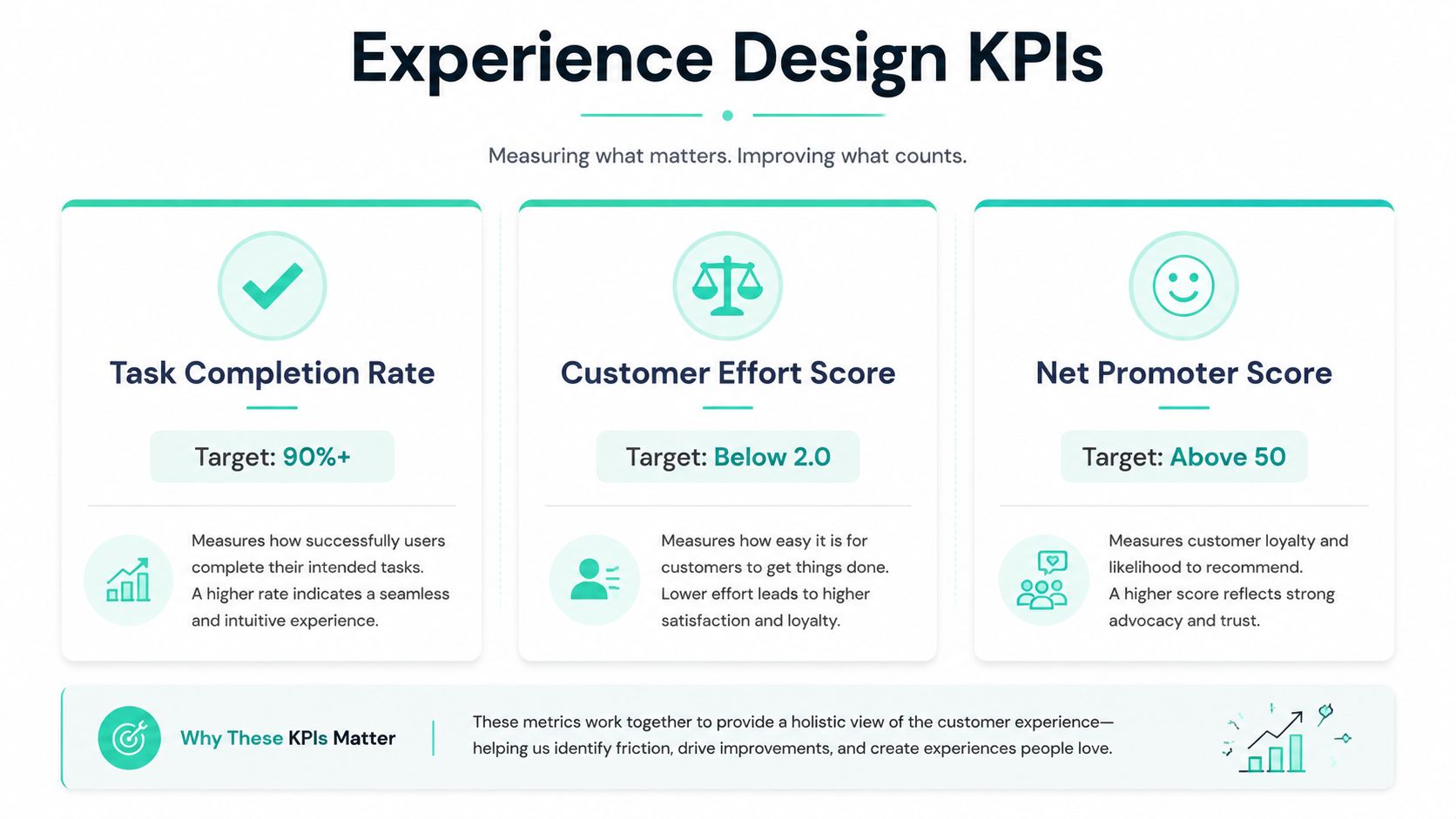
Task completion rate is the most direct sign that users can do what they came to do. Time to value shows whether the journey gets them to a useful outcome quickly. Adoption of self-service features tells you whether the design is reducing dependency on human support.
Those metrics belong in product analytics, content analytics, and event tracking, not just in dashboards owned by marketing. If a self-service flow is live but no one instruments the handoff points, the team is blind to where friction really sits.
Add operational metrics so the full picture is visible
Support ticket volume is often the most underused indicator in experience programs. If the journey is clearer, support demand should ease in the areas the design changed. Net promoter score can help at the relationship level, but only if it's paired with task and operational metrics, otherwise it stays too vague to guide design decisions.
Measure the interface and the operating system behind it, or you'll only see half the story.
For revenue-facing programs, conversion lift and revenue influence from personalization are useful, but only when the attribution model is credible and the content or pattern changes are clearly isolated. The stronger the instrumentation, the easier it becomes to defend investment in redesign, governance, and experimentation.
Don't separate web analytics from business data
The gap in many enterprises is the disconnect between digital behavior and operational systems like CRM and support tooling. Experience design closes that gap when composable architectures expose shared data flows and consistent component behavior across properties. That's how the steering committee gets an evidence trail instead of a deck full of opinions.
Common Enterprise Pitfalls and How to Avoid Them
The hardest experience programs usually fail for predictable reasons. The trap isn't ignorance, it's scale, because enterprise teams can keep shipping while the deeper problem stays hidden.
Treating experience design as visual polish
The symptom is familiar. Leadership approves a redesign because the interface looks cleaner, but the journey problems remain. The fix is to define experience goals in terms of task success, handoff quality, and system consistency before anyone starts a visual sprint.
Skipping accessibility audits
Accessibility gets framed as a compliance task, then pushed to the end. That's a mistake, because inaccessible patterns tend to be structural, not cosmetic. The corrective pattern is to build accessibility requirements into the component library, the content model, and the testing plan from the start.
Ignoring localization as a translation problem
Translation alone doesn't create a localized experience. Teams need regional content governance, locale-aware navigation, and workflows that let markets adapt without breaking the common system. Otherwise, the same portal feels foreign in every region, even when the copy is technically translated.
Bolting service design onto a monolithic CMS
Good intentions run into platform reality. If the CMS can't support reusable structures, workflow automation, or clean integration with operational systems, service design becomes a series of manual workarounds. The right move is to modernize the architecture so the service model can be delivered in the interface.
These failures usually show up early. Releases slow down, content duplication rises, support tickets cluster around the same tasks, and local teams start bypassing the official system. Once that pattern appears, the organization doesn't need more creative direction, it needs a better operating model.
Putting Experience Design to Work in an Enterprise Program
A multinational enterprise I'd expect to see in the real world often has three different digital surfaces that evolved separately, a Sitecore XM Cloud marketing estate, an AEM content hub, and a SharePoint Online intranet. When those properties are treated as one journey system, the team can align navigation, content patterns, accessibility expectations, and measurement around a shared model instead of three disconnected roadmaps.
The practical change is not abstract. Releases get easier to govern, reusable components reduce duplicate work, and regional teams have clearer rules for localization. The organization also gets a more honest view of performance because the same experience language now spans customer and employee touchpoints.
That's the outcome of experience design in an enterprise program, not a prettier website, but a governed journey model that your platforms can support. If you're rethinking how Sitecore, AEM, or SharePoint should work together in one operating framework, Kogifi designs and builds those experience layers for enterprise teams that need reusable components, composable delivery, and measurable outcomes.