


A product launch is underway when a regional Azure incident takes a multilingual Sitecore estate offline. The homepage is unavailable, editors can't publish, search returns incomplete results, and the identity provider is unreachable. The backup dashboard is green, but nobody can say which copy contains the latest approved content or whether the deployment pipeline can recreate the application in another region.
That scenario changes when the platform is SharePoint Online, a headless Sitecore XM Cloud implementation, or a composable DXP connected to commerce, analytics, search, and external APIs. A backup may preserve data while leaving the customer-facing service unusable. Disaster recovery as a service is therefore a recoverability discipline, not just a storage purchase.
Table of Contents
- When an Outage Stops Being an IT Problem
- What Disaster Recovery as a Service Actually Covers
- Targets belong to components
When an Outage Stops Being an IT Problem
A regional failure is rarely confined to one server. A Sitecore platform may depend on content databases, media storage, search indexes, identity services, certificates, DNS, queues, deployment pipelines, and third-party APIs. A SharePoint estate may add permissions, Power Platform flows, Microsoft 365 integrations, and business-critical sites whose owners expect work to continue immediately.
A ransomware event creates a different failure pattern. The attacker may encrypt production and reach the account that stores recovery copies. A failed Sitecore upgrade can corrupt the master database while leaving infrastructure apparently healthy. In each case, the operational question is the same: can the organization restore a functioning digital experience, with known data integrity, within its agreed objectives?

The financial exposure is visible in outage research. A 2022 Uptime Institute global survey found that 25% of respondents said their most recent outage cost more than $1 million, while another 45% reported costs between $100,000 and $1 million, with more than two-thirds reporting outages exceeding $100,000 in direct and indirect costs, as documented in the Uptime Institute outage analysis.
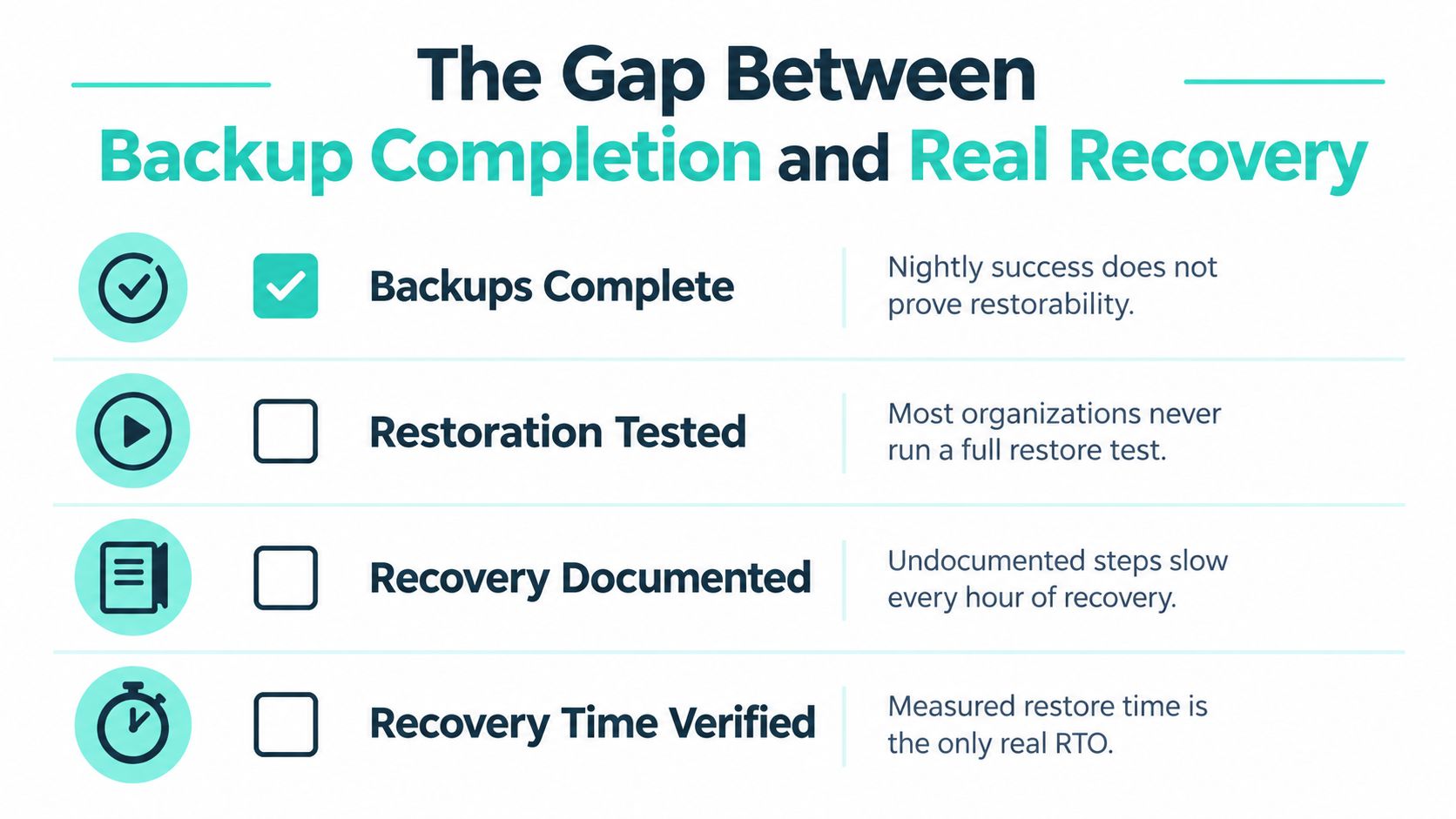
Practical rule: A successful backup job proves that a copy was created. It doesn't prove that customers, editors, and employees can use the recovered platform.
That distinction positions DRaaS as a business continuity concern rather than just a specialist infrastructure option. Marketing teams care about campaign availability, commerce teams care about transactions, legal teams care about records and regulatory obligations, and executives care about revenue and reputation. The recovery design has to reflect all of those dependencies.
A resilient plan also assigns ownership clearly. The provider may operate replication and recovery infrastructure, but the enterprise still owns application priorities, data classification, identity decisions, content validation, communications, and approval of failover. Without that division, a contract can provide infrastructure while nobody owns the recovery of the actual digital experience.
What Disaster Recovery as a Service Actually Covers
DRaaS starts with cloud-based backup and restore, then becomes more capable as the recovery target becomes stricter. A low-criticality authoring environment may use scheduled backups, separate storage, and a documented manual restoration process. That pattern is cheaper, but restoration depends on available people, clean configuration, compatible versions, and a realistic sequence of steps.
The next tier is an orchestrated recovery environment. A warm standby for a customer-facing Sitecore estate keeps replicated data and pre-provisioned services available, then activates application components in a defined order. A global commerce portal may require an active-active design, with serving capacity in multiple locations and carefully coordinated data consistency. That approach reduces dependence on a single recovery event, but it brings greater architectural complexity and operating cost.
| Recovery Tier | Typical DXP Workload | Pattern |
|---|---|---|
| Backup and restore | Internal authoring tools, historical analytics | Scheduled copies, manual restoration, longer interruption tolerance |
| Warm standby | Customer-facing Sitecore XM Cloud support services, important SharePoint workloads | Replicated data, pre-provisioned capacity, orchestrated failover |
| Hot or active-active | Global commerce and transaction services | Multiple operating environments, automated traffic and dependency control |
The market's expansion reflects this broader meaning of recovery. One estimate places the global DRaaS market at USD 13.5 billion in 2025, with a projection to USD 93.4 billion by 2034 at a 23.26% compound annual growth rate, while another projects growth from USD 17.8 billion in 2025 to USD 129.6 billion in 2035, equivalent to approximately 22.5% annual growth, according to IMARC's DRaaS market assessment.
DRaaS differs from self-managed recovery in accountability. With self-managed DR, the enterprise designs the topology, purchases capacity, maintains replication, updates runbooks, schedules tests, and carries the operational burden. With DRaaS, a provider may operate much of that stack, but the service is only as good as its scope, runbooks, test evidence, and contract terms.
For a concise explanation of the service model and its relationship to cloud recovery, the Cloudvara disaster recovery guide is a useful introductory reference. Enterprise DXP teams should then translate the general model into application dependencies, rather than accepting a server-centric recovery plan. A practical managed recovery perspective is also available in Kogifi's managed disaster recovery guidance.
Setting RPO and RTO for a DXP Estate
Recovery Point Objective, or RPO, defines the maximum acceptable period of data loss. Recovery Time Objective, or RTO, defines the maximum tolerable service interruption. Those targets should be assigned to services, not written once for an entire platform.
A content database may need frequent replication because editors publish continuously. Media assets may tolerate a different restoration sequence. Search indexes can often be rebuilt from authoritative content, while identity services, certificates, secrets, queues, and external integrations may determine whether the restored application can serve anyone at all.
A simple Sitecore example makes the architecture implications clear. Suppose the business sets a 15-minute RPO and a 1-hour RTO for a customer-facing XM Cloud deployment. That target calls for more than a nightly archive. The design needs frequent replication or equivalent recovery points, prebuilt infrastructure, dependency-aware orchestration, credentials available through a separate recovery path, and a tested process for validating publishing, search, personalization, and customer journeys.
Targets belong to components
For each service, record the acceptable data loss, downtime, recovery order, validation owner, and fallback decision. This usually produces a more useful plan than assigning one target to “the CMS.”
- Content and media: Preserve approved content and assets, then verify publishing and rendering.
- Search: Decide whether indexes are restored or rebuilt, and test relevance and availability.
- Identity: Recover authentication paths, permissions, service accounts, and administrative access.
- Application services: Recreate the runtime, configuration, secrets, certificates, and deployment process.
- External dependencies: Document payment, commerce, analytics, translation, email, and API behavior during failover.
Microsoft 365 Backup defines a SharePoint and OneDrive recovery point objective of 10 minutes for the trailing two weeks, with one-week intervals from two weeks through 52 weeks, and 52-week retention for sites removed from the backup policy, as documented in the Microsoft 365 Backup FAQ. Those intervals establish available recovery points, but administrators still need to validate permissions, integrations, and user access after restoration.
A useful recovery walkthrough should show how targets influence design decisions:
For teams designing Azure-based recovery, this Azure disaster recovery overview provides additional implementation context. The important test is not whether the platform restarts. It's whether the complete service satisfies the defined RPO and RTO, including content, identity, search, integrations, and user journeys.
Why One Recovery Pattern Cannot Fit Every Workload
Replicating every component with the same recovery pattern wastes money in some areas and leaves critical services underprotected in others. A high-traffic publishing platform, a transactional commerce service, an internal collaboration portal, and an archive have different consequences when they fail.
The Uptime Institute data supports a disciplined economic comparison. If an outage can create losses exceeding $100,000 for a significant share of organizations, the annualized cost of downtime and reconstruction deserves comparison with replication, immutable storage, secondary capacity, monitoring, and testing. The exact calculation belongs to each organization because staffing, revenue, regulatory exposure, and customer impact differ.
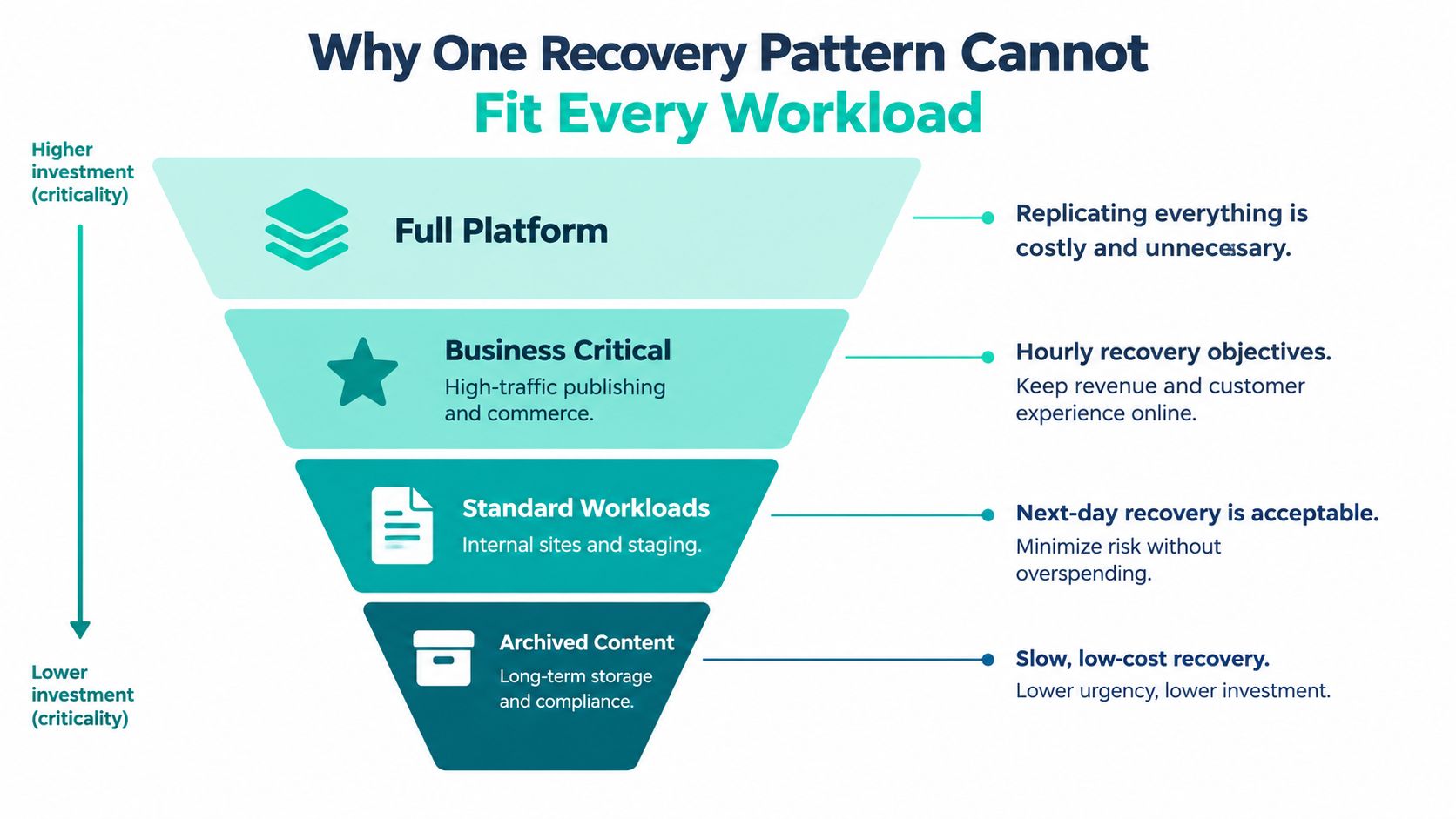
A practical tiering model looks like this:
- Business-critical publishing and commerce: Use warm standby or active-active recovery where the service directly supports customers, transactions, or urgent communications.
- Internal portals and authoring: Use tested backup-and-restore when a longer interruption is acceptable and dependencies are simpler.
- Staging and historical analytics: Protect data integrity and rebuildability without paying for continuously running recovery capacity.
- Archived content: Prioritize retention, access control, and low-cost restoration rather than immediate failover.
The same logic applies to correlated failure. A backup stored in the same account, region, identity path, or administrative boundary as production can become unavailable during the incident it was meant to solve. Separate accounts, isolated credentials, geographically separated storage, immutable recovery points, and infrastructure as code reduce that shared blast radius.
Recovery investment should follow the business consequence of failure, not the convenience of applying one policy to every workload.
A proposal that promises broad coverage but doesn't state replication lag, restore behavior, dependency scope, or exercise frequency needs closer examination. A lower-cost tier can be correct for an archive and dangerously inadequate for identity or commerce.
The Gap Between Backup Completion and Real Recovery
Nightly backup success is one checkpoint in a recovery process, not the outcome. A DXP can restore its database and still fail because media paths are missing, search indexes are stale, certificates are unavailable, deployment secrets are inaccessible, or identity cannot authenticate users.
The testing gap is substantial. A 2025 resilience report found that 62% of organizations do not regularly perform backup-and-restoration exercises and 71% do not conduct failover testing, exposing the difference between backup completion and demonstrated end-to-end restoration, as reported in the State of Resilience 2025 report.
Build the runbook around the service
An application-level runbook should identify what gets recovered, in what order, by whom, and how the team proves that each step worked.
- Map dependencies: Include CMS databases, media, indexes, identity, DNS, certificates, queues, APIs, configuration, and deployment pipelines.
- Define recovery order: Restore authoritative data before rebuilding derived indexes, then bring up application services and external connections.
- Validate the experience: Test login, publishing, search, localized pages, forms, personalization, integrations, and representative customer journeys.
- Record rollback criteria: State when the team stops the recovery, returns to the previous environment, or selects another recovery point.
- Preserve access evidence: Confirm that credentials, secrets, configuration, and administrative permissions remain available during a compromised-cloud scenario.
The exercise should simulate a failure that resembles reality. Test an unavailable region, a corrupted database, an identity failure, or a compromised backup account in an isolated environment. Measure the achieved RPO and RTO, document each manual intervention, and assign owners for every gap.
A recovery process for deleted content has a different scope from a regional failover, but it still benefits from defined ownership and validation. Deleted-item recovery guidance can sit alongside the broader application recovery runbook rather than being treated as a substitute for it.
The first real incident shouldn't be the first time the team discovers that the recovery environment can't authenticate users.
Comparing DRaaS Deployment Models
The deployment model affects control, operating burden, compliance evidence, and the shape of the recovery boundary. A cloud-native Sitecore estate may suit provider-managed recovery, while a regulated hybrid platform may need replication from an on-premises environment into a separately governed region.
| Model | Best Fit | Trade-off |
|---|---|---|
| Provider-managed public cloud | Cloud-native Sitecore, AEM, and supporting services | Fast adoption and elastic capacity, with dependence on provider scope and cloud controls |
| Hybrid replication | On-premises or mixed DXP estates with existing infrastructure | Preserves existing investments, but increases network, version, and operational complexity |
| Fully managed third-party service | Teams needing runbooks, testing, monitoring, and coordinated incident response | Reduces internal burden, while requiring careful contract and responsibility boundaries |
Evaluate each model against the same questions. How quickly is the first usable recovery point created? What remains inside the failure boundary? Who owns identity and certificates? Can the team test without disrupting production? Does the provider understand the Sitecore or SharePoint support model? Which costs continue during normal operation, and which appear during failover?
Operational telemetry also matters. Teams assessing facilities and infrastructure can use Snowflake data center analytics as an example of how analytics can support capacity and operational visibility. For DXP recovery, that principle extends to replication lag, restore status, dependency health, and evidence from exercises.
A vendor proposal should separate infrastructure availability from application recoverability. A provider may offer excellent cloud uptime while leaving the customer responsible for rebuilding indexes, validating personalization, restoring Power Platform connections, or coordinating DNS and identity. Those responsibilities aren't necessarily a problem, but they must be explicit.
For SharePoint Online, the deployment model also needs to account for Microsoft-managed recovery mechanics and customer-owned application behavior. Restored sites still need permission checks, integration validation, and a clear process for returning users to productive work.
What to Demand from a DRaaS Vendor
A DRaaS proposal should state measurable service levels for backup completion, replication lag, restore success, failover duration, and exercise frequency. Provider availability matters, but it doesn't answer whether a Sitecore page renders, a SharePoint workflow runs, or an editor can publish after recovery.
Cyber-recovery deserves equal attention. A 2025 ransomware report found that 89% of organizations said attackers targeted backups during an incident, while only about one-third protected backups with immutable storage. The same source reports that only 33% of organizations had an organized outage-response approach, as summarized in backup strategy and resilience guidance from CNIC Solutions.
Questions that expose the real service
Ask the vendor to demonstrate the recovery process, not just describe it.
- Isolation: Can recovery points use immutable storage, a separate account, separate credentials, and an independent identity path?
- Clean recovery: How does the team scan restored systems, select a known-clean point, and perform a clean-room restoration?
- Application scope: Does the service include Sitecore content, media, search, deployment configuration, integrations, and personalization data?
- AI configuration: For Sitecore Stream, are brand-ingestion documents, retrieval context, AI workflows, and entitlement assumptions documented? For Sitecore Personalize, are decision strategies, events, goals, offers, and API integrations included?
- SharePoint continuity: Which sites are protected, how are permissions and integrations validated, and how does the plan reflect Microsoft 365 Backup recovery intervals?
- Evidence: Can the provider show exercise results, achieved recovery times, failed steps, corrective actions, and the next scheduled test?
Sitecore Stream operates as an AI layer across supported Sitecore products. Its documented capabilities include brand-aware AI, copilots, agents, and agentic workflows, with Azure OpenAI Service and retrieval-augmented generation grounding outputs in ingested organizational material. Sitecore Personalize combines behavioral and customer data for experimentation, decisioning, individualized experiences, REST API execution, and event-driven orchestration. Those capabilities belong in the recovery inventory because restoring the page without restoring the decisioning and content context can produce a technically available but materially degraded experience.
Use a structured vendor selection process to compare proposals. Red flags include “backup successful” as the primary success metric, undefined customer responsibilities, no isolated test environment, no recovery evidence, and SLAs that cover only provider infrastructure rather than the DXP service.
Building a Resilient DRaaS Program for Your DXP
Start with an inventory of services and dependencies. Mark each component as customer-facing, operationally important, rebuildable, or archival, then assign an RPO, RTO, owner, validation test, and recovery tier. Include Sitecore, AEM, SharePoint, identity, search, integrations, deployment tooling, and content governance in the same conversation.
A practical rollout can follow this sequence:
- Assess the current state: Trace dependencies, recovery points, access paths, and known gaps.
- Set tiered objectives: Approve service-level RPO and RTO targets with business owners.
- Write and review runbooks: Document recovery order, validation, rollback, and communications.
- Exercise the design: Run tabletop scenarios, isolated restores, and controlled failover drills.
- Measure and improve: Record achieved results, remediate gaps, and update the plan after platform changes.
The program should also account for supplier dependencies and physical infrastructure risks. Resources on mastering supply chain for data centers can help teams broaden resilience reviews beyond application configuration. DRaaS works when recovery remains part of platform governance, change management, support contracts, audits, and release planning.
Kogifi helps enterprise teams assess dependencies, design recovery runbooks, orchestrate backups and replication, and conduct controlled failover exercises across Sitecore, AEM, and SharePoint environments. Visit Kogifi to discuss a DXP recovery assessment and turn your documented backup plan into tested service recovery.